Anti-Corruption Probe: DVAC Raids Premises Linked to DMK MP C.N. Annadurai Over Alleged Sand Theft
TIRUVANNAMALAI — In a significant escalation of anti-corruption scrutiny within Tamil Nadu, officials from the Directorate of Vigilance and Anti-Corruption (DVAC) launched coordinated raids on Friday, September 25, 2026, targeting properties associated with Tiruvannamalai Lok Sabha MP C.N. Annadurai. The operation, which spanned several hours, has sent shockwaves through the local political establishment, drawing renewed attention to the intersection of political infrastructure projects and allegations of environmental exploitation.
The Morning Operation: A Coordinated Crackdown
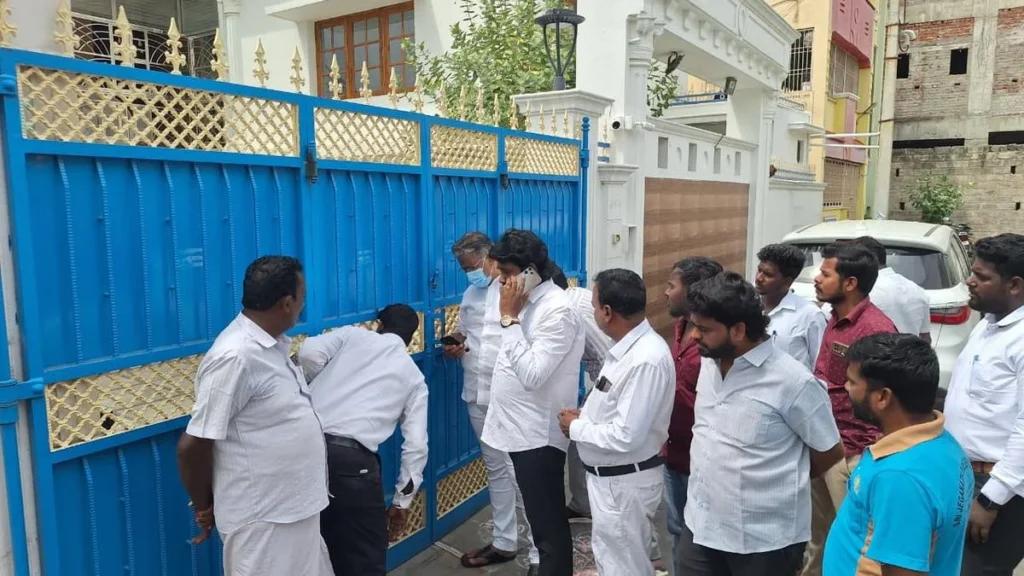
The silence of Vengaikaal village, situated in the shadow of the Tiruvannamalai Collectorate, was broken at approximately 7:30 a.m. on Friday as DVAC teams descended upon the residence of the two-time DMK parliamentarian. Led by Deputy Superintendent of Police (DSP) Arul, the operation involved specialized teams dispatched from both Vellore and Tiruvannamalai.
The raids were not confined to the MP’s private residence. Simultaneously, investigators fanned out to other strategic locations, most notably the offices of APU Constructions. This firm, which holds a significant portfolio of government contracts—including over 50 projects under the State Highways Department—has become the focal point of the investigation. Witnesses observed heavy security cordons as officials spent seven hours meticulously scouring financial records, project logs, and digital archives. The operation concluded at approximately 2:30 p.m., with officials reportedly seizing several files and electronic records for further forensic analysis.
Chronology of the Allegations
The current investigation traces its origins to a formal complaint lodged on August 13, 2026, by Arappor Iyakkam, a prominent anti-corruption non-governmental organization known for its rigorous tracking of public fund misappropriation.
The crux of the complaint revolves around an event that took place in December 2025: the DMK’s high-profile Youth Wing Conference. According to the NGO, the site preparation for this massive gathering required significant topographical adjustments. It is alleged that, under the directives of then-PWD and Highways Minister E.V. Velu, massive quantities of sand were illegally extracted from the dry lake bed at Malappambadi village.
The complaint details how this extracted sand was utilized to level a sprawling 124.56-acre open plot, transforming it into a venue capable of hosting the conference, which was attended by then-Chief Minister M.K. Stalin and his son, Udayanidhi Stalin. Arappor Iyakkam contends that this unauthorized mining operation caused an estimated loss of ₹8 crore to the State exchequer, citing environmental destruction and the illicit sale of government-owned natural resources.
A Pattern of Scrutiny: The Wider Context
The raid on C.N. Annadurai’s premises is not an isolated incident but rather the latest in a series of legal and investigative challenges facing key DMK figures in the Tiruvannamalai region.
In June 2026, the DVAC conducted expansive searches at educational institutions linked to E.V. Velu in Kilnachipattu, located on the busy Vellore-Thoothukudi High Road. These operations followed a trajectory of investigations that began as early as March 2023, when the Income Tax Department launched a series of raids on properties and businesses connected to Mr. Velu.
Political analysts observe that the consistency of these probes—shifting from federal tax scrutiny to state-level anti-corruption investigations—suggests a multi-layered attempt by oversight agencies to trace the financial trails between private construction entities and political power centers. The involvement of APU Constructions, a firm heavily involved in Highways Department works, highlights a recurring theme in these investigations: the potential for "crony contracting," where government projects are allegedly used to facilitate political mobilization and personal enrichment.
Official Responses and Political Defense
Emerging from his residence following the conclusion of the search, C.N. Annadurai addressed a gathered press contingent, adopting a stance of defiance mixed with professional cooperation.

"I have fully cooperated with the DVAC officials," Annadurai stated. "I answered all their queries regarding the sand mining allegations related to the Youth Wing Conference held in December 2025. I have provided the documentation they requested."
However, the MP did not shy away from labeling the investigation as politically motivated. "It is a false case," he asserted, characterizing the timing of the raids as a calculated maneuver. He specifically linked the intervention to the upcoming bypolls in the Madurantakam and Dharapuram Assembly constituencies. According to Annadurai, the raids are intended to distract DMK functionaries and weaken the party’s ground-level mobilization efforts during a critical electoral window.
"The attempt is to prevent our cadres from focusing on the bypolls, but we will not be deterred," he added.
Implications for the State Administration
The legal implications of this case are significant. If the DVAC investigation validates the claims of illegal sand mining, it could lead to charges under the Mines and Minerals (Development and Regulation) Act, alongside potential criminal charges for misappropriation of public funds.
Furthermore, the involvement of a sitting MP and the implicit connection to a former Cabinet minister places the DMK leadership in a precarious position. The party, which has historically campaigned on themes of social justice and administrative integrity, now faces a narrative of institutionalized corruption that could be leveraged by the opposition in the upcoming by-elections.
For the DVAC, the challenge lies in the complexity of the evidence. Proving the "direction" of a specific Minister or MP in an environmental crime requires linking financial transactions to physical labor and logistical operations. The seizure of files from APU Constructions is expected to be the "smoking gun" or the "dead end" of the investigation. If the records show that the firm’s resources were diverted to the conference site without proper authorization or payment, the legal consequences could be severe.
Looking Ahead: The Road to the Bypolls
As the dust settles in Tiruvannamalai, the focus shifts to the legal and political aftermath. The DVAC is expected to analyze the seized materials over the coming weeks. Whether this will lead to formal charges or serve as a preliminary step in a longer legal battle remains to be seen.
For the people of Tiruvannamalai, the incident has highlighted the fragile state of local natural resources. The illegal mining of lake beds, regardless of the political motivation, carries long-term ecological risks, including the degradation of local water tables and the destruction of catchment areas.
As the state moves toward the bypolls, the "Tiruvannamalai Case" is poised to become a central talking point. The opposition is likely to use the ₹8 crore figure as a rallying cry, framing the incident as an example of systemic looting. Conversely, the DMK’s leadership will likely double down on the narrative of victimhood, framing the DVAC’s actions as an overreach by central agencies—or state agencies acting under pressure—to destabilize the party.
The coming months will determine whether these searches will result in a landmark corruption conviction or join the long list of high-profile political investigations that conclude with limited legal consequence. For now, the files seized from the MP’s premises represent the latest chapter in a long-standing struggle over the integrity of governance in Tamil Nadu.