AWS Contributors and Open Source Communities Converge at Open Source Summit Korea 2026
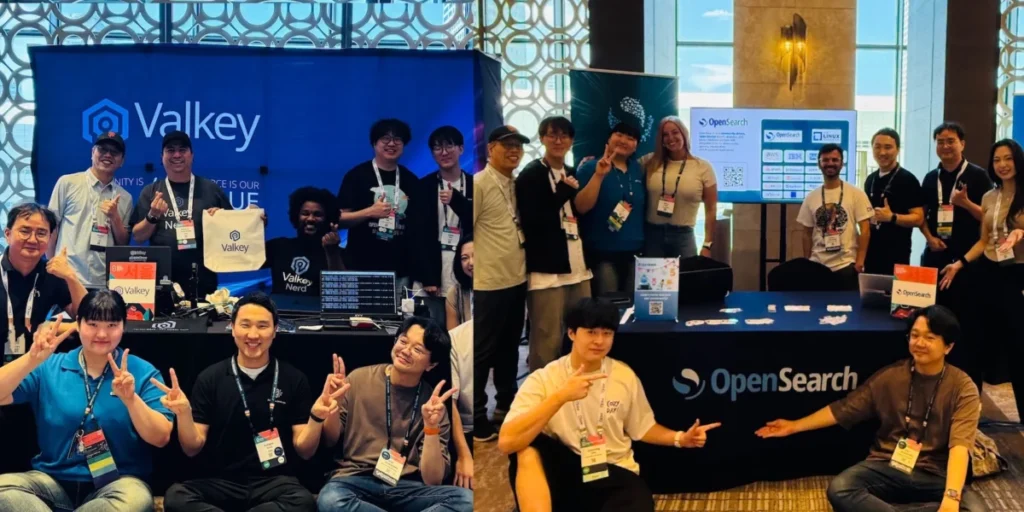
SEOUL, SOUTH KOREA — In a vibrant display of global open-source collaboration, Amazon Web Services (AWS) contributors converged last week with the vibrant OpenSearch and Valkey communities at the prestigious Open Source Summit Korea 2026 and the concurrent MCP DevSummit Seoul 2026. Over four action-packed days, thousands of developers, architects, project maintainers, and Linux Foundation community leaders gathered in the South Korean capital to exchange technical knowledge, co-create innovative solutions, and chart the future trajectory of these critical enterprise infrastructure projects.
The event served as a melting pot of enterprise technology and grassroots open-source passion. Local leaders from the Korean OpenSearch community played an instrumental role, volunteering at dedicated project booths, mentoring emerging developers, and spearheading a lively local user group meetup that fostered deep technical discussions and long-term professional networking.
For AWS, participation in these events underscores a broader, long-standing strategic commitment to supporting open-source software (OSS). By actively contributing to projects hosted by the Linux Foundation and other open governance bodies, AWS aims to ensure that foundational technologies remain robust, secure, and accessible to developers worldwide.
Main Facts
The four-day dual-summit in Seoul highlighted major engineering milestones, community-driven governance, and direct enterprise integrations for two of the industry’s most widely adopted open-source technologies: OpenSearch and Valkey.
- The Gathering: AWS contributors joined forces with the OpenSearch and Valkey communities at Open Source Summit Korea 2026 and MCP DevSummit Seoul 2026.
- Community Leadership: Local Korean OpenSearch community leaders volunteered at event booths and hosted a dedicated user group meetup to connect regional developers.
- OpenSearch 3.7 Integration: Released in June 2026 and integrated into Amazon OpenSearch Service in July 2026, version 3.7 introduces advanced observability capabilities and delivers up to 5.5x faster vector retrieval speeds.
- Valkey 9.1 Integration: Released in May 2026 and brought to Amazon ElastiCache in June 2026, version 9.1 features a redesigned I/O threading model yielding up to a 17% increase in throughput and a 20% reduction in memory usage for small strings.
- Ongoing Engagement: Both projects maintain active global event calendars, offering continuous opportunities for developers to interact directly with core maintainers and AWS contributors.
Chronology of Recent Milestones
To fully understand the significance of the discussions at Open Source Summit Korea 2026, it is necessary to examine the rapid technical cadence that preceded the event over the spring and summer of 2026.
Spring 2026: Performance Enhancements and New Releases
- May 19, 2026: The Valkey project officially launched Valkey 9.1. This major release focused heavily on core engine efficiency, introducing a newly engineered I/O threading model designed to maximize multi-core hardware utilization.
- June 9, 2026: The OpenSearch project rolled out OpenSearch 3.7. This update represented a massive leap forward for unified observability and artificial intelligence (AI) workloads, bringing logs, metrics, and traces into a single correlated interface while radically accelerating vector search mechanics.
Early Summer 2026: Rapid Cloud Native Adoption
- June 23, 2026: AWS announced general availability for running Valkey 9.1 on Amazon ElastiCache for node-based clusters. This integration allowed enterprise customers to immediately harness the performance gains of the new I/O architecture within fully managed, scalable cloud environments.
- July 30, 2026: AWS integrated OpenSearch version 3.7 into Amazon OpenSearch Service. This deployment brought enterprise-grade vector search optimizations, enhanced search relevance controls, and advanced Query Insights directly to managed cloud architectures.
Mid-August 2026: Community Convergence in Seoul
- Mid-August 2026: AWS contributors, open-source maintainers, and regional developers converged in Seoul for Open Source Summit Korea 2026 and MCP DevSummit Seoul 2026, translating these upstream software achievements into face-to-face developer empowerment, live demonstrations, and collaborative workshops.
Supporting Data and Technical Architecture
The technical momentum driving OpenSearch and Valkey is rooted in rigorous engineering benchmarks. Both projects have achieved significant performance gains that directly translate into cost savings and operational efficiency for enterprise architectures.
OpenSearch 3.7: Redefining Search and Observability
OpenSearch has evolved far beyond a traditional search engine into an enterprise-grade observability and vector database suite capable of organizing unstructured data at massive scale.
- Unified Observability Interface: OpenSearch 3.7 provides tools designed to query, alert, and track Service Level Objectives (SLOs) across logs, traces, and metrics through a single, cohesive pane of glass. This eliminates the operational friction of switching between disparate monitoring tools.
- Accelerated Vector Search: With artificial intelligence and Retrieval-Augmented Generation (RAG) pipelines becoming ubiquitous in modern applications, vector search performance is paramount. OpenSearch 3.7 achieves vector retrieval speeds up to 5.5x faster than previous iterations.
- Managed Integration: Operating OpenSearch 3.7 on Amazon OpenSearch Service grants organizations these performance enhancements alongside automated cluster management, robust security controls, and advanced Query Insights.
Valkey 9.1: High-Performance Data Storing
Valkey has firmly established itself as an enterprise-grade, high-performance key/value datastore. Capable of supporting diverse workloads—ranging from low-latency caching and real-time message queues to acting as a primary database—Valkey is optimized for speed and resilience.
- Throughput Optimization: Valkey 9.1 introduced a redesigned I/O threading model. In benchmarks, this architectural refinement delivers up to a 17% increase in overall throughput, allowing clusters to handle higher request volumes with fewer computing resources.
- Memory Efficiency: For modern microservices architectures that rely heavily on string-based data types, memory overhead is a constant concern. Valkey 9.1 reduces memory usage for strings under 128 bytes by up to 20%, maximizing RAM utilization in memory-bound caching tiers.
- Managed Execution: Running Valkey 9.1 on Amazon ElastiCache provides enterprise customers with node-based clustering that inherits these throughput and memory benefits while introducing enhanced access control features tailored for secure, multi-tenant workloads.
Official Responses and Industry Perspectives
The convergence of cloud providers and open-source foundations in Seoul highlights an ongoing shift in how enterprise software is built, consumed, and maintained. Industry leaders at the summit emphasized that open-source governance models are maturing, offering a sustainable alternative to proprietary lock-in.
Open-source advocates noted that events like Open Source Summit Korea play an irreplaceable role in bridging the gap between upstream software maintainers and downstream enterprise users. While digital forums, GitHub issues, and Slack channels form the day-to-day communication backbone of projects like OpenSearch and Valkey, face-to-face interactions build the trust required for complex, mission-critical infrastructure deployments.
AWS representatives reiterated that their engineering contributions to OpenSearch and Valkey are driven by customer demand for open, interoperable standards. By collaborating directly with the community—such as supporting local meetup groups in Seoul and sponsoring Linux Foundation events—AWS aims to ensure that enterprise cloud architectures remain transparent, flexible, and responsive to developer needs.
Korean community leaders similarly highlighted the value of regional representation. By stepping up as event volunteers and hosting localized meetups, Korean developers are not merely consuming open-source tools; they are actively shaping the roadmap, contributing localizations, bug fixes, and feature requests that benefit the global ecosystem.

Implications for the Enterprise and Developer Ecosystem
The technical milestones celebrated at Open Source Summit Korea 2026 carry profound implications for enterprise architecture, cloud strategy, and the future of community-driven software development.
1. The Maturation of Open-Source Alternatives
The rapid evolution of Valkey and OpenSearch proves that open-source projects operating under independent foundations (such as the Linux Foundation) can innovate at a pace that rivals or exceeds traditional proprietary software vendors. For enterprises wary of licensing shifts or vendor lock-in, the robust performance metrics of Valkey 9.1 and OpenSearch 3.7 offer a compelling, high-performance upgrade path.
2. AI-Ready Infrastructure
As organizations rush to deploy generative AI applications, the underlying database and search tiers must adapt. OpenSearch 3.7’s 5.5x faster vector retrieval speeds directly address the latency bottlenecks inherent in large-scale RAG systems. Similarly, Valkey’s low-latency caching capabilities make it an ideal companion for storing session states and embedding caches in AI-driven workflows. By bringing these versions into managed services like Amazon OpenSearch Service and Amazon ElastiCache, cloud providers are removing the operational complexity of deploying AI-ready infrastructure at scale.
3. Deepening Developer Engagement
For individual developers and enterprise architects alike, community events like those held in Seoul provide a direct channel to influence software evolution. Developers are no longer passive recipients of software updates; they are active participants in a global feedback loop.
As AWS and other technology leaders continue to support global open-source communities, developers are encouraged to engage further. Engineers interested in connecting with core maintainers and contributors can explore upcoming events on the official OpenSearch Events and Valkey Events portals. Furthermore, builders can tap into a wealth of localized resources by joining the AWS Builder Center, attending regional AWS Summits and Community Days, or monitoring the What’s New with AWS and AWS Blogs pages for ongoing announcements, technical deep dives, and architectural guidance.