AWS Enhances Amazon S3 Vectors with Metadata Pre-Filtering to Boost Search Recall and Multi-Tenant Efficiency
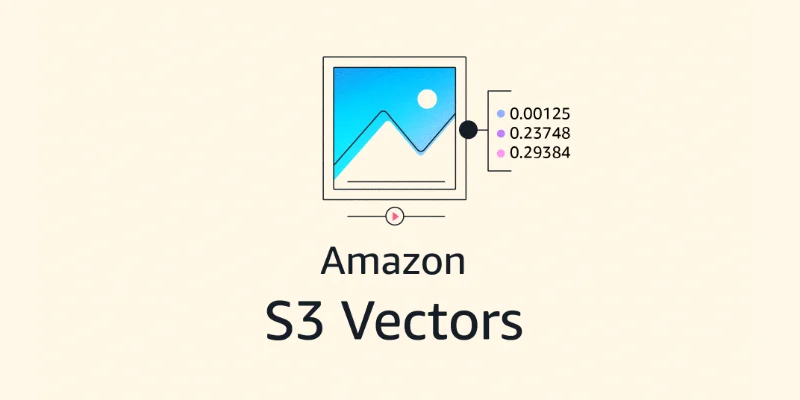
In a significant update for cloud architects and AI engineers building semantic search engines, retrieval-augmented generation (RAG) pipelines, and autonomous AI agents, Amazon Web Services (AWS) has announced the immediate availability of metadata pre-filtering for Amazon S3 Vectors. Authored by AWS technologist Daniel Abib, the release introduces a mechanism designed to drastically improve the accuracy and relevance of filtered similarity searches.
By evaluating metadata filters before conducting vector similarity searches, the new feature ensures that systems no longer sacrifice recall when scoping queries by tenant, category, timestamp, or security status. Crucially, AWS has rolled out this capability with no additional cost, zero re-ingestion requirements for existing data, and complete backward compatibility with existing API query structures.
Main Facts: What is Amazon S3 Vectors Pre-Filtering?
At its core, vector search relies on mathematical distance metrics—such as cosine similarity or Euclidean distance—to find items closest to a given query vector in a high-dimensional space. However, real-world enterprise applications rarely search an entire global index blindly. Instead, they scope searches to specific users, organizational tenants, product categories, or security permissions.
Previously, many vector databases and search engines relied on post-filtering or in-tandem filtering, where similarity searches and metadata matching happened simultaneously or sequentially after initial candidate selection. This often led to poor recall, as relevant candidate vectors belonging to the correct scope were frequently crowded out by a broader pool of unrelated data points.
Amazon S3 Vectors now addresses this structural bottleneck through two distinct operating modes:
- CLASSIC Mode: The legacy approach, where vector searches and filter evaluations run in tandem, validating candidate vectors against filters on-the-fly during the search traversal.
- ENHANCED Mode (New): The pre-filtering approach, where S3 Vectors resolves the metadata filter first, restricts the search space exclusively to the matching subset of vectors, and then executes the similarity search across that perfectly scoped pool.
Key technical specifications of the S3 Vectors pre-filtering update include:
- Rich Metadata Support: Each vector can carry up to 2 KB of application-defined, schema-free metadata.
- High Constraint Capacity: A single query can support up to up to 100 distinct filter constraints.
- Prefix Matching (
$startsWith): Enables hierarchical key filtering for paths, URLs, and nested structures (e.g., matching subtrees in document stores). - Zero Cost and Friction: Available at no extra charge, requiring no data re-ingestion or modifications to existing application query syntax.
Chronology of the Release and Evolution of S3 Vector Capabilities
The introduction of pre-filtering represents the latest milestone in AWS’s continuous expansion of native data storage and retrieval infrastructure designed to support modern artificial intelligence workloads.
- Phase 1: Foundation of S3 Vectors: AWS initially introduced Amazon S3 Vectors to give developers an integrated, scalable way to store, manage, and query vector embeddings directly within object storage environments without managing complex external vector database clusters.
- Phase 2: Identification of the Scoping Bottleneck: As enterprise adoption grew—particularly around multi-tenant RAG applications and enterprise knowledge bases—developers ran into limitations regarding filtered query performance. When querying specific tenants within millions of unstructured records, traditional tandem-filtering architectures routinely suffered from suppressed recall rates.
- Phase 3: Development of ENHANCED Index Modes: AWS engineers designed the architecture for metadata pre-filtering, optimizing the underlying indexing engine to process filter constraints prior to metric space traversal.
- Phase 4: General Availability (Current): AWS officially launches metadata pre-filtering across all commercial regions and AWS China regions, empowering developers to update their existing indexes instantly via the
UpdateIndexModeAPI.
Supporting Data and Technical Performance Analysis
To understand the tangible impact of metadata pre-filtering, consider a large enterprise customer support knowledge base containing 8 million historical tickets. In a traditional customer service scenario, a support agent might need to search a single customer’s interaction history for a recurring technical bug.
If that specific customer accounts for 400 tickets out of the total 8 million, resolving the customer_id filter first in ENHANCED mode means the vector similarity search runs strictly across those 400 targeted tickets. The agent receives a comprehensive, highly relevant set of prior occurrences for that exact user.
By contrast, under the legacy CLASSIC evaluation method, the similarity search pulled candidates from the entire 8-million-ticket corpus, occasionally discarding vital contextual matches for that user due to broader distance thresholds.
According to AWS performance metrics on highly selective filters, pre-filtering returns up to 5 times more matching vectors than previous methods on equivalent queries.
Step-by-Step Implementation Guide
Implementing pre-filtering involves three straightforward phases: creating an enhanced index, ingesting vectors with metadata, and querying with JSON-based constraints.
1. Creating a Vector Index
Developers can provision a new vector index specifying dimensions and distance metrics matching their embedding model:
aws s3vectors create-index
  --index-name product-catalog
  --vector-bucket-name my-vector-bucket
  --dimension 1536
  --distance-metric cosine
2. Ingesting Vectors with Metadata
Using the PutVectors API, applications attach up to 2 KB of structured metadata to each vector record. Every field remains dynamically filterable without requiring a rigid, upfront database schema:
aws s3vectors put-vectors
  --index-name product-catalog
  --vector-bucket-name my-vector-bucket
  --vectors '[
    "key": "doc-001",
    "data": "float32": [0.1, 0.2, 0.3, ...],
    "metadata":
      "tenant_id": "t-10428",
      "category": "legal",
      "created_date": "2026-03-15",
      "active": true

  ]'
3. Executing Filtered Similarity Queries
Queries use a compact JSON syntax combining logical operators ($and, $or, $gt) with exact matches or prefix rules:
aws s3vectors query-vectors
  --index-name product-catalog
  --vector-bucket-name my-vector-bucket
  --query-vector '"float32": [0.1, 0.2, 0.3, ...]'
  --top-k 50
  --return-metadata
  --filter '"$and": [
    "tenant_id": "t-10428",
    "category": "legal",
    "active": true
  ]'
4. Upgrading Existing Indexes
For infrastructure already deployed in production, transitioning from legacy processing to the new pre-filtering framework requires a single API call to shift the index mode:
aws s3vectors update-index-mode
  --vector-bucket-name my-vector-bucket
  --index-name product-catalog
  --index-mode ENHANCED
Official Responses and Architectural Perspective
In his technical release announcement, Daniel Abib emphasized the operational philosophy driving the new feature:
"Most applications never search a whole index. They search the part of it that belongs to a particular user, account, or category, and they express that scope as a metadata filter. Semantic search, retrieval-augmented generation (RAG), and agentic applications all need the same thing from a filtered query: a similarity search that covers the vectors matching the filter, and returns the closest of them. With pre-filtering, a filtered query returns more of the relevant matches your index contains, giving you higher recall on filtered searches."
Architectural analysts note that this update solves one of the most persistent trade-offs in vector database design: the friction between rigid multi-tenant data isolation and high-performance similarity search accuracy. By letting S3 handle filtering at the storage layer prior to metric calculation, engineering teams can build multi-tenant AI applications with absolute confidence in data boundaries and search precision.
Implications for Enterprise AI and Multi-Tenant Applications
The arrival of metadata pre-filtering has broad implications across multiple sectors of software development and enterprise cloud engineering:
- Enhanced Multi-Tenant Security & Compliance: Software-as-a-Service (SaaS) providers managing shared vector search infrastructures can now strictly partition data by tenant identifiers (
tenant_id) without risking data leakage or suffering from degraded search recall for smaller accounts. - Optimized Autonomous Agent Workflows: Agentic AI systems—which frequently query historical user documents, code repositories, or customer support tickets on behalf of specific individuals—benefit from precise, user-scoped retrieval loops.
- Hierarchical Document Navigation: The introduction of the
$startsWithoperator streamlines document discovery within deeply nested cloud storage directory structures, legal discovery systems, and enterprise content management platforms. - Cost-Efficient Scalability: Because the feature introduces no auxiliary storage tax, schema configuration overhead, or re-ingestion expenses, organizations can modernize legacy indexes immediately without disrupting active production workflows.
Availability and Getting Started
Metadata pre-filtering is available starting today at no additional cost across all commercial AWS Regions supporting Amazon S3 Vectors, as well as AWS China Regions. Standard pricing applies exclusively to underlying S3 Vectors storage, PUT requests, and query operations.
Engineering teams looking to deploy or upgrade their architectures can consult the official Amazon S3 Vectors documentation or provide feedback and technical inquiries via the AWS re:Post for S3 community channels.