AWS Revolutionizes Infrastructure Deployment: Introducing CloudFormation Express Mode
In a significant leap forward for cloud engineering, Amazon Web Services (AWS) has unveiled CloudFormation Express mode, a transformative update to its flagship Infrastructure as Code (IaC) service. Designed to meet the demands of modern, high-velocity development cycles, Express mode fundamentally alters how infrastructure stacks are provisioned, offering a radical reduction in wait times for developers and AI-assisted workflows alike.
By decoupling the act of resource configuration from the time-intensive process of stabilization verification, AWS is providing teams with a way to iterate on infrastructure with unprecedented speed. This article examines the mechanics, strategic implications, and operational impact of this new capability.
Main Facts: Redefining Deployment Velocity
The core innovation behind CloudFormation Express mode is the elimination of "stabilization checks" as a gating mechanism for deployment completion. In standard AWS CloudFormation deployments, the service waits for every individual resource to report a "fully operational" status before marking a stack deployment as complete. While this ensures a high degree of reliability for production-ready services, it creates a significant bottleneck during development, testing, and CI/CD cycles.
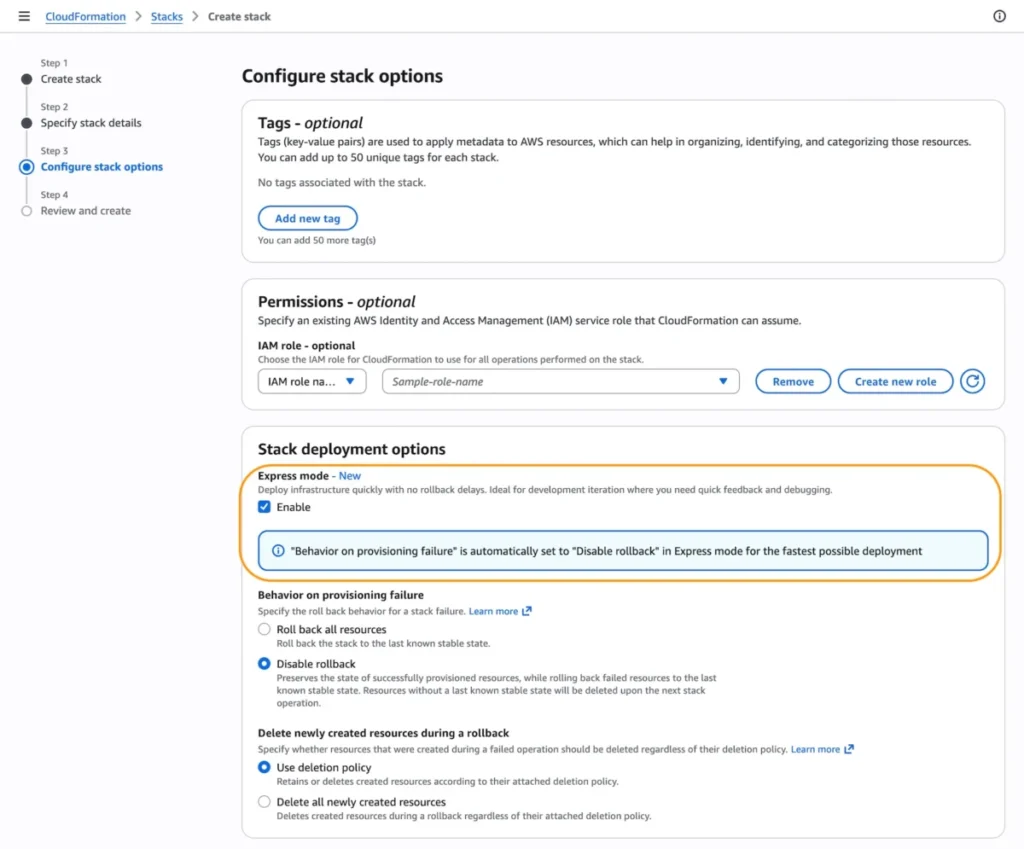
Express mode changes this paradigm. When enabled, the deployment process concludes as soon as the resource configuration is successfully applied to the AWS backend. The resources then continue to stabilize and reach an operational state in the background. AWS has built-in intelligent retry logic that handles transient failures automatically, ensuring that dependent resources still provision correctly without requiring manual intervention from the developer.
Key Benefits at a Glance:
- Up to 4x Faster Deployments: By removing the wait time for stabilization, developers see drastically reduced feedback loops.
- AI-Native Compatibility: Designed for AI tools that require rapid, sub-minute feedback to refine infrastructure code.
- No Template Changes Required: Existing templates work seamlessly with Express mode, requiring only a configuration flag update.
- Built-in Resilience: Automatic handling of transient failures between dependent resources.
Chronology: The Evolution of IaC at AWS
To understand why Express mode is such a critical development, one must look at the progression of Infrastructure as Code.
The Era of Manual Configuration
In the early days of cloud computing, infrastructure was largely managed via console clicks or imperative scripting. This led to "configuration drift" and environment inconsistency, where staging environments rarely matched production.
The Rise of Standard CloudFormation
AWS CloudFormation introduced declarative templates, allowing developers to define their infrastructure as JSON or YAML. The "Standard" mode of deployment became the gold standard for safety: the system would not proceed until it confirmed that every load balancer, database, and instance was fully healthy. However, as microservices architectures grew, the time required to "stabilize" hundreds of resources began to creep into the minutes, slowing down the development lifecycle.
The Present: The "Express" Paradigm
As of today, AWS has acknowledged that the definition of "ready" has shifted. In a world of ephemeral testing environments and AI-driven coding assistants, waiting for a load balancer to pass health checks before moving to the next task is a luxury many developers cannot afford. By launching Express mode, AWS has effectively created a "fast-track" for development-stage infrastructure, mirroring the agility found in modern application development frameworks.
Supporting Data: Benchmarking the Speedup
The efficiency gains introduced by Express mode are not merely theoretical; they are substantial enough to fundamentally change developer workflows. AWS provided specific benchmarking data that highlights the disparity between traditional stabilization and the new Express mode.
Case Study 1: Amazon SQS Queue Provisioning
When creating an Amazon Simple Queue Service (SQS) queue paired with a Dead Letter Queue (DLQ), the standard deployment lifecycle—which includes verifying the health and integration of both components—typically takes approximately 64 seconds. Under the new Express mode, this process is completed in just 10 seconds. This is a 6.4x speed improvement, allowing developers to test queue configurations in near real-time.
Case Study 2: AWS Lambda Function Deletion
Perhaps more dramatic are the gains in resource cleanup. Deleting a Lambda function that has a network interface attachment (often used for VPC access) traditionally involves a lengthy cleanup process that can take between 20 and 30 minutes. Express mode completes this request in roughly 10 seconds. For teams that spin up and tear down complex, network-attached Lambda environments for integration testing, this represents a massive recovery of lost productivity time.
Official Responses and Strategic Vision
Channy Yun, a leading voice at AWS, noted in the announcement that the goal of Express mode is to prioritize "iterative development workflows." The strategic vision here is clear: AWS wants to remain the platform of choice for the next generation of AI-integrated development.
The Role of AI-Assisted Development
The mention of tools like Kiro in the documentation is telling. As developers increasingly rely on AI to generate infrastructure code, the speed of the "feedback loop" becomes the primary bottleneck to productivity. If an AI agent writes a piece of code and must wait five minutes to see if it failed, the agent’s learning curve is severely throttled. Express mode provides the "low-latency feedback" necessary for AI models to iterate, fail, correct, and succeed in seconds rather than minutes.
Operational Guardrails
AWS has been careful to address concerns regarding reliability. While Express mode is faster, it is not "less reliable" in terms of final state; it simply changes the timing of when the completion signal is sent. The built-in retry mechanisms for transient failures demonstrate that AWS has prioritized architectural integrity even while optimizing for speed.

Implications for the Future of Infrastructure
The rollout of CloudFormation Express mode carries significant implications for DevOps teams and organizational cloud strategies.
1. Shifts in CI/CD Pipeline Design
Teams will likely begin bifurcating their deployment strategies. We expect to see "Express Mode" become the default for development and sandbox environments, where rapid iteration is the priority. Conversely, production pipelines will likely retain "Standard" mode to maintain the strict stabilization guarantees that ensure zero-downtime deployments.
2. A New Standard for "Developer Experience"
The inclusion of cdk deploy --express signals that AWS is deeply committed to the AWS Cloud Development Kit (CDK). By making the fastest deployment mode a first-class citizen in the CDK, AWS is signaling that the "developer experience" (DX) is now as important as the underlying service performance.
3. Cost-Effective Testing
With faster deployments, the cost of "testing infrastructure" drops. When it takes 30 minutes to provision an environment, developers are incentivized to keep environments running. When it takes 10 seconds, developers are more likely to provision an environment on-demand and tear it down immediately after use, leading to cleaner cloud footprints and potential cost savings on idle resources.
4. Implementation Best Practices
For organizations looking to adopt Express mode, a word of caution is necessary: Disablement of rollbacks. Because Express mode is optimized for speed, it disables rollback by default. Organizations must ensure that their developers are using mature monitoring tools or have robust "cleanup" scripts to handle the rare instances where a configuration might fail to stabilize in the background. For production, the recommendation remains to set disableRollback to false and integrate with mature observability suites.
Conclusion: The Path Forward
AWS CloudFormation Express mode is more than just a speed boost; it is a fundamental acknowledgment of how software is built today. By lowering the friction of infrastructure management, AWS is empowering engineers to treat infrastructure with the same fluidity as application code.
As of today, the feature is available in all commercial regions at no additional cost. Organizations are encouraged to review their current stack definitions and begin incorporating the --deployment-config parameter into their CI/CD scripts. In an era where velocity is the primary currency of the digital economy, AWS has provided its users with a powerful new tool to stay ahead of the curve. Whether you are an individual developer experimenting with serverless architectures or a large enterprise scaling microservices, the ability to iterate faster is a competitive advantage that cannot be overlooked.