AWS Unveils Glue 6.0: A Major Leap Forward with 30% Price Reductions, Apache Spark 4.1, and Full Apache Iceberg v3 Support
SEATTLE — In a move set to reshape the economics and technical capabilities of cloud-based data engineering, Amazon Web Services (AWS) has officially announced the general availability of AWS Glue 6.0. This flagship release introduces a modernized serverless runtime architecture, robust native integration with Apache Iceberg v3, and—most notably—a dramatic 30% price reduction across the board compared to previous iterations.
Designed to meet the surging demands of modern enterprise data workloads, AWS Glue 6.0 bridges the gap between high-performance analytics and cost optimization. Built upon the latest foundational open-source technologies—including Apache Spark 4.1, Python 3.13, and Scala 2.13—the new version promises significantly faster ETL (Extract, Transform, Load) execution times while simultaneously lowering the cost barrier for organizations managing petabyte-scale data lakes.
According to AWS technical spokespeople, Glue 6.0 delivers the most comprehensive implementation of the Apache Iceberg v3 specification available on any fully serverless managed Spark service today. The release addresses longstanding pain points in data engineering, such as the cumbersome handling of semi-structured data, high cloud infrastructure bills, and the operational overhead of migrating between major framework versions.
1. Main Facts: What Defines AWS Glue 6.0?
AWS Glue 6.0 is not merely an incremental version bump; it represents a comprehensive overhaul of AWS’s premier serverless data integration and ETL service. The release centers on three core pillars: drastic cost savings, cutting-edge open-source framework upgrades, and advanced support for open table formats.
- 30% Cost Reduction: Users benefit from a structural price drop of 30% compared to legacy versions of AWS Glue, making large-scale data processing considerably more economical.
- Apache Spark 4.1 & Modern Runtimes: The engine is powered by Apache Spark 4.1, coupled with Python 3.13 and Scala 2.13, delivering enhanced execution speeds, advanced memory management, and optimized query planning.
- Full Apache Iceberg v3 Integration: Built on Iceberg 1.11.0, Glue 6.0 introduces the groundbreaking
VARIANTdata type complete with advanced shredding capabilities. - Low-Latency Real-Time Streaming: The updated runtime enables real-time stream processing capabilities operating with single-digit millisecond latencies.
- Seamless Backward Compatibility: Organizations can adopt Glue 6.0 without rewriting underlying application logic, utilizing existing API parameters and migration toolkits.
2. Chronology: The Evolution Leading to Glue 6.0
To understand the significance of AWS Glue 6.0, it is helpful to trace the evolution of AWS’s serverless data ecosystem and the broader shift toward open table formats in modern data architecture.
The Rise of Serverless ETL (2017–2020)
When AWS initially launched Glue, it solved a critical operational bottleneck for data engineers: the need to provision, scale, and manage underlying clusters for Apache Spark. Over the subsequent years, AWS introduced continuous enhancements, including Glue version 2.0 and 3.0, which focused heavily on startup time reductions and support for newer Python and Spark runtimes. However, as data lakes grew into data meshes and data lakehouses, customers began demanding tighter integration with open table formats like Apache Iceberg and Delta Lake to avoid vendor lock-in and enable ACID transactions on cloud object storage like Amazon S3.
The Apache Iceberg Revolution (2021–2024)
As organizations increasingly migrated away from traditional proprietary data warehouses toward open table formats on data lakes, Apache Iceberg emerged as an industry standard. AWS steadily increased its support for Iceberg across its analytics portfolio, integrating it with Amazon Athena, Amazon EMR, and AWS Glue. With Glue 2.0, 3.0, and 4.0, support for Iceberg evolved incrementally. However, limitations remained regarding how semi-structured data (such as nested JSON, logs, and telemetry events) was stored and queried within Iceberg tables, often forcing engineers to flatten schemas manually or rely on slower string-based data types.
The Spark 4.1 and Iceberg v3 Milestone (Late 2024–2026)
With the maturation of Apache Spark 4.1 and the finalization of the Apache Iceberg v3 specification, AWS engineering teams embarked on a comprehensive modernization project. Throughout early 2026, preview builds were tested by select enterprise customers. This culminated in the official general availability announcement of AWS Glue 6.0, aligning AWS’s serverless offerings with the absolute cutting edge of the open-source big data ecosystem.
3. Supporting Data and Technical Architecture
The technical underpinnings of AWS Glue 6.0 introduce several architectural breakthroughs designed to maximize throughput while minimizing compute overhead.

The Power of the VARIANT Data Type and Shredding
The standout capability within the Iceberg v3 specification implemented in Glue 6.0 is the introduction of the VARIANT data type paired with shredding support. Historically, processing semi-structured data like JSON logs or event payloads required storing them as large string columns or enforcing rigid, flattened table schemas. Both approaches had severe drawbacks: string types resulted in slow, CPU-intensive parsing during query time, while flattening schemas often led to data explosion, pipeline breakage upon upstream schema evolution, and massive duplication.
The new VARIANT data type in Glue 6.0 allows data teams to ingest, store, and query semi-structured data natively.
- No Schema Flattening Required: Ingest raw JSON or nested event streams directly without altering upstream data structures.
- Structural Shredding: The engine intelligently shreds the semi-structured payload into optimized columnar representations behind the scenes.
- Accelerated Query Performance: Queries targeting specific nested attributes run significantly faster—often orders of magnitude faster—than traditional queries parsing raw string columns.
- Resilience to Schema Drift: When upstream applications alter their JSON payloads, downstream pipelines remain unbroken, protecting data reliability.
Performance Enhancements in Spark 4.1
By anchoring Glue 6.0 on Apache Spark 4.1, AWS delivers the most significant performance upgrade to the runtime engine in recent history. Spark 4.1 brings advanced Catalyst optimizer rules, improved vectorized execution paths, and tighter integration with modern cloud object storage semantics. Furthermore, the inclusion of Python 3.13 and Scala 2.13 allows data scientists and data engineers to leverage modern language features, enhanced type safety, and improved garbage collection metrics during heavy ETL jobs.
4. Official Responses and Industry Context
Industry reaction to the release of AWS Glue 6.0 has been overwhelmingly positive, particularly from data architects and enterprise leaders grappling with spiraling cloud analytics budgets.
In the official release announcement, AWS engineering leadership emphasized the dual focus on performance and cost-efficiency. "We listened closely to our customers who are scaling massive data lakehouses," noted the AWS engineering team. "They wanted state-of-the-art open table format capabilities without trade-offs. By combining a 30% price reduction with the complete power of Apache Iceberg v3 and Spark 4.1 on a fully serverless foundation, AWS Glue 6.0 removes the friction between cost management and technical performance."
Independent data consultants and enterprise infrastructure leads have echoed these sentiments. As data volumes continue to expand exponentially—driven by IoT telemetry, real-time application logs, and generative AI training datasets—organizations have faced mounting pressure to optimize their cloud spend. The structural 30% price cut on Glue jobs provides an immediate financial relief valve, while the efficiency gains of Spark 4.1 reduce the total compute hours required to process identical workloads.
5. Implications for Enterprise Data Strategies
The release of AWS Glue 6.0 carries profound implications for how organizations design, execute, and scale their data architectures moving forward.
1. Accelerated Adoption of Open Table Formats
For years, hesitation around operational complexity and performance overhead slowed the enterprise migration to open table formats. By baking a complete, highly optimized implementation of Apache Iceberg v3 directly into a serverless engine with advanced features like VARIANT shredding, AWS has largely removed these technical barriers. Enterprises can now commit fully to open table strategies on Amazon S3 without fearing vendor lock-in or substandard query speeds.
2. Paradigm Shift in Semi-Structured Data Processing
The ability to handle JSON and event streams natively via the VARIANT type changes the calculus of data ingestion pipelines. Data engineering teams can drastically reduce the amount of custom parsing code they write and maintain. This reduction in boilerplate code translates directly into lower maintenance overhead, fewer pipeline failures due to unexpected schema modifications, and faster time-to-insight for downstream business intelligence and machine learning applications.

3. Favorable Economics for High-Volume ETL Workloads
Cloud cost optimization (FinOps) has become a primary boardroom metric for technology companies. Because AWS Glue 6.0 introduces a 30% baseline price reduction while simultaneously executing workloads faster via Spark 4.1, organizations stand to gain a compounding economic benefit. Jobs that previously required large, expensive worker configurations can now run efficiently on smaller footprints or complete faster, freeing up cloud budgets for strategic AI and analytics initiatives.
6. Getting Started and Migration Pathways
Migrating to AWS Glue 6.0 has been designed to be as frictionless as possible for existing users.
Zero API Redesigns Required
Organizations do not need to rewrite their core application logic or modify complex API structures to begin utilizing the new version. Upgrading is as simple as updating the job configuration parameter.
- Via AWS CLI or SDKs: Developers can specify the new version using the existing
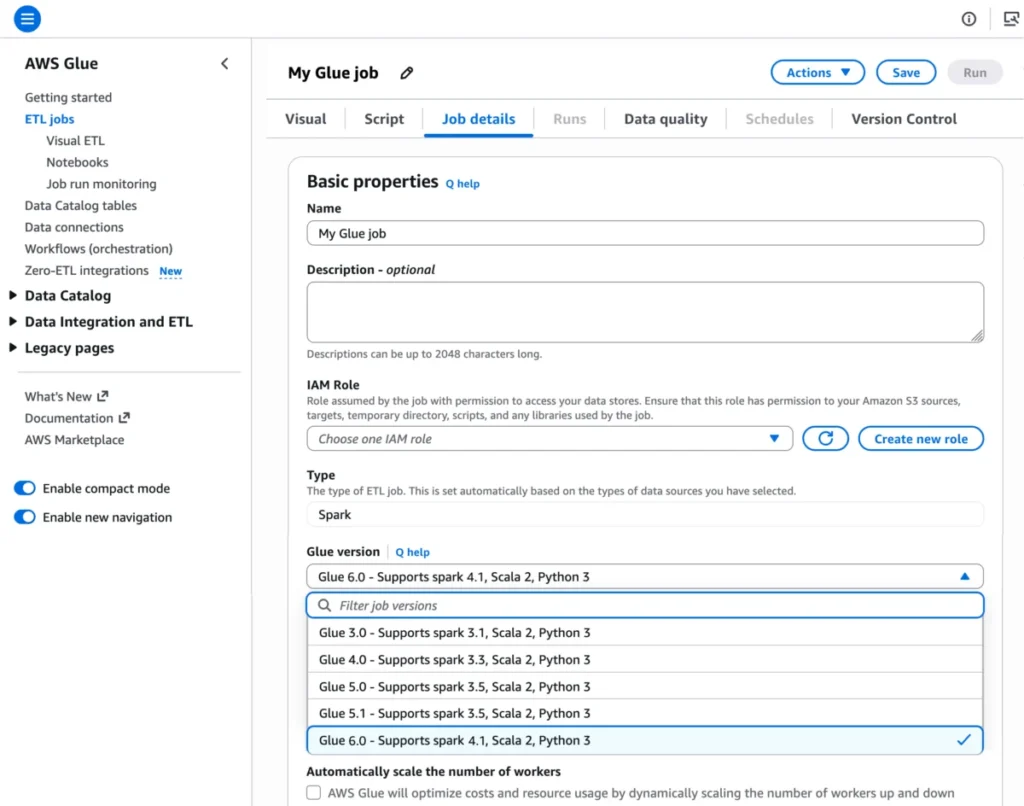
--glue-versionparameter set to6.0withincreate-joborupdate-jobAPI calls. - Via AWS Glue Studio: Navigate to the Job Details tab within the console and select the option labeled "Glue 6.0 – Supports Spark 4.1, Scala 2, Python 3."
- Interactive Notebooks: For data scientists utilizing AWS Glue Studio notebooks or Jupyter interactive sessions, version 6.0 can be initialized instantly by setting
%glue_version 6.0in the magic commands.
Automated Upgrade Tools
To assist enterprises managing hundreds or thousands of legacy ETL jobs, AWS has integrated the Spark upgrade agent directly into AWS Glue Studio. Additionally, an automated upgrade feature is available to seamlessly transition existing jobs to the new runtime environment while flagging any potential deprecations or compatibility considerations.
Regional Availability and Support
AWS Glue 6.0 is generally available today across all commercial AWS Regions where AWS Glue operates. Organizations can verify specific regional capabilities and future roadmap items through the AWS Capabilities portal. Furthermore, teams looking to integrate documentation searches, API calls, and troubleshooting workflows into their preferred AI-assisted development environments can leverage the AWS MCP Server and associated plugins.
Pricing Structure
Users continue to pay a predictable, transparent hourly rate billed by the second for crawlers and ETL execution jobs. The AWS Glue Data Catalog maintains its simplified monthly fee structure for metadata storage and access, which continues to include a generous free tier (the first million objects stored and the first million accesses are completely free).
As enterprises race to modernize their data foundations for the era of advanced analytics and generative AI, AWS Glue 6.0 provides a timely, high-performance, and economically compelling vehicle to power the next generation of data-driven innovation.