Breaking the Mold: Why Your AI Images Look Generic—and the Blueprint to Fix Them
By Global Tech & Marketing Desk
In the fast-evolving landscape of digital marketing, artificial intelligence has fundamentally altered how content is produced. Yet, a pervasive frustration plagues creators and brands alike: the sea of sameness. Across social media feeds, pitch decks, and ad campaigns, AI-generated visuals increasingly look identical—yielding what industry insiders disparagingly term "AI slop."
However, according to recent insights from AI strategist Lauren deVane, co-created alongside marketing expert Michael Stelzner, the root of the problem does not lie within the technology itself. Much like judging classical piano proficiency by listening to a toddler smash keys in a dentist’s office, the poor quality of generic imagery stems from execution, not capability. Today’s advanced generative models are fully capable of producing hyper-realistic, brand-aligned visual assets. The missing link is a sophisticated, repeatable framework for wielding them.
Main Facts: The Evolution of AI Imagery
To understand why modern AI images can look remarkably distinct—or painfully generic—one must examine the technological leap that occurred between older diffusion models and contemporary architectures.
- The Architectural Shift: Early models relied heavily on diffusion techniques, starting with field noise and systematically chipping away at it like a sculptor. Modern engines, such as OpenAI’s GPT Image, operate fundamentally differently. Trained on billions of pixel patterns and corresponding text descriptions, they synthesize entirely novel imagery based on learned patterns rather than simply stitching together archival fragments.
- Contextual Comprehension: Backed by advanced Large Language Models (LLMs), current tools can reason, interpret nuance, and ingest complex reference imagery. If fed a photo of a niche consumer product, the model can reverse-engineer its flavor profile, colorway, or design language and build an entirely bespoke ecosystem around it.
- Precision Rendering: Contemporary models routinely handle complex typographical demands, precise font hierarchies, and spatial composition—provided the user supplies sufficiently detailed instructions rather than vague placeholders like "make me a flyer."
Chronology: From Experimental Flaws to Enterprise Workflows
The journey of AI image generation has been remarkably swift, moving from a novelty plagued by surreal anatomical anomalies to a core pillar of modern digital production.
- Phase 1: The Uncanny Valley (Early Years): When tools like early iterations of DALL-E first hit the mainstream, their limitations were glaring. Six-fingered hands, distorted gaze planes, and glossy, plastic skin textures acted as immediate "tells" of artificial generation. Many marketers dismissed the technology as an unusable gimmick.
- Phase 2: The Fall of the Tells: Within a brief window, traditional markers of artificial origin largely vanished. Resolution skyrocketed, and realism reached parity with traditional digital photography. However, a new issue emerged: because users defaulted to lazy, shorthand prompts, the resulting outputs defaulted to predictable, homogenized layouts.
- Phase 3: The Multi-Model & Reference Era (Present Day): Today, platforms like Magnific (formerly Freepik) and integrations via Model Context Protocol (MCP) enable cross-model workflows. Creators can now run parallel generations across competing engines (such as GPT Image and Google’s Imagen), stream outputs directly into Adobe design suites, and leverage autonomous creative director skills within environments like Claude.
Supporting Data: Scalability and Brand Cohesion
For modern enterprises, moving past generic AI prompting unlocks massive operational efficiencies. Consider the manufacturing and retail space:

- High-Volume SKUs: Companies managing massive product catalogs—such as family-owned 3D-printed toy enterprise Club Critterz, which handles over 800 distinct SKUs—traditionally faced insurmountable photography costs. By implementing structured prompt templates that ingest reference photos, brands can programmatically generate hundreds of cohesive, customized product environments from a single core instruction set.
- Agile Ad Iterations: Rather than relying on rigid, quarterly photo shoots, digital marketers can refresh ad creative on a bi-weekly basis. This agility allows seasonal campaigns, localized flavor drops, and dynamic styling adjustments to roll out seamlessly without breaking brand continuity.
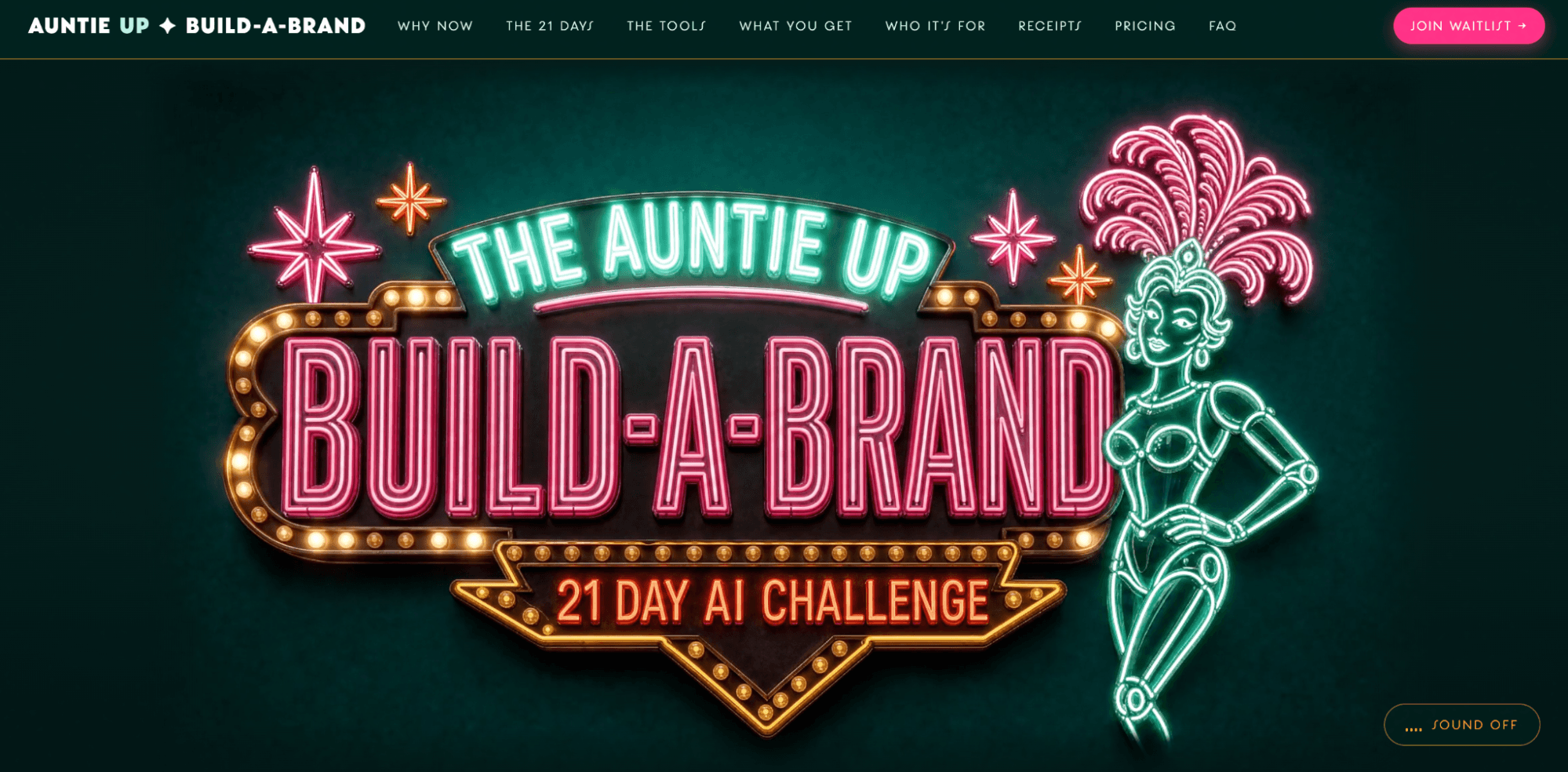
- B2B World-Building: Service-based and B2B brands are leveraging the technology to construct immersive digital assets. For instance, sub-brands like Auntie Up have successfully deployed entire sales pages wrapped in a unified, futuristic aesthetic—ranging from hero banners to section illustrations—ensuring strict chromatic and stylistic harmony across every touchpoint.
Official Responses and Strategic Frameworks
According to deVane, fixing the "generic image" dilemma requires treating AI not as a magic button, but as a collaborative junior designer that requires explicit, highly articulated creative direction.
Developing "Taste" and Reverse-Engineering Aesthetic
A primary bottleneck for marketers is the gap between having taste and articulating taste. While a professional may intuitively recognize strong composition, translating that intuition into text commands requires deliberate practice.
To bridge this gap, modern workflows utilize AI-driven "taste accelerators"—custom prompts or tools designed to break down reference imagery. By analyzing lighting geometry, focal lengths, color grading, and framing angles in inspiration photos, creators can teach AI to reverse-engineer their preferred aesthetic, laying the foundation for reliable, repeatable brand templates.
The Seven-Pillar Prompt Framework
To systematically eliminate generic outputs, deVane advocates for a robust, multi-dimensional prompt structure known as the Seven Pillar Prompt Framework. This model operates less like a rigid checklist and more like an advanced mixing console:
- Medium: Defining the exact output format—whether a fine-art photograph, a vector illustration, a Sharpie line drawing, or a 3D render.
- Subject and Action: Moving beyond simple nouns to dynamic scenarios (e.g., swapping "a soda can" for "a condensation-beaded soda can precariously balanced on its wet edge").
- Setting and Scene: Displacing the model’s lazy defaults with rich environmental specifics (replacing "a retro diner" with "a dimly lit retro diner featuring rich mahogany paneling and glowing neon beer signage").
- Composition: Directing visual framing—specifying wide-angle architectural views, macro close-ups, low-angle hero shots, or minimalist grid layouts.
- Lighting: Controlling emotional resonance through precise atmospheric descriptions (e.g., crisp morning light filtering through sheer linen curtains versus stark, single-source noir shadows).
- Aesthetic and Vibe: Translating broad stylistic preferences (such as symmetry or saturated palettes) into descriptive language rather than relying on prohibited artist name-dropping.
- Intent: Communicating the underlying psychological goal of the asset—instructing the model how to shape viewer emotion, urgency, or brand trust through facial expressions and color temperature.
Implications: The Future of AI-Driven Marketing
The transition from default "AI slop" to hyper-customized, high-fidelity visual assets carries profound implications for the marketing industry.
As multi-model platforms and MCP connectors become standard fixtures in workflows—allowing text-based AI assistants to directly script, generate, and organize imagery across enterprise tools—the barrier to entry for world-class design continues to drop. However, this democratization raises the baseline. When anyone can generate a technically proficient image, aesthetic differentiation will belong exclusively to those who master advanced prompting frameworks, curate strict brand reference libraries, and maintain a rigorous editorial vision.
Ultimately, artificial intelligence will not replace creative direction; it will amplify it. Marketers who learn to articulate their creative intent with precision will thrive in the new visual economy, while those who rely on generic prompts will continue to fade into the background.