BJP Gears Up for 2027: Nitin Nabin Sets Ambitious Target for Uttar Pradesh "Double Engine" Victory
LUCKNOW – In a high-stakes political maneuver aimed at consolidating the Bharatiya Janata Party’s (BJP) electoral machinery ahead of the 2027 Uttar Pradesh Assembly Elections, newly appointed BJP National President Nitin Nabin arrived in the state capital on Saturday, July 4, 2026. The two-day visit, characterized by a series of high-level consultations with the party’s grassroots and legislative leadership, served as a formal clarion call for a "third consecutive term" for the incumbent government.
The Mandate: A Strategy for 2027
Addressing a gathering of state office-bearers, district presidents, and a cadre of MPs, MLAs, and MLCs, Mr. Nabin outlined a vision centered on aggressive outreach and the continuation of the "double engine" governance model. The term, which signifies the synergy between the central government in New Delhi and the state government in Lucknow, remains the cornerstone of the party’s electoral narrative.
"In 2027, the double engine government will be formed in Uttar Pradesh for the third consecutive time with a massive majority," Mr. Nabin asserted. "The synergy between Prime Minister Narendra Modi and Chief Minister Yogi Adityanath has transformed Uttar Pradesh into a beacon of development. We are not just looking for a win; we are looking for a mandate that reflects the unwavering faith of the people in our vision for a developed India."
Chronology of the Visit
Mr. Nabin’s arrival in Lucknow was marked by significant fanfare, underscoring the importance the central leadership places on the country’s most populous state.
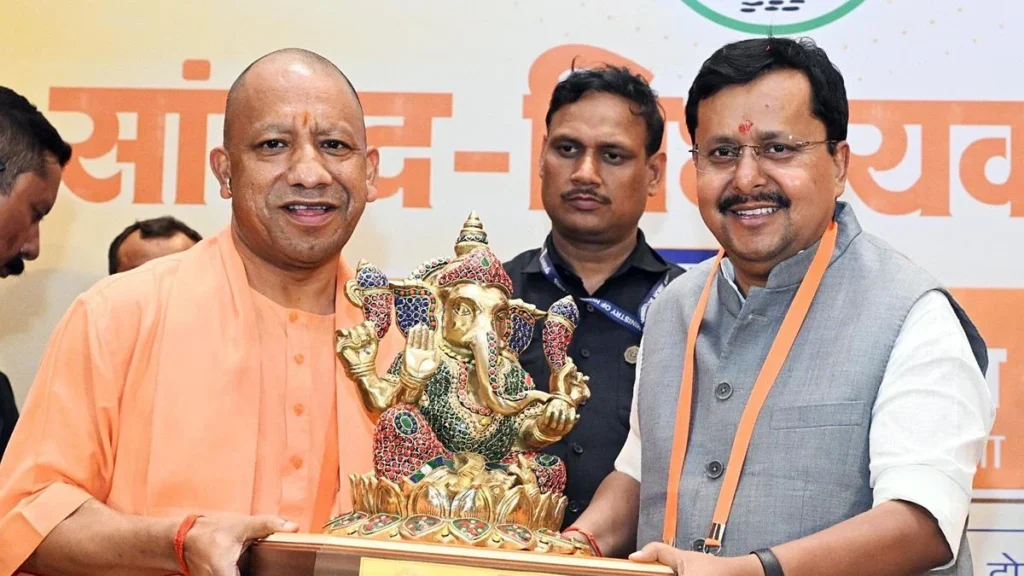
- Saturday Morning: Mr. Nabin arrived in Lucknow to a warm reception from party cadres. Upon his arrival, he was felicitated by Chief Minister Yogi Adityanath, who presented him with a bejeweled idol of Lord Ganesha—a symbolic gesture of auspicious beginnings.
- Mid-Day Consultations: The BJP president immediately transitioned into a series of closed-door meetings. The first session focused on state office-bearers and district presidents, where the primary discussion revolved around the logistics of reaching the "last-mile" voter.
- Afternoon Legislative Session: Mr. Nabin chaired a critical meeting with the state’s parliamentarians and legislators. This session was designed to synchronize the legislative wing with the organizational goals of the party, ensuring that the work done in the Vidhan Sabha and Parliament translates into tangible benefits at the booth level.
- Closing Statements: The day concluded with a public-facing address in which Nabin emphasized the need for unity and "full devotion" in the run-up to the 2027 cycle.
Supporting Data and the "Growth Engine" Narrative
The BJP’s rhetoric is heavily reliant on the narrative of Uttar Pradesh’s economic transformation. Since the party assumed power in 2017, the state has witnessed significant infrastructure shifts, including the expansion of expressways, the construction of the Purvanchal and Bundelkhand corridors, and a concerted effort to improve the "Ease of Doing Business" rankings.
Party officials emphasize that the 2027 election will be fought on the platform of "Governance and Growth." Data points frequently cited by the leadership include:
- Infrastructure: The development of the Noida International Airport and the expansion of Metro networks in tier-2 cities.
- Welfare Schemes: The saturation of central schemes such as PM Awas Yojana and Jal Jeevan Mission, which the party claims have reached the most marginalized sections of society.
- Law and Order: A central pillar of the Yogi Adityanath administration, which the party continues to leverage as a primary differentiator from previous regimes.
Official Responses and Internal Unity
The meeting was attended by the highest echelons of the state’s political hierarchy. Notably present were National General Secretary (Organization) B.L. Santhosh, Uttar Pradesh BJP Chief Pankaj Chaudhary, and Deputy Chief Ministers Brajesh Pathak and Keshav Prasad Maurya.
The presence of the two Deputy Chief Ministers—who have occasionally been the subject of media speculation regarding internal power dynamics—was interpreted by political observers as a display of a "united front." By gathering the entire leadership under one roof, the central command sought to quell rumors of factionalism and project a singular, cohesive path forward.

"The outpouring of public support in Lucknow today clearly shows that the people have unwavering faith in the NDA government’s resolve," Mr. Nabin remarked during his address. "With the spirit of ‘Nation First,’ each of our workers is working with full dedication to make Uttar Pradesh the growth engine of the country."
Implications for the 2027 Assembly Elections
The visit marks the beginning of an intensive, multi-year campaign cycle. As the party looks toward 2027, the implications of Mr. Nabin’s strategy are clear:
1. The "Booth-Level" Focus
Mr. Nabin’s directive to "travel to every village, every home, every person" suggests a move toward micro-management of the electorate. The party is moving away from purely macro-level narratives, focusing instead on ensuring that the beneficiaries of welfare schemes remain firmly within the BJP’s support base.
2. Countering the Opposition
Mr. Nabin’s warning to "not be fooled by the Opposition" highlights the party’s awareness of the growing strength of the I.N.D.I.A. bloc and other regional players. The BJP is preparing for a battle that will likely be fought on the issues of caste census, inflation, and unemployment—topics the opposition has increasingly utilized to challenge the government’s development narrative.
3. The "Double Engine" Legitimacy
For the BJP, the 2027 election is a litmus test for the "double engine" model. Should the party succeed, it will solidify the model as a template for other states. Failure, however, would be seen as a significant setback for the national leadership, particularly given the state’s pivotal role in national parliamentary politics.
Looking Ahead: The Path to 2027
As Mr. Nabin’s two-day visit draws to a close, the focus now shifts to the implementation of the directives issued in Lucknow. The party is expected to launch a series of "Vijay Sankalp" (Victory Resolution) yatras and public outreach programs over the coming months.
The political landscape in Uttar Pradesh is historically volatile, and the 2027 election is expected to be one of the most contested in recent memory. However, with the full backing of the central leadership and a clear focus on the "Modi-Yogi" duo, the BJP appears to be positioning itself as a dominant force.
The party’s success will ultimately hinge on its ability to bridge the gap between its high-level governance claims and the lived realities of the common voter. As Nitin Nabin stated, "If you want to make a place in the common people’s heart and mind, you have to reach out to them." For the next two years, that "reaching out" will be the defining theme of Uttar Pradesh politics.
Summary of Key Takeaways
- National Leadership Intervention: The visit of Nitin Nabin signals a direct oversight from the central party leadership in the state’s election preparations.
- Third-Term Ambition: The BJP has formally set the goal of a third consecutive term, focusing on the historical continuity of the "double engine" government.
- Grassroots Mobilization: The strategy emphasizes an exhaustive outreach program targeting individual households rather than relying solely on general public rallies.
- Unified Leadership: The presence of top state leadership at the meeting was intended to signal unity and minimize internal friction ahead of the polls.
- Development Narrative: The core message remains centered on the state’s transformation into a "growth engine" under the combined leadership of the Centre and the State.