Bridging the Deployment Gap: Architectural Patterns for LLM Agent Execution
The rapid maturation of Large Language Model (LLM) frameworks has democratized the creation of "agentic" systems. Today, a developer can stand up a Python script in minutes that allows an agent to loop through web searches, database queries, and multi-step reasoning processes. However, a significant "deployment gap" persists between a functional prototype and a production-ready agent capable of handling high-concurrency, real-world traffic.
Moving an agent from a Jupyter notebook to a cloud environment exposes architectural vulnerabilities—system timeouts, memory leaks, and dropped user requests—that are inherent to the way we manage execution. To build resilient AI, developers must look beyond high-level libraries and embrace standard distributed system paradigms: specifically, the choice between synchronous and asynchronous execution.
The Architecture of "Wait and See": Synchronous Execution
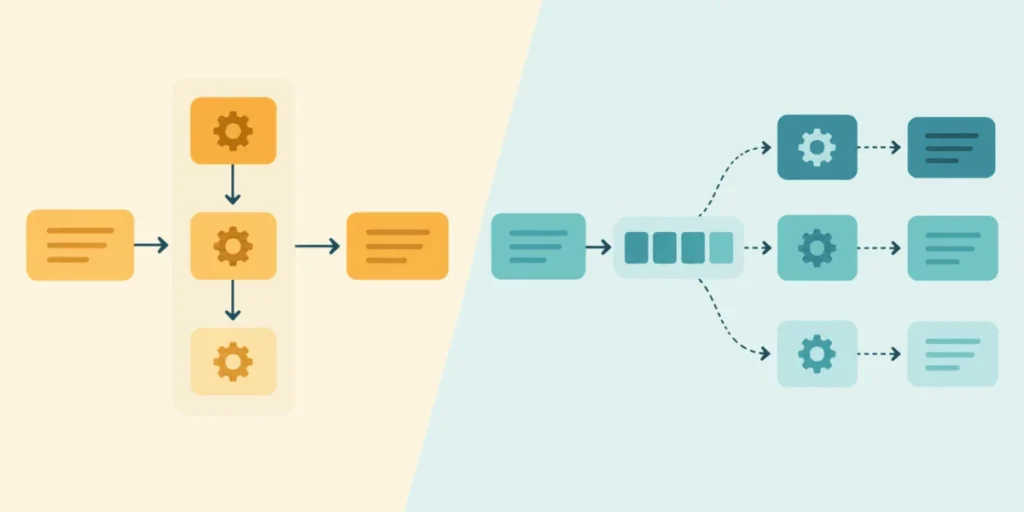
The synchronous execution pattern is the digital equivalent of a standard HTTP request-response cycle. In this model, an external client submits a prompt, and the server thread remains blocked until the agent completes its entire reasoning loop and tool-use sequence.
When Synchronous Patterns Prevail
This "Wait and See" approach is not inherently inferior; it is highly effective for specific use cases. It is the gold standard for low-latency tasks such as standard Retrieval-Augmented Generation (RAG) pipelines, where the primary objective is to fetch data and synthesize an answer within a single request window. Because the process is sequential, the state is easy to track, and error handling is straightforward—if the process fails, the error is immediately reported to the client.
The Fragility of the Request-Response Cycle
The primary limitation of synchronous architecture arises when an agent’s complexity exceeds the constraints of the underlying infrastructure. Most cloud-native API gateways, such as AWS API Gateway or Google Cloud Run, impose strict timeout limits—often capped at 29 or 60 seconds.
If an agent requires 45 seconds to plan, execute a search, parse a document, and generate a final response, the synchronous pipeline will trigger a timeout. The client receives a "504 Gateway Timeout" error, despite the agent still working in the background. This results in wasted compute, abandoned tokens, and a degraded user experience.
Implementation: The Synchronous Loop
In a synchronous agent, the logic is linear. Consider a mock implementation of an agent that iterates through a series of steps:
import time

def mock_llm_call(prompt):
    """Simulating an LLM latency."""
    time.sleep(1)
    if "research" in prompt.lower():
        return "action": "tool_call", "tool": "web_search"
    return "action": "final_answer", "text": "Task complete."

def synchronous_agent(query):
    # Blocking thread logic
    for step in range(3):
        response = mock_llm_call(f"query (step step)")
        if response["action"] == "final_answer":
            return response['text']
        # Execute tool and continue
    return "Timeout"
The "Fire and Forget" Paradigm: Asynchronous Execution
When agents evolve into complex orchestrators—handling multi-agent debates, long-form code refactoring, or workflows requiring Human-in-the-Loop (HITL) approval—synchronous models become a bottleneck. This is where asynchronous, event-driven architecture becomes mandatory.
Decoupling Execution from Interaction
Asynchronous execution decouples task submission from task completion. When a client sends a request, the system immediately returns a job_id and places the request into a message broker (e.g., RabbitMQ, Redis). A fleet of background workers then picks up these tasks independently.
This model offers two critical benefits for production systems:
- Non-blocking UX: The UI remains responsive while the agent runs in the background.
- Resilience and Checkpointing: Because the agent’s state is frequently saved to a database (PostgreSQL or MongoDB), a system crash does not result in total data loss. A worker can resume the task from the last successful checkpoint.
Infrastructure Demands
The trade-off for this robustness is infrastructure complexity. Developers must manage message brokers, persistent databases for state storage, and monitoring tools to track worker health. It is a transition from simple script management to complex distributed systems engineering.
Implementation: The Worker Model
The asynchronous pattern utilizes Python’s asyncio and a task queue to ensure the API remains available:
import asyncio
import uuid

task_queue = asyncio.Queue()
database =

async def agent_worker():
    while True:
        task = await task_queue.get()
        # Process task, update DB, checkpointing state
        database[task['id']] = "Completed"
        task_queue.task_done()
Comparative Analysis: Key Differences at a Glance
| Feature | Synchronous (Sync) | Asynchronous (Async) |
|---|---|---|
| User Experience | Blocking (User waits) | Non-blocking (Polling/Webhooks) |
| Scalability | Limited by connection timeout | Highly scalable via worker nodes |
| Complexity | Low | High (requires queues/DBs) |
| Best Use Case | Real-time Q&A, simple RAG | Complex reasoning, multi-step agents |
Implications for Modern AI Engineering
The Rise of Event-Driven AI
The shift toward asynchronous agent execution mirrors the evolution of microservices. As LLMs become more capable of taking independent actions, the "Agent" ceases to be a single function call and becomes a stateful service. This necessitates the use of robust "state machines" where the LLM’s reasoning is treated as a transition in a broader workflow.
Handling "Human-in-the-Loop"
Perhaps the most significant implication is how these architectures handle human intervention. In a synchronous model, human approval is impossible without holding a connection open for minutes or hours—a recipe for disaster. In an asynchronous model, the agent simply updates the database state to Awaiting_Approval and pauses. Once the user clicks "Approve," the worker node retrieves the task and resumes.
Data Integrity and Observability
Asynchronous systems require advanced observability. Because the process is distributed, tracking the "Chain-of-Thought" across multiple worker nodes requires centralized logging and distributed tracing (e.g., OpenTelemetry). Developers must be able to visualize the agent’s path, identifying where a specific tool call failed or where a reasoning step drifted.
Official Industry Trends and Best Practices
Leading AI platforms and frameworks (such as LangGraph, CrewAI, and Temporal) are increasingly defaulting to asynchronous paradigms for production deployment. Official documentation from these projects emphasizes that "Agentic" workflows are fundamentally different from traditional software because they are non-deterministic.
Industry experts suggest that organizations should adopt a "Tiered Execution" strategy:
- Tier 1 (Sync): Simple LLM completions and small-scale RAG.
- Tier 2 (Async): Multi-step agents with tool usage and internal reasoning.
- Tier 3 (Orchestrated): Complex, long-running agent swarms requiring state persistence and human intervention.
Conclusion
The architecture of your agent dictates its production lifespan. While starting with synchronous patterns allows for rapid prototyping and quick feedback loops, it inevitably creates a ceiling on performance and reliability.
As we move toward a future where agents act as autonomous workers rather than simple chatbots, the infrastructure must catch up. Embracing asynchronous execution—with its message queues, persistent state storage, and decoupled worker nodes—is not merely a technical preference; it is the prerequisite for scaling complex AI agents into reliable, production-grade assets. By understanding the trade-offs between "Wait and See" and "Fire and Forget," developers can bridge the deployment gap and build AI systems that are truly ready for the demands of the real world.