Bridging the Gap: AWS Lambda MicroVMs and the Future of Isolated Compute
In a significant expansion of its serverless portfolio, Amazon Web Services (AWS) has unveiled AWS Lambda MicroVMs, a groundbreaking compute primitive designed to resolve the long-standing tension between high-performance execution and secure, multi-tenant isolation. By leveraging the industry-proven Firecracker virtualization technology, AWS is empowering developers to spin up dedicated, stateful, and ephemeral execution environments with unprecedented speed.
This release marks a strategic pivot for the serverless model. While traditional AWS Lambda functions have long dominated the event-driven, request-response landscape, they have historically struggled with long-running, state-heavy, or untrusted code execution. Lambda MicroVMs aim to fill this void, providing a "Goldilocks" solution that sits between the heavyweight, slow-booting nature of traditional Virtual Machines (VMs) and the shared-kernel risks of standard container architectures.
The Core Innovation: Solving the Multi-Tenancy Dilemma
The modern application landscape is increasingly defined by "code-as-a-service" functionality. From AI-driven coding assistants and interactive data science notebooks to automated vulnerability scanners and browser-based game servers, developers are frequently tasked with executing code they did not write, often within a multi-tenant environment.
The Trade-Off Landscape
Until now, developers were forced into an architectural compromise:

- Virtual Machines: Offer ironclad isolation through hardware-assisted virtualization but suffer from "cold start" times that can stretch into minutes—an eternity for a user waiting for an interactive session to load.
- Containers: Provide rapid deployment but rely on a shared-kernel architecture. When running untrusted code, this necessitates complex, brittle security hardening to prevent container breakouts.
- Functions as a Service (FaaS): Optimized for ephemeral, short-lived tasks, these are ill-suited for sessions that require persistent memory and disk state across multiple user interactions.
AWS Lambda MicroVMs solve this by decoupling the initialization phase from the execution phase. By utilizing Firecracker snapshots, AWS allows developers to boot a fully initialized, stateful environment in milliseconds. This is not merely an incremental improvement; it is a fundamental shift in how compute resources are provisioned for individual user sessions.
Technical Chronology: From Firecracker to Production
The roots of this technology trace back to the development of Firecracker, an open-source virtual machine monitor (VMM) purpose-built for creating and managing secure, multi-tenant container and function-based services. Firecracker has quietly powered over 15 trillion monthly Lambda invocations, proving its reliability at an unmatched scale.
- Foundation Phase: AWS engineers identified that the same technology powering the world’s most popular serverless function service could be adapted to provide long-running, stateful environments.
- Snapshot Innovation: The technical breakthrough involved the ability to take a granular snapshot of a running MicroVM’s memory and disk state. This snapshot serves as the "golden image" for all future instances.
- API Integration: AWS developed a dedicated API surface for Lambda MicroVMs, distinct from the traditional Lambda function APIs, allowing for lifecycle management, auto-suspension, and stateful resumption.
- The Launch: On June 22, 2026, AWS officially launched the service, making it available across major global regions, including US East, US West, Europe (Ireland), and Asia Pacific (Tokyo).
Operational Mechanics: A New Paradigm for Developers
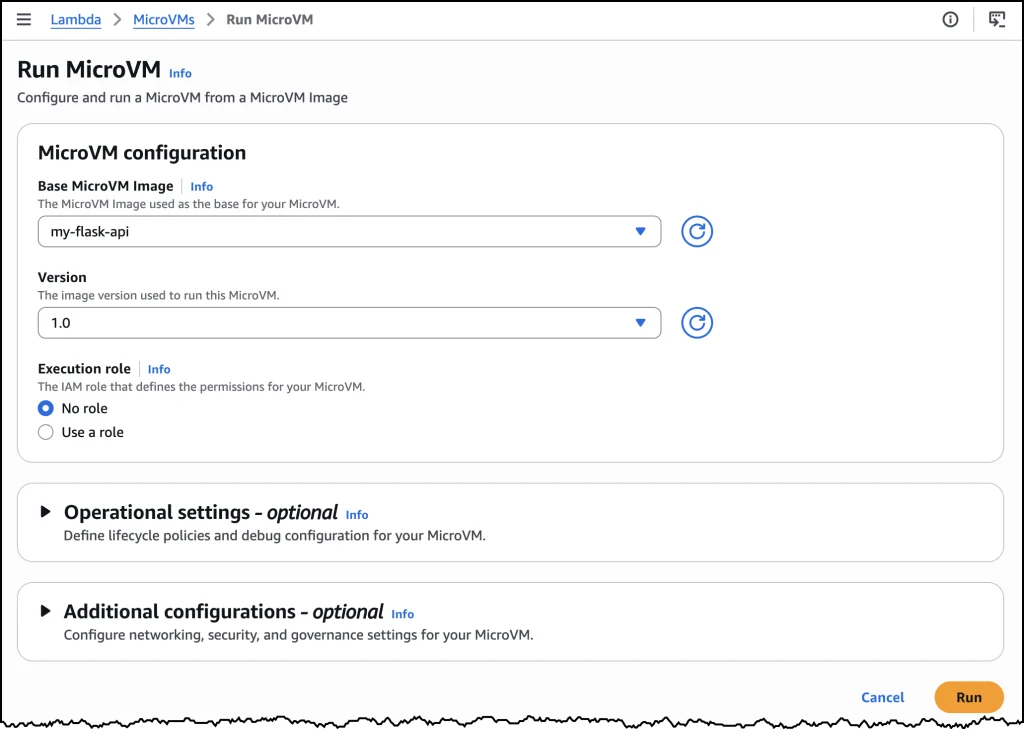
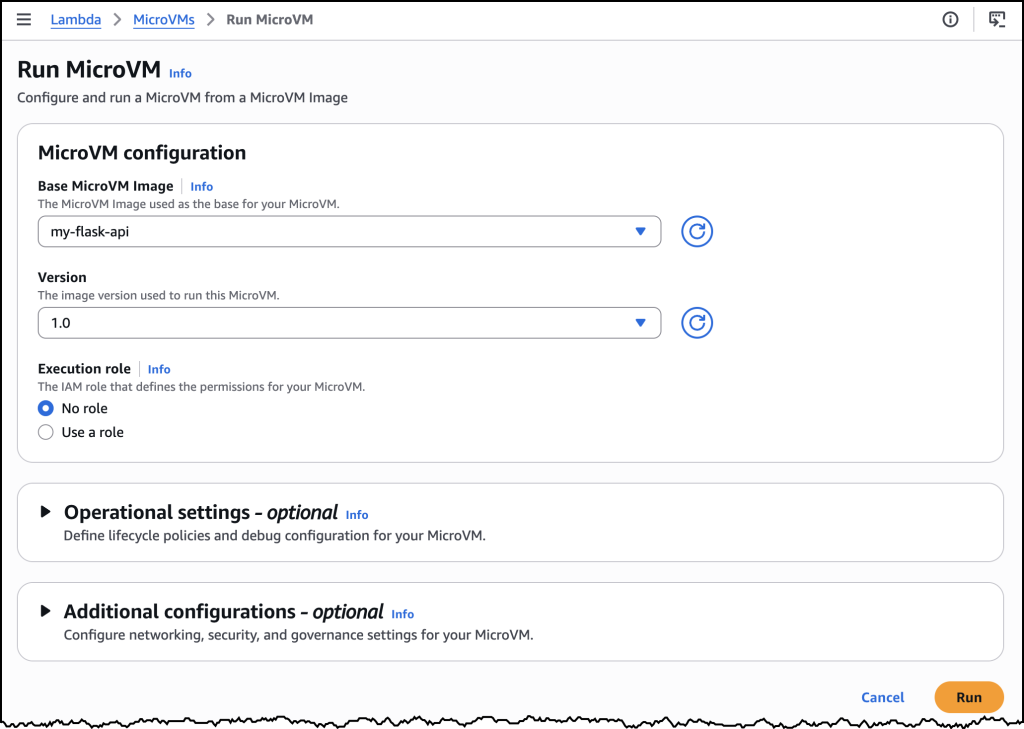
Lambda MicroVMs function via a "build, snapshot, and resume" workflow. This process is designed to be intuitive for developers already familiar with containerization.
Building the Environment
Developers package their code—along with its dependencies—into a standard Dockerfile. Unlike standard containers, this Dockerfile is processed by the AWS Lambda infrastructure to create a MicroVM image. During this build phase, Lambda initializes the environment, executes startup scripts, and installs necessary libraries.

Once the environment is primed, Lambda takes a snapshot of the running memory and disk. This snapshot is the secret sauce: when a user initiates a session, the system doesn’t "boot" the OS; it "resumes" the snapshot. This results in near-instant availability.
Lifecycle Management
A standout feature is the Idle Policy. Developers can configure how the system handles inactivity. For example, a system can be set to suspend after 15 minutes of idling, saving on costs while preserving the user’s exact working state. When the user returns and triggers a request, the MicroVM resumes instantly from the snapshot.
Implications for Industry and Security
The implications of this technology extend far beyond convenience; they represent a fundamental improvement in the security posture of modern web applications.
Enhanced Security for Untrusted Code
By providing virtual machine-level isolation at the individual user level, Lambda MicroVMs eliminate the risk of cross-tenant data leakage. If an application runs a user’s arbitrary script or a potentially malicious AI-generated snippet, that code is contained within its own dedicated kernel. Should the code attempt a breakout, it is confined by the hardware-level security boundaries of the Firecracker VMM, not just the software-level constraints of a container namespace.

Enabling New AI Use Cases
The rise of Large Language Models (LLMs) has created a demand for "agentic" workflows where AI writes and executes code to solve problems. Lambda MicroVMs provide the perfect execution sandbox for these agents. Because the state is preserved, the agent can perform multi-step tasks, install packages, or manipulate files across a session without the overhead of re-initializing the environment for every step.
Official Responses and Strategic Positioning
In a statement accompanying the launch, AWS leadership emphasized that Lambda MicroVMs are intended to be a complementary tool rather than a replacement for existing Lambda functions.
"We are not changing the core value proposition of AWS Lambda," a spokesperson noted. "Lambda Functions remain the gold standard for event-driven, high-concurrency request-response workloads. MicroVMs are specifically for the developer who needs a persistent, stateful, and highly secure environment for individual user sessions. They are two different tools in the same, high-performance toolkit."
Industry analysts suggest that this move is a direct response to the "serverless-for-everything" trend. By providing a dedicated primitive for stateful tasks, AWS is effectively competing against specialized platforms that offer "code-in-the-browser" environments, potentially consolidating market share for interactive development platforms.
Supporting Data and Technical Specifications
To support demanding workloads, AWS has launched MicroVMs with significant compute headroom:
- Architecture: Optimized for ARM64, providing high performance-per-watt efficiency.
- Scalability: Supports up to 16 vCPUs and 32 GB of memory per MicroVM.
- Storage: 32 GB of dedicated disk space per environment.
- Regional Availability: Initially available in US East (N. Virginia, Ohio), US West (Oregon), Europe (Ireland), and Asia Pacific (Tokyo).
- Compatibility: Seamlessly integrates with Amazon S3 for artifact storage and Amazon CloudWatch for real-time telemetry and log streaming.
Conclusion: The Path Forward
The introduction of AWS Lambda MicroVMs represents a maturing of the serverless ecosystem. As applications become more interactive and intelligence-driven, the demand for secure, stateful, and rapid-response compute environments will only grow.
By abstracting away the complexities of virtualization while retaining the benefits of dedicated, isolated environments, AWS has cleared a path for a new generation of applications. Developers no longer need to choose between the safety of a VM and the agility of a function. With Lambda MicroVMs, they can have both.
As the industry moves toward more sophisticated, user-centric compute models, the ability to rapidly spin up and tear down stateful environments will likely become a baseline requirement for any scalable platform. AWS has once again defined the state of the art, setting the stage for a future where the distinction between "local" and "cloud" execution becomes increasingly transparent to the end user.