Bridging the Gap: Integrating Local LLMs into Machine Learning Workflows with Scikit-Ollama
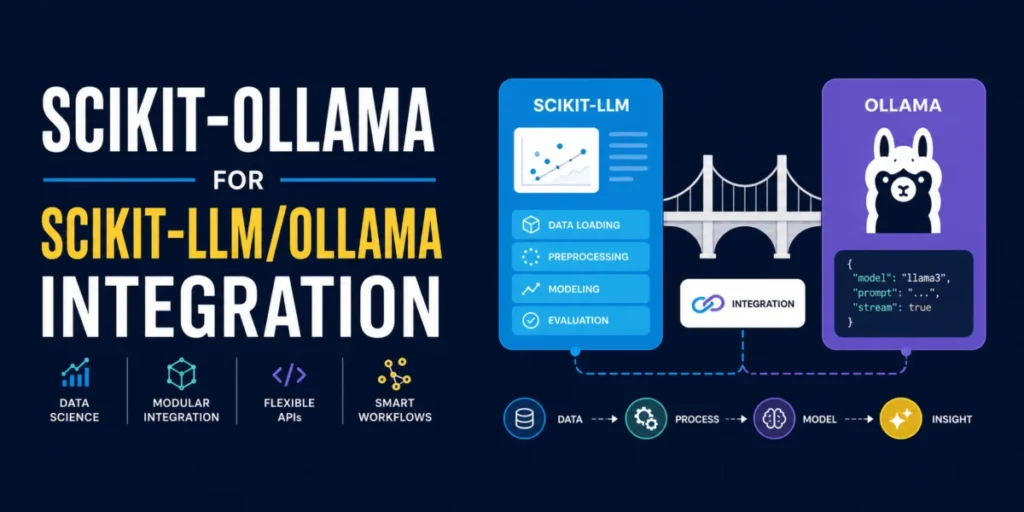
In the rapidly evolving landscape of artificial intelligence, the reliance on commercial cloud-based Large Language Model (LLM) APIs has become the standard for developers seeking to incorporate generative capabilities into their applications. However, this convenience often comes at the cost of high latency, recurring subscription fees, and significant data privacy concerns. A new development, scikit-ollama, is poised to disrupt this paradigm by bridging the gap between the industry-standard scikit-learn interface and locally hosted LLMs powered by Ollama.
By enabling zero-shot text classification without the need for external cloud infrastructure, scikit-ollama empowers data scientists to maintain full sovereignty over their data while leveraging the reasoning capabilities of state-of-the-art models like Llama 3 on their own hardware.
The Core Concept: Democratizing LLM Inference
The integration of LLMs into traditional machine learning pipelines has historically been fragmented. Developers often found themselves juggling two entirely different ecosystems: the rigorous, static nature of classical ML libraries like scikit-learn and the fluid, unpredictable nature of generative LLMs.
Scikit-ollama serves as a crucial adapter. It is built upon the architectural foundations of scikit-llm, a library designed to make LLMs "behave" like traditional machine learning estimators. By wrapping the complexity of local Ollama instances within the familiar fit() and predict() methods, it allows engineers to perform zero-shot classification—where a model classifies data it has never been trained on—using nothing more than a local machine.
Why Local Inference Matters
The shift toward local inference is driven by three primary factors:
- Data Sovereignty: Many industries, particularly healthcare, finance, and legal, cannot transmit sensitive, proprietary text data to third-party cloud servers. Local execution ensures data never leaves the developer’s infrastructure.
- Cost Efficiency: While API calls are inexpensive at scale, they accumulate. Local inference leverages existing hardware, eliminating the "per-token" billing model.
- Connectivity Independence: Local models function in air-gapped environments, ensuring that mission-critical classification tasks remain operational even without an internet connection.
Chronology of Development: From Scikit-LLM to Scikit-Ollama
The journey toward this integration began with the recognition that while powerful, LLMs are inherently unstructured. Traditional ML models output clear labels or probabilities; LLMs output natural language text.
The Foundation: Scikit-LLM
The initial innovation was the creation of scikit-llm, which introduced the concept of the "LLM-as-a-Classifier." It addressed the primary pain point: forcing an LLM to follow a specific output schema. By utilizing system prompts and constrained generation, it ensured that even if a model was asked a complex question, the final output would be a predictable, parsable label.
The Evolution: Integration with Ollama
Ollama emerged as the premier tool for managing the lifecycle of open-source models (Llama 3, Mistral, Gemma) locally. The community-driven scikit-ollama library was subsequently developed to bridge the gap between scikit-llm’s architectural design and Ollama’s robust local runtime. This allowed the Python community to move away from OpenAI or Anthropic dependencies and toward an ecosystem of models that could be swapped or updated with a simple terminal command.
Supporting Data: The Technical Implementation
To implement this, the environment must be correctly configured. The library requires Python 3.9 or higher, reflecting the need for modern asynchronous programming features to manage model communication effectively.
Step 1: Environment Setup
After installing the library via pip install scikit-ollama, the user must ensure the Ollama service is running. This can be verified by pulling the desired model from the registry:
ollama pull llama3
Step 2: Dataset Preparation
Using the built-in datasets provided by the skllm module, developers can experiment with sentiment analysis. The following snippet illustrates the standard ingestion process:
from skllm.datasets import get_classification_dataset
X, y = get_classification_dataset()
# X represents text reviews; y represents labels: "positive", "negative", "neutral"
Step 3: The "Fitting" Paradox
In a traditional scikit-learn model, fit() is used to update weights during training. In a zero-shot LLM context, no weight updates occur. Instead, the fit() method serves as a registration step. It informs the LLM of the candidate label space, essentially "teaching" the model which output classes are permissible for the current task.
from skollama.models.ollama.classification.zero_shot import ZeroShotOllamaClassifier
clf = ZeroShotOllamaClassifier(model="llama3:latest")
clf.fit(None, ["positive", "negative", "neutral"])
Performance Expectations
When executing predict(), the model treats each input record as a distinct prompt. The latency is entirely dependent on the local hardware’s GPU/NPU capabilities. Unlike cloud APIs, where latency fluctuates based on network congestion, local performance is deterministic. For smaller batches, the inference time is negligible, providing a near-real-time user experience.
Official Perspectives and Expert Analysis
Industry experts have lauded the integration for its adherence to the "Pipeline" philosophy. By making the LLM act as a transformer—a component that can be placed in a Pipeline object alongside a CountVectorizer or a StandardScaler—developers can create hybrid models. For instance, one could use a traditional TF-IDF model to filter out "neutral" reviews and then pass only the "complex" ones to the LLM for high-level sentiment analysis, optimizing both cost and speed.
However, researchers note that this approach requires careful prompt engineering. The underlying scikit-ollama implementation uses specific templates to ensure the LLM doesn’t "hallucinate" a response, but rather conforms strictly to the provided labels. The robustness of this classification depends heavily on the model’s ability to follow those syntactic instructions.
Broader Implications for the ML Industry
The Rise of "Small" Language Models
The success of scikit-ollama highlights a growing trend: the shift toward "Small Language Models" (SLMs) and quantized versions of larger models. By running a 4-bit or 8-bit quantized Llama 3 model, developers can achieve high-accuracy sentiment analysis on consumer-grade hardware like an M-series Mac or a standard workstation with a modern NVIDIA GPU.
Transforming Enterprise Workflows
For enterprises, the implication is a paradigm shift in how they handle unstructured data. Previously, the cost of sending millions of customer feedback logs to a cloud provider for sentiment analysis was prohibitive. With local integration, companies can process this data as a background task on internal servers, turning qualitative feedback into quantitative business intelligence without exposing customer data to third-party providers.
Future Outlook: Beyond Classification
While scikit-ollama currently focuses on classification, the logical progression includes:
- Zero-shot Regression: Predicting numeric scores based on textual input.
- Multi-label Classification: Allowing models to assign multiple tags to a single document.
- Embedding Generation: Integrating local vector stores with Ollama to build RAG (Retrieval-Augmented Generation) pipelines entirely within the
scikit-learnecosystem.
Conclusion
The integration of scikit-ollama marks a maturation point in the AI lifecycle. It signifies that we are moving past the "novelty phase" of LLMs—where developers are content with simply chatting with a bot—and entering a phase of industrial application. By forcing these complex, probabilistic machines to adhere to the strict, deterministic interfaces of classical machine learning, we are finally unlocking the ability to use AI as a reliable, secure, and cost-effective component of the modern data stack.
Whether you are a developer looking to protect user privacy or a data scientist seeking to optimize your infrastructure, the path forward is clear: bring the intelligence to the data, not the data to the intelligence.