The Digital Frontier: Why Accessibility is No Longer Optional for the Modern Enterprise
In an era where the digital landscape serves as the primary gateway to commerce, healthcare, and civic engagement, the imperative of digital accessibility has shifted from a peripheral corporate social responsibility initiative to a mission-critical business mandate. With over 1.3 billion people worldwide living with some form of disability, the failure to provide an inclusive online experience is no longer just a moral oversight—it is a significant legal and financial liability.
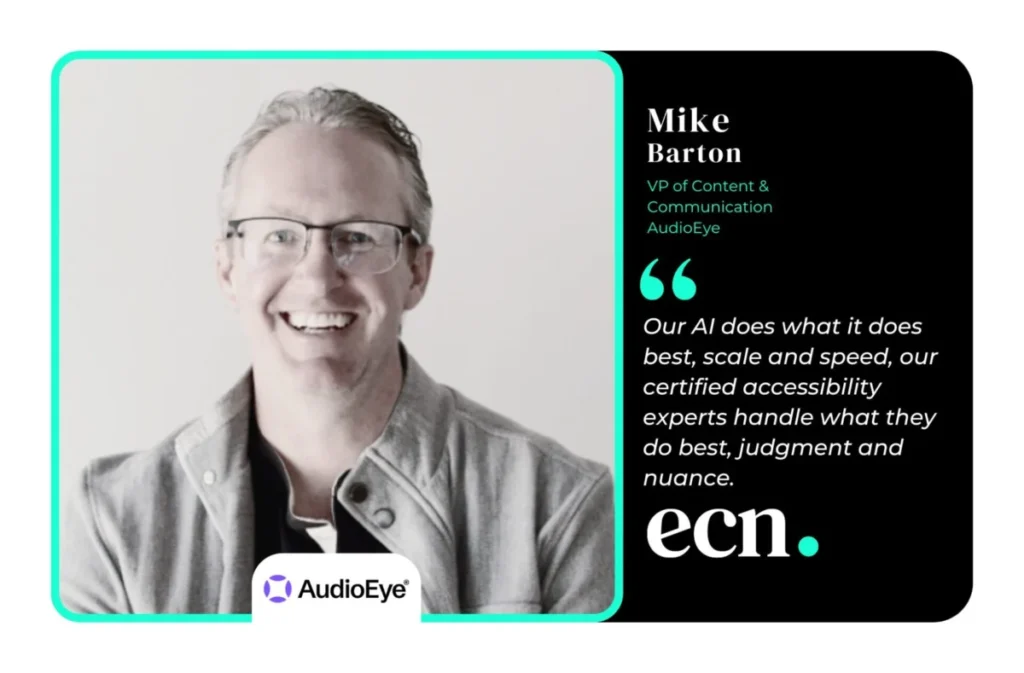
Leading the charge in this evolution is AudioEye, a digital accessibility platform that has spent nearly two decades refining the intersection of artificial intelligence and human expertise. In an exclusive interview, Mike Barton, VP of Content Marketing and Communications at AudioEye, outlines why the future of the internet must be built on the foundation of universal access.
The Mission: Redefining the Digital Default
For AudioEye, the vision is clear: a digital world where accessibility is not an afterthought or a reactive scramble to avoid litigation, but the standard operating procedure for every website and application.
"Our mission is to deliver the strongest, most cost-effective accessibility protection in the industry," says Barton. By supporting over 127,000 organizations, AudioEye has moved beyond the "checkbox" mentality that once plagued the tech industry, instead focusing on high-velocity detection and robust legal defense for their clients. The goal is to make the digital world fundamentally open to everyone, regardless of their physical or cognitive ability to navigate it.
A Chronology of Change: From Niche to Necessity
The journey of digital accessibility has been marked by a radical shift in urgency. When AudioEye was founded, accessibility was widely viewed as a niche concern—a "nice-to-have" rather than a foundational requirement.
The Turning Point
The landscape changed as the legal environment caught up with the rapid digitalization of society. In the last five years, accessibility-related lawsuits have doubled, signaling a shift in judicial expectations. Simultaneously, the introduction of the European Accessibility Act (EAA) has expanded the regulatory footprint from a domestic U.S. concern to a global standard.
"What’s changed is that the stakes have caught up to the principle," explains Barton. "New laws like the EAA now reach across borders, and AI is fundamentally changing how websites are built and how users find them."
As these legal pressures mounted, AudioEye evolved its methodology. The company doubled down on a hybrid strategy: using AI to handle the scale and speed of modern web demands, while relying on human experts to provide the nuance and judgment that machines cannot replicate.
Supporting Data: The Case for Inclusivity
The economic implications of neglecting accessibility are stark. For modern businesses, accessibility is intrinsically linked to revenue growth and brand equity.
- Spending Power: People with disabilities represent an estimated $18 trillion in global spending power.
- Consumer Loyalty: Research indicates that seven out of ten individuals with disabilities will abandon a website if it is not accessible.
- Market Reach: Most users with disabilities consistently shop only at platforms they know are accessible, effectively creating a "walled garden" that excludes competitors who fail to prioritize inclusive design.
- Legal Exposure: E-commerce remains the primary target for accessibility lawsuits, accounting for 78% of current litigation.
These figures illustrate that an accessible website is a growth engine. By removing barriers, businesses lower their bounce rates and capture a customer segment that competitors are inadvertently—and often aggressively—excluding.
The Hybrid Approach: How AudioEye Works
AudioEye’s platform functions as a sophisticated layer between the user and the digital experience. It deploys a single line of JavaScript, allowing it to integrate seamlessly into existing tech stacks—whether that be a headless setup, a standard CMS, or a custom build.
The AI-Human Synergy
The efficacy of the platform rests on a two-pronged approach:
- AI-Driven Automation: The system monitors user sessions 24/7 and automatically fixes common issues like missing alt text, broken form labels, and poor heading structures. According to a 2026 independent study by Adience, AudioEye detects up to 2.5 times more issues than competing tools.
- Expert Human Validation: Automation accounts for roughly half of all fixes. The remaining, more complex issues—which often involve context-sensitive design or user-intent problems—are handled by certified accessibility experts. These specialists perform audits and deploy custom fixes, ensuring that roughly 97% of all accessibility issues are resolved without requiring a single pull request from the client’s internal engineering team.
Implications for Global Business and Regulation
The implications of the current digital climate are twofold: increased regulatory scrutiny and the emergence of AI as a primary driver of web discovery.
The Global Regulatory Landscape
With the EAA now in full force, companies that previously focused solely on the Americans with Disabilities Act (ADA) are finding their compliance maps expanding rapidly. The danger for companies is treating compliance as a "one-time audit." AudioEye emphasizes that compliance must be the byproduct of a continuous, well-maintained system. When litigation does occur, AudioEye provides expert debunk reports, boasting a track record that includes documented courtroom dismissals.
The AI Discovery Factor
Perhaps the most forward-looking implication is the role of AI in search and discovery. "AI agents are starting to navigate the web on behalf of users, and they read your site’s accessibility tree to do it," Barton notes. If a site is not accessible, it is essentially invisible to these agents.
As search behavior shifts toward AI-driven agents, accessibility will cease to be a separate department and will instead become a fundamental requirement for search engine optimization (SEO) and digital visibility.
Future Outlook: The Road Ahead
Looking toward the future, AudioEye is bracing for a paradox: while AI is the tool that makes accessibility possible at scale, it is also currently being used to generate inaccessible content at record speeds.
"General-purpose AI coding tools are generating a more inaccessible internet, faster than ever, because they are trained on a web that was already inaccessible," Barton explains. AudioEye views this as their next great challenge: bridging the gap between automated content creation and the necessity for inclusive design.
As the company continues to innovate, its goal remains consistent: to ensure that the "front door" of the internet is unlocked for everyone. By leading the conversation on how AI discovery and accessibility will inevitably merge, AudioEye is positioning itself not just as a compliance provider, but as a critical infrastructure partner for the digital-first economy.
For the modern enterprise, the message is clear: accessibility is no longer a peripheral consideration. It is a defining characteristic of a modern, successful, and legally sound business. The companies that treat it as table stakes are the ones that will win the future.