Choosing the Right Classifier: Benchmarking Traditional ML Against Modern LLMs
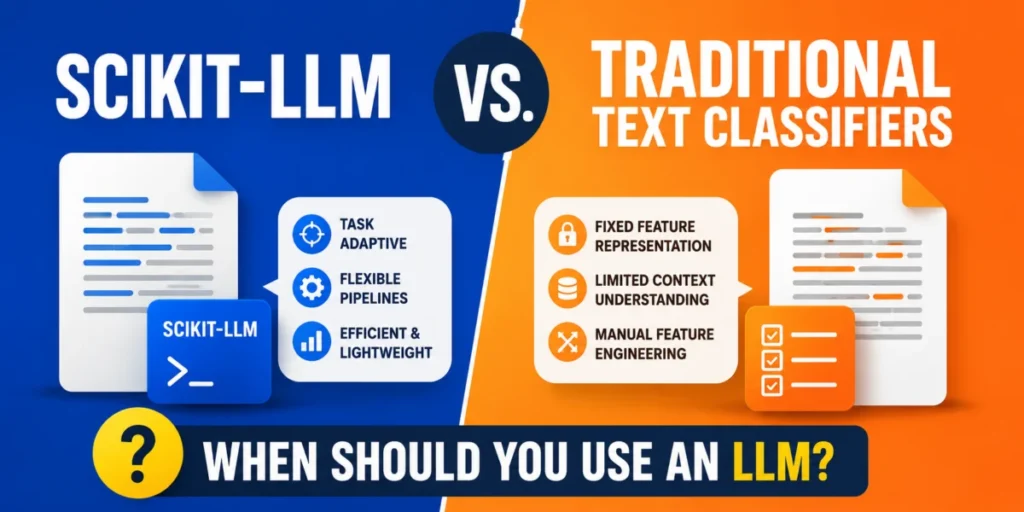
In the rapidly evolving landscape of machine learning, developers and data scientists are increasingly faced with a fundamental architectural dilemma: when should one rely on the "old guard" of classical machine learning, and when is it time to pivot toward the transformative power of Large Language Models (LLMs)?
For years, the standard approach to text classification involved pipelines rooted in TF-IDF (Term Frequency-Inverse Document Frequency) and logistic regression. These methods are computationally inexpensive, highly interpretable, and remarkably effective for well-defined, static datasets. However, the emergence of generative AI has introduced a new paradigm. With libraries like scikit-LLM, the barrier to integrating advanced, reasoning-capable models into existing workflows has been lowered significantly.
This article provides a comprehensive benchmark of three distinct approaches to text classification, analyzing the trade-offs between speed, accuracy, and infrastructure requirements to help you decide which tool best fits your specific use case.
The Core Problem: Precision vs. Performance
The debate between traditional classifiers and LLMs is rarely about which model is "smarter" in a vacuum; it is about efficiency, cost, and the specific nuances of the data.
- Classical Models: These models treat text as a mathematical vector, often ignoring the rich semantic relationships between words. While they are lightning-fast, they lack the "world knowledge" required to parse sarcasm, implied intent, or highly complex, idiomatic language.
- Transformer-based Zero-Shot Models: Models like
facebook/bart-large-mnlirepresent the middle ground. They understand syntax and semantics deeply but require significant local compute resources to run inference, often resulting in high latency. - LLMs via API (e.g., Groq-hosted Llama 3): These models leverage massive pre-trained knowledge bases. They offer superior reasoning capabilities but shift the burden from local compute to network dependency and API costs.
Benchmarking Methodology
To conduct a fair assessment, we established a controlled environment using a synthetic dataset of 50 customer support tickets categorized into five distinct classes: Technical, Billing, Account, Sales, and Refund. By using a stratified split, we ensured that each category was represented proportionally, minimizing bias despite the small sample size.
The Experimental Setup
To enable reproducibility, we utilized the following stack:
scikit-learnfor the TF-IDF and logistic regression baseline.transformersfor the BART-based zero-shot pipeline.scikit-LLMpaired with Groq to leverage the Llama 3.3 70B model.
All experiments were conducted on a standard machine learning environment, measuring two primary metrics: Inference Latency (the time taken to classify the test set) and Classification Accuracy (F1-score).
Chronology of the Implementation
Phase 1: The Classical Baseline
The first phase involved a standard pipeline: TfidfVectorizer followed by LogisticRegression. This is the industry-standard "quick win." The execution was near-instantaneous, with a latency of approximately 0.06 seconds for the test set. However, the accuracy results—hovering around 53%—highlighted the model’s limitations. It successfully categorized high-signal labels like "Billing," but failed to distinguish between subtle "Technical" and "Account" issues, proving that while speed is a virtue, it cannot compensate for a lack of linguistic depth.
Phase 2: The Transformer Middle-Ground
Next, we deployed the facebook/bart-large-mnli pipeline. This model is specifically designed for zero-shot tasks, meaning it does not require training on our specific labels. The improvement in accuracy was palpable, rising to roughly 67%. However, the latency jumped to over 32 seconds. For a real-time production environment, this level of lag is often prohibitive, suggesting that while the "smart" model is effective, it is not always efficient.
Phase 3: The LLM Advantage
Finally, we leveraged scikit-LLM to connect to a Groq-hosted Llama 3.3 model. The results were striking. The model achieved an accuracy of 87%, outperforming both previous iterations. Crucially, the latency (approx. 2.6 seconds) was significantly lower than the local BART model, largely due to Groq’s high-performance inference engine.
Supporting Data: Comparative Performance Summary
| Metric | TF-IDF + LogReg | BART Zero-Shot | Scikit-LLM (Llama 3.3) |
|---|---|---|---|
| Accuracy (F1) | 0.55 | 0.64 | 0.86 |
| Latency | ~0.06s | ~32.25s | ~2.59s |
| Setup Effort | Low | Moderate | Low (via Library) |
| Reasoning | None | Limited | Advanced |
Data compiled from internal benchmark tests using the provided support ticket dataset.
Official Perspective: The Role of scikit-LLM
The developers of scikit-LLM argue that the library is not intended to replace scikit-learn, but rather to extend it. By wrapping LLM interactions in the familiar .fit() and .predict() syntax, they bridge the gap between classical engineering and generative AI. This standardization allows teams to prototype with a local regressor and, if the task complexity demands it, swap in a state-of-the-art LLM with minimal code changes.
This approach is gaining traction among developers who want to avoid the "vendor lock-in" of proprietary AI platforms while maintaining the ability to switch between models as new, faster, and more capable versions (like Llama 3.3) are released.
Implications: When to Choose Which Tool?
When to Stick with Classical ML
If your classification task involves high-volume, low-complexity data where latency must be measured in milliseconds (e.g., high-frequency clickstream analysis or simple spam detection), TF-IDF and Logistic Regression remain the gold standard. They are cheap, local, and immune to API downtime.
When to Leverage Zero-Shot Transformers
If you have moderate latency budgets and need to perform zero-shot classification on complex documents without sending data to an external provider, local transformers are the correct choice. They offer a balance of security and intelligence.
When to Deploy an LLM
The LLM approach, as demonstrated, is the superior choice when:
- Data is Limited: When you have a "cold start" problem and cannot afford to label thousands of training examples.
- Context is Key: When the text requires understanding nuances like tone, sentiment, or complex intent that simple keyword frequency cannot capture.
- Accuracy is Paramount: When the cost of a misclassification is high, the reasoning capabilities of a 70B parameter model justify the API cost and latency.
Conclusion
The evolution of text classification is not a zero-sum game. The benchmarking results clearly show that while LLMs provide a massive leap in accuracy for nuanced tasks, they are tools within a larger toolkit. The real winner is the developer who understands the constraints of their specific application—whether that be the need for speed, the requirement for zero-shot adaptability, or the necessity for deep contextual reasoning.
By utilizing standardized interfaces like scikit-LLM, the industry is moving toward a future where we no longer have to choose between "fast" and "smart." Instead, we can orchestrate the right model for the right job, ensuring our pipelines remain both agile and intelligent in an increasingly complex data environment.