Communal Tensions Rise in North Bengal: Poster Campaign Ignites Debate Over Religious Identity and Commerce
By Staff Correspondent
October 12, 2026
As the vibrant, rhythmic beats of the dhak begin to resonate across the state, signaling the imminent arrival of Durga Puja, a shadow of discord has been cast over the festivities in North Bengal. A controversial poster campaign, spearheaded by the Hindu Jagaran Manch—an affiliate of the Rashtriya Swayamsevak Sangh (RSS)—has sparked a fierce debate regarding the intersection of religious identity, local commerce, and the secular fabric of West Bengal’s social traditions.

The Spark: A Campaign for "Religious Economic Solidarity"
In the days leading up to the state’s largest festival, posters appeared prominently across the city, urging residents to prioritize purchasing food, specifically biryani, and essential puja articles exclusively from shops owned by Hindus. The messaging, which explicitly frames commerce through a religious lens, has drawn sharp reactions from political figures, civil society, and residents who argue that such rhetoric threatens the inclusive spirit of the region.
The Hindu Jagaran Manch (HJM), which organized the campaign, has defended the posters as a proactive measure to bolster the Hindu economy. Abhishek Das, a key member of the organization, clarified that the posters were not intended as a "diktat" but rather as a heartfelt appeal to the community.

"This is not a command; it is an appeal to our community to support businesses run by Hindus," Das stated. "If people choose to support businesses run by their own, it will positively impact the local economy and ensure that our own artisans and shopkeepers thrive during the festive season."
Chronology of the Controversy
The posters began appearing in high-traffic areas earlier this week, coinciding with the final preparations for Durga Puja. The timing of the campaign, which arrives just as the city is decorated with lights and the air is filled with the scent of incense and new clothes, has amplified its impact.

- Early October 2026: Small-scale posters begin appearing in various pockets of the city, initially unnoticed by the general public.
- October 9–10, 2026: As the density of the posters increases, they attract the attention of local residents and political activists. Social media discussions begin to mirror the discomfort felt on the ground.
- October 11, 2026: The controversy enters the public domain as political leaders condemn the move. The Hindu Jagaran Manch issues a public statement clarifying its intent, leading to a heated exchange of views between political parties and local citizens.
- Present: Tensions remain palpable as community leaders and law enforcement monitor the situation to ensure that the festive atmosphere is not disrupted by communal friction.
The Economic and Cultural Paradox
The controversy has highlighted a deep-seated irony that many residents are quick to point out: the interdependence of communities during Durga Puja. While the campaign advocates for a separation of commerce based on religious lines, the reality of the festival’s supply chain is deeply pluralistic.
In West Bengal, the production of puja materials—from the clay used to craft the idols to the intricate shola (pith) decorations—is often a collaborative endeavor involving artisans from diverse religious backgrounds. Many of the master craftsmen and decorators in the state are Muslims, a fact that has led critics to label the HJM’s campaign as not only divisive but also economically impractical and historically insensitive.

"Bengalis have traditionally enjoyed biryani and other delicacies without ever inquiring about the religious identity of the chef," remarked a local resident. "The essence of Durga Puja lies in its ability to bring people together, regardless of their faith. To suggest that we should segment our economy based on religion is an insult to the syncretic culture of Bengal."
Political Reactions: A Divided Landscape
The campaign has become a lightning rod for political posturing, with the opposition and the ruling party trading barbs over the incident.

The Left Front’s Stance
Senior CPI(M) leader and former minister Asok Bhattacharya was among the first to demand swift police action. "Putting up such posters is a crime in a secular, democratic nation," he asserted. "The administration should not only remove these inflammatory posters but also initiate legal action against those responsible for this communal campaign. We cannot allow the secular ethos of our state to be dismantled by such polarizing tactics."
The BJP’s Perspective
The Bharatiya Janata Party (BJP), often aligned with the ideology of organizations like the HJM, has distanced itself from the specific campaign. A local BJP spokesperson stated that the Hindu Jagaran Manch is an independent entity and that the ruling party at the state level has no direct involvement in the specific distribution or design of these posters. However, critics argue that such distancing is a strategic move to avoid direct accountability for the fallout.

The Constitutional and Ethical Implications
At the heart of the debate is the constitutional guarantee of equal rights for all citizens. Legal experts and constitutional scholars have weighed in, noting that while businesses are free to market themselves, organized campaigns that pressure consumers to discriminate based on religion can infringe upon the principles of a secular state.
"The Constitution of India protects the right of every individual to practice their trade and commerce without fear of discrimination," noted a local legal expert. "When a campaign specifically targets shops based on the owner’s religion, it creates a hostile environment that is fundamentally at odds with the spirit of the Constitution."

Furthermore, there is the question of the impact on the local economy. In a post-pandemic economic climate, where small businesses are struggling to regain their footing, the injection of communal politics into the marketplace could have long-term consequences. Economists suggest that such campaigns, if successful, lead to the "ghettoization" of local markets, which eventually stifles competition and innovation, ultimately harming the consumer.
A Legacy of Inclusion Under Threat
The controversy also invites a reflection on the history of Durga Puja. As evidenced by the traditions in places like Krishnanagar, where the festival has been celebrated since 1606, the event has historically served as a social equalizer. It is a time when the distinction between the "divine" and the "human" blurs, and the contributions of various communities—whether they are the potters of Kumartuli, the weavers of shola, or the cooks in the local stalls—are all recognized as essential to the grand narrative of the festival.

By targeting the livelihoods of individuals based on their faith, the HJM’s campaign risks eroding this delicate social contract. The resistance shown by local residents suggests that while political rhetoric can be loud, the underlying social fabric of Bengal remains resilient and committed to its history of pluralism.
Looking Ahead: The Path to Harmony
As the days progress toward the main festivities, the eyes of the city are on the local administration. The demand for the removal of the posters remains high, and there is a growing consensus that such campaigns must be checked to ensure that the festive spirit is not compromised.

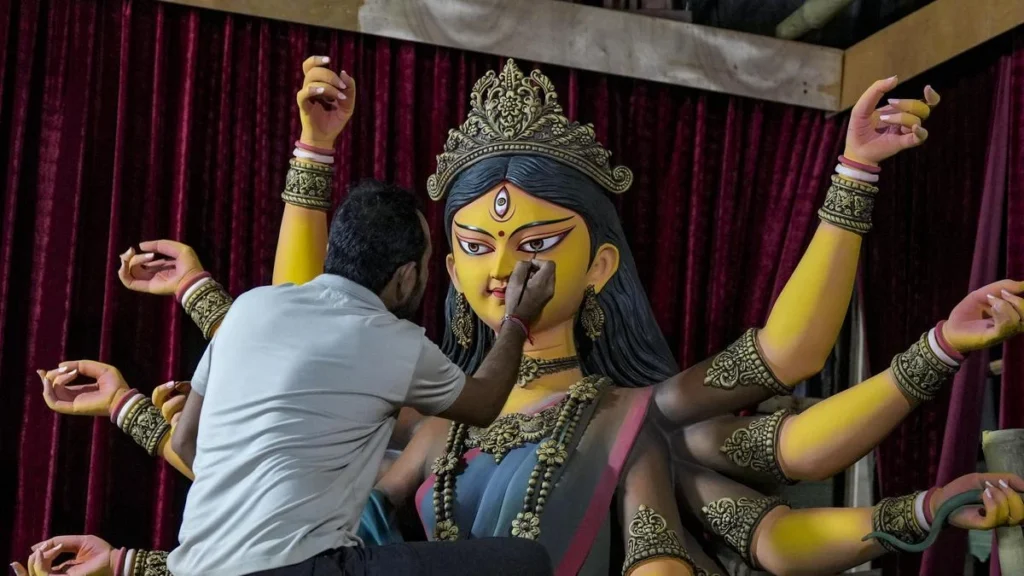
The incident serves as a sobering reminder of the fragile nature of secularism in the face of rising identity politics. As the idols of Goddess Durga are being painted with final, delicate strokes, the city waits to see whether it will celebrate the festival in its traditional, inclusive spirit or succumb to the pressures of an increasingly polarized landscape.
The hope remains that the unity of the citizens—who have long prioritized culture over communal lines—will prevail, and that the coming days will be marked by the collective joy of a festival that has always belonged to everyone.