Congress Launches Nationwide "Vote Bachao, Desh Bachao" Movement Amidst Allegations of Electoral Malpractice
NEW DELHI – In a significant escalation of political tensions, the Indian National Congress has formally declared a nationwide, multi-phase agitation aimed at the Election Commission of India (ECI) and Chief Election Commissioner (CEC) Gyanesh Kumar. Alleging systemic "vote theft" and the deliberate exclusion of millions of citizens from the electoral rolls, the party has galvanized its ranks under the rallying cry: “Vote bachao, desh bachao” (Save your vote, save the country).
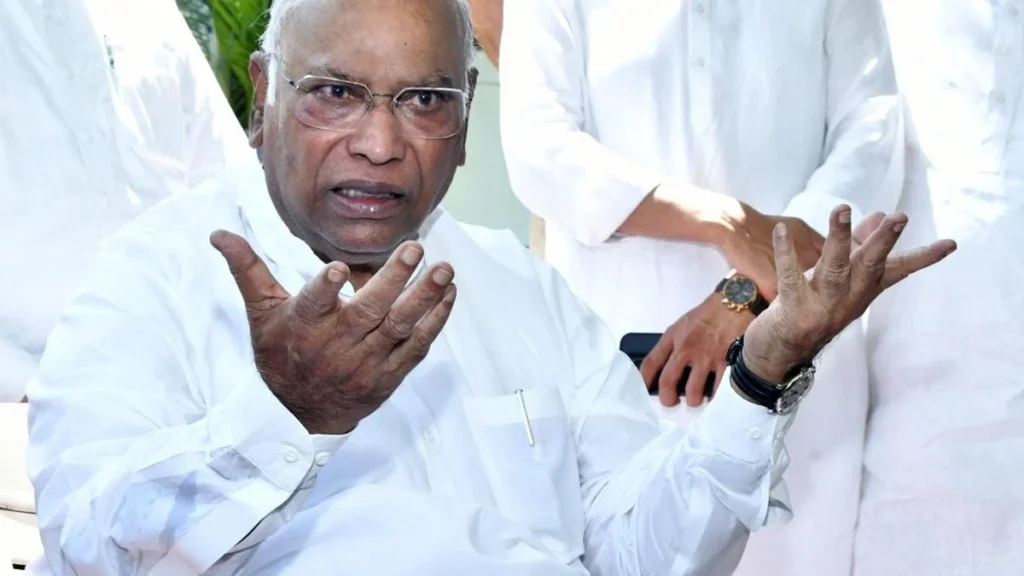
The announcement follows a high-level strategy meeting held at Indira Bhawan on Monday, October 5, 2026. Chaired by Congress President Mallikarjun Kharge and attended by Leader of the Opposition in the Lok Sabha, Rahul Gandhi, the meeting brought together the party’s general secretaries, state in-charges, and heads of various Pradesh Congress Committees to finalize a roadmap for what the leadership describes as a "fight to the finish."
The Genesis of the Crisis: Allegations of Electoral Roll Manipulation
The Congress party’s grievance stems from the recent "Special Intensive Revision" (SIR) of electoral rolls. According to senior party officials, the current process has been weaponized to systematically disenfranchise over 13.3 crore citizens across the country. The party alleges that these names were removed without due process, notice, or verification, effectively shrinking the electorate in regions perceived as opposition strongholds.
During the brainstorming session, party leaders framed this not merely as a technical failure of the Election Commission, but as a calculated "modus operandi" orchestrated by the ruling dispensation. Mr. Kharge, while addressing the party’s top brass, emphasized that the removal of these voters is a direct assault on the democratic fabric of the nation. He urged the party to demand the immediate resignation of CEC Gyanesh Kumar, while simultaneously warning that the ruling Bharatiya Janata Party (BJP) would likely deploy "distractions" and "narrative warfare" to shift public attention away from the alleged electoral fraud.
Rahul Gandhi echoed these sentiments, stressing that the issue of "vote chori" (vote theft) is fundamentally a people’s movement. He directed party workers to ensure that the campaign is grassroots-driven, transforming the abstract concept of "electoral integrity" into a tangible, localized cause that resonates with the common citizen.

Chronology of the Planned Agitation
The Congress has structured its protest in a phased approach, spanning from the block level to the national capital, culminating in a historic demonstration on Constitution Day.
Phase 1: Grassroots Mobilization (October 10 – October 20)
The campaign will commence with block-level marches and demonstrations outside the offices of Sub-Divisional Magistrates (SDM). These marches will serve as the first point of contact between the party and the affected voters.
Phase 2: Village Chaupals and Voter Guardians
Parallel to the marches, the party will organize Village Chaupals—traditional community gatherings—across rural India. At these meetings, party workers are tasked with explaining the alleged modus operandi of the voter list manipulation. Central to this phase is the appointment of "Vote Rakshaks" (Vote Guardians) at every polling booth. These agents are tasked with identifying every individual whose name was unfairly deleted and facilitating their re-enrollment, effectively acting as a bridge between the disenfranchised voter and the electoral machinery.
Phase 3: The National Push (November 1 – November 26)
- November 1: A mega INDIA bloc rally is scheduled at Delhi’s Ramlila Maidan. The Congress has extended an open invitation to non-bloc allies, including the Dravida Munnetra Kazhagam (DMK) and the Aam Aadmi Party (AAP), to stand in unified protest against the current state of the ECI.
- November 25: The "Delhi Chalo" rallies will commence simultaneously from various points in Rajasthan, Haryana, and Uttar Pradesh, bringing thousands of protesters toward the capital.
- November 26: The movement will culminate in a massive demonstration on Constitution Day, signaling the party’s intent to protect the fundamental right to vote as enshrined in the Indian Constitution.
Official Responses and Political Rhetoric
The rhetoric from the Congress leadership has been uncharacteristically sharp. K.C. Venugopal, the Congress General Secretary (Organization), did not mince words during the press briefing following the meeting. He explicitly labeled the Election Commission the "Cheating Commission of India."
"Gyanesh Kumar is not leaving his post, even as the entire country demands his accountability," Venugopal stated. "We are not going to allow him to sit on that chair. We will ensure he is removed."

The intensity of this language suggests a pivot in the Congress strategy: from traditional parliamentary protest to aggressive, street-level confrontation. When asked about the ultimate goals of the agitation, Venugopal emphasized that the party’s resolve is absolute. "Our fight is to the finish. We will keep fighting on the streets until Gyanesh is removed, arrested, and prosecuted for his role in undermining our electoral process," he added.
Jairam Ramesh, General Secretary in charge of Communications, emphasized the necessity of broad-based support. "The issue of voter integrity transcends party lines. By inviting other opposition parties to the November 1 rally, we are signaling that this is a collective struggle to preserve the sanctity of the ballot box," he noted.
Implications for Indian Democracy
The current standoff between the principal opposition and the Election Commission marks a dangerous nadir in the relationship between India’s constitutional bodies and political stakeholders.
Erosion of Institutional Trust
The Congress party’s decision to label the ECI a "Cheating Commission" carries profound implications for the credibility of future electoral exercises. If a major political force refuses to accept the neutrality of the election regulator, the legitimacy of the entire electoral process is called into question, potentially leading to widespread civil unrest and a decline in voter turnout.
The Challenge of Data and Verification
The Congress claim regarding 13.3 crore deleted voters is a massive figure that will require rigorous, independent verification. While the party claims to have the data to back this up, the ECI is expected to counter with its own statistics regarding routine electoral roll purges—typically conducted to remove duplicate, deceased, or shifted voters. The political battlefield is effectively being fought over the interpretation of administrative data.

Strategic Distractions
As highlighted by Mr. Kharge in the closed-door meeting, the ruling party is expected to counter-attack. Political analysts suggest that the BJP may leverage cultural or national security issues to drown out the "vote theft" narrative. By keeping the conversation focused on the mechanics of the vote rather than the ideology of the vote, the Congress is attempting to force a debate on the foundational principles of democracy—a move that carries high risk but also high reward if it successfully mobilizes the electorate.
Conclusion: A Turning Point?
As India approaches the final months of 2026, the political atmosphere is charged with a level of volatility not seen in recent years. The Congress party’s plan to transition from formal complaints to a national, multi-week agitation indicates that they view the electoral roll revision as an existential threat to their electoral prospects.
With the November 26 Constitution Day rally looming, the government is faced with a difficult choice: engage in a transparent dialogue with the Opposition to address the concerns regarding the electoral rolls, or adopt a hardline stance that could deepen the existing polarization. For the Election Commission, the challenge will be to restore its image as an impartial arbiter in an environment where its very existence is being contested by the principal Opposition.
The coming weeks will determine whether the "Vote Bachao" movement remains a localized grievance or evolves into a defining national struggle for the future of Indian democracy.