Defending the Open Web: WordPress Joins Coalition Calling for Unrestricted Access to Open Weight AI Models
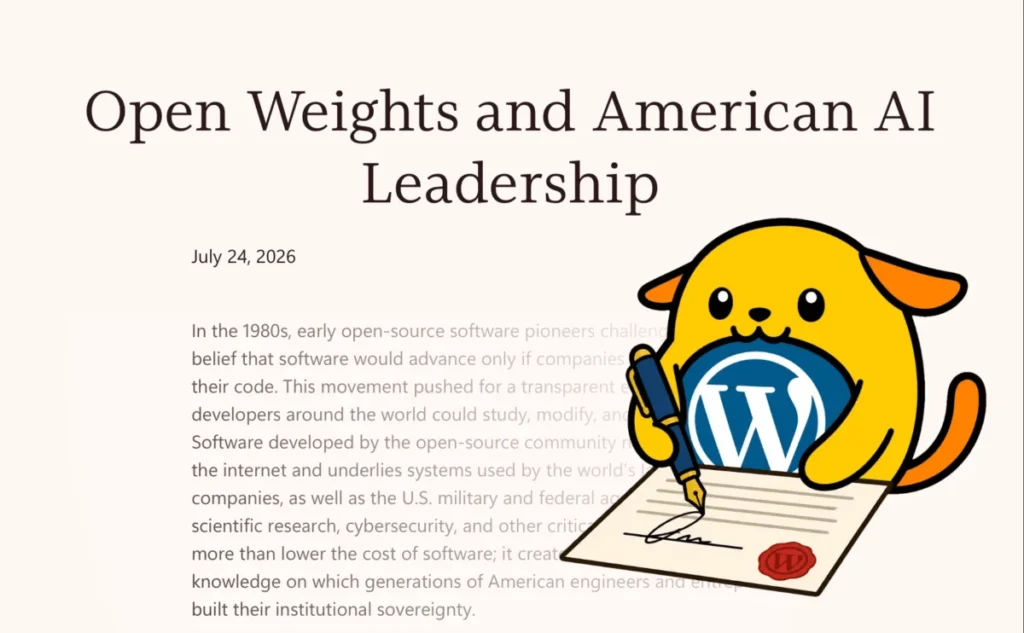
WASHINGTON — In a move that cements its decades-long commitment to democratization, transparency, and decentralization, WordPress has officially announced its signature on the Open Weights and American AI Leadership open letter. Published initially on July 24, 2026, the landmark letter brings together a formidable coalition of more than 270 technology companies, research institutions, and organizations. The collective is urging U.S. policymakers to refrain from placing early, restrictive regulations on open weight artificial intelligence models—technologies that can be downloaded, inspected, modified, and executed on localized infrastructure by anyone.
By adding its weight to the coalition, WordPress is drawing a direct line of continuity between the foundational philosophies of the open-source software movement and the current, rapidly evolving landscape of artificial intelligence. As AI systems become deeply embedded within the publishing and creative tools used by millions worldwide, the debate over who controls these models—and who is permitted to modify them—has transformed into one of the most critical technology policy battles of the decade.
Main Facts
The core debate surrounding the Open Weights and American AI Leadership letter centers on the distinction between "closed" or proprietary AI models and "open weight" models. Proprietary models, typically controlled by a handful of massive technology conglomerates, operate behind closed APIs. Users interact with them, but the underlying weights, architectures, and training data remain inaccessible, leaving developers entirely dependent on the operational terms, pricing, and safety guardrails dictated by the model’s creator.
In stark contrast, open weight models provide developers, researchers, and hobbyists with the actual parameters and weights derived from the training process. This level of access transforms AI from a remote, centralized service into a modular software component. Anyone with adequate computing infrastructure can download the model, fine-tune it for a specific niche, audit it for security vulnerabilities, or run it locally without sending sensitive user data to third-party servers.
The July 24 letter directly petitions U.S. lawmakers to approach AI regulation with an eye toward preserving this freedom. Specifically, the signatories are asking policymakers to:
- Expand Access to Computing Power: Lower barriers to entry by ensuring that startups, academic researchers, and independent developers can access high-performance computing resources necessary to train and adapt AI models.
- Invest in Public Resources: Allocate government support toward shared digital infrastructure, including public datasets and standardized evaluation tools, leveling the playing field against monopolistic market players.
- Protect Model Diversity: Prevent regulatory capture that would narrow the market down to a handful of proprietary systems, ensuring that open weight models remain a viable alternative.
- Clarify Legal Boundaries on Development: Ensure that standard software development practices—such as utilizing the outputs of one model to train or refine another—are not automatically classified as copyright infringement or theft.
For WordPress, a platform that currently powers over forty percent of the top ten million websites on the internet, supporting this initiative is not merely a political statement; it is an ideological continuation of its core mission.
Chronology of the Open Weight Advocacy Movement
The road to the July 24, 2026 open letter was paved by years of mounting tension between centralized tech giants advocating for strict, precautionary gatekeeping and open-source advocates warning against corporate monopolies.
Late 2022 – 2023: The Generative AI Boom and the Compliance Dilemma
Following the public explosion of generative artificial intelligence, global policymakers rushed to understand the technology. Early legislative frameworks—most notably the European Union Artificial Intelligence Act and preliminary bipartisan discussions in the U.S. Congress—tended to treat foundational AI models as monolithic entities. Early drafts of policy proposals often suggested heavy compliance burdens, mandatory registration, and strict liability frameworks that disproportionately favored well-capitalized corporations capable of absorbing massive legal and operational overheads.
Throughout 2024 – 2025: The Grassroots Pushback
As regulatory pressure mounted, open-source advocates, academics, and smaller AI startups began organizing. They argued that regulating open weight models the same way one regulates closed, commercial API services would effectively legislate open-source AI out of existence. Technical papers from prominent institutions demonstrated that open models were critical for security auditing, enabling researchers to discover hidden biases, vulnerabilities, and failure modes that closed systems obscured.
July 24, 2026: The Coalition Goes Public
The release of the Open Weights and American AI Leadership letter marked a turning point. Gathering momentum swiftly across the technology sector, the letter united more than 270 diverse organizations. By bridging the gap between traditional open-source software foundations (like WordPress) and cutting-edge machine learning labs, the coalition presented a unified front to U.S. policymakers: technological innovation and public safety are best served by openness, not restriction.
Supporting Data: Why Open Source Prevails
To understand why WordPress and hundreds of other entities are fiercely defending open weights, one must look at the historical data of open-source software development over the past three decades.
The Security-through-Transparency Paradigm
Critics of open weight models often raise safety concerns, arguing that bad actors could misuse freely downloadable models to generate malware, misinformation, or biological threats. However, empirical data from cybersecurity and software engineering overwhelmingly supports the "Linus’s Law" principle—named after Linux creator Linus Torvalds—which states that "given enough eyeballs, all bugs are shallow."
- Vulnerability Remediation: Studies tracking open-source software repositories consistently show that vulnerabilities in transparent codebases are identified and patched faster than those in proprietary software, where security relies entirely on "security through obscurity."
- Customization and Trust: In an enterprise environment, organizations are hesitant to hand over proprietary data, intellectual property, and user communications to black-box APIs. Open weight models allow companies to deploy AI locally, ensuring strict compliance with data privacy regulations such as GDPR and CCPA.
- Economic Impact: Research from organizations like the Open Source Initiative (OSI) indicates that open-source software underpins trillions of dollars in global economic activity. Extending these principles to AI ensures that the next wave of economic growth is distributed among millions of entrepreneurs rather than concentrated within a handful of monopolistic firms.
Official Responses and Leadership Perspectives
The announcement of WordPress joining the coalition has drawn widespread attention from technology leaders and open-web advocates. Mary Hubbard, Executive Director of WordPress, released a definitive statement capturing the philosophical alignment between content management systems and artificial intelligence:
"The next generation of innovation won’t come from models alone. It will come from millions of people building with them. Open weights help make that possible. WordPress is proud to support the Open Weights and American AI Leadership letter."
Hubbard’s perspective underscores a fundamental truth about modern digital creation: technology is rarely adopted in a vacuum. Just as personal publishing tools liberated media creation from the hands of traditional print and proprietary software monoliths in the early 2000s, open-weight AI is poised to democratize automation, translation, design, and code generation.
Industry analysts have similarly praised the move. Dr. Aris Thorne, a senior policy researcher focusing on decentralized technologies, noted:
"When a titan of the open web like WordPress steps forward to lobby for open AI weights, it changes the conversation in Washington. It shifts the narrative away from a false dichotomy between ‘safety’ and ‘openness,’ and toward a pragmatic discussion about how distributed innovation inherently creates a safer, more resilient digital ecosystem."
Implications for the Future of the Open Web and Publishing
The implications of the U.S. policy decisions influenced by this letter will echo across the technology landscape for decades. For WordPress users—ranging from independent bloggers and small business owners to global media enterprises—the availability of open weight AI models directly impacts how content is created, edited, and distributed.
1. Preserving Creator Agency
As AI integration becomes a standard expectation in content management systems, reliance on proprietary, subscription-based AI services introduces recurring costs and external dependencies. Open weight models enable platform developers to build native, highly optimized AI features directly into software ecosystems without being held hostage to sudden API price hikes or policy changes dictated by third-party gatekeepers.
2. Democratizing the Next Generation of Builders
For over twenty years, WordPress has operated on a simple premise: the people using a technology should be free to shape it, fork it, and adapt it to their unique circumstances. By ensuring that open-weight AI models remain accessible, policymakers can guarantee that the next generation of digital creators—students, developers, and entrepreneurs currently learning the ropes of web development—will have the same unhindered starting point that open-source software provided to the builders of the web today.
3. Mitigating Centralization and Corporate Capture
Without legal and regulatory protections for open weights, the artificial intelligence landscape risks calcifying into an oligopoly. A market dominated by three or four closed-model providers would stifle competition, concentrate economic power, and limit cultural and linguistic diversity in AI training data. By championing open weights, WordPress and its fellow signatories are laying the groundwork for a pluralistic, resilient technological future—one where innovation belongs to everyone, not just the highest bidder.