Democratizing AI: Mastering Local Text Classification with Scikit-LLM and Ollama
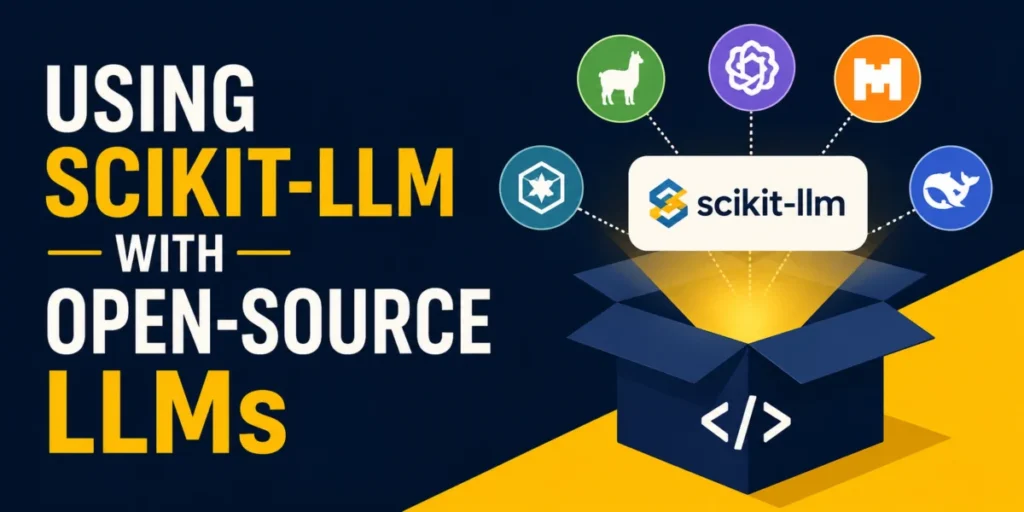
In the rapidly evolving landscape of artificial intelligence, the barrier to entry for developers has traditionally been defined by the exorbitant cost of API calls and the requirement for massive, cloud-based GPU clusters. However, a new paradigm is shifting the power dynamic back to the local developer. By combining the accessibility of Ollama with the structural elegance of the Scikit-LLM Python library, engineers can now perform sophisticated natural language processing (NLP) tasks—specifically text classification—entirely on their own hardware, free of charge and free of external oversight.
This article explores the technical integration of open-source Large Language Models (LLMs) into standard machine learning workflows, providing a blueprint for running high-performance AI tasks locally.
Main Facts: The Intersection of Scikit-learn and LLMs
The core premise of this integration is the bridging of two worlds: the standardized, object-oriented workflow of scikit-learn and the generative, reasoning capabilities of modern LLMs like Llama 3, Mistral, and Gemma.
Typically, to perform zero-shot text classification, a developer might rely on proprietary APIs from major tech corporations. While these services are powerful, they impose costs per token and require data to be sent to external servers, which can be a non-starter for organizations handling sensitive or proprietary information.
The solution lies in Ollama, an open-source framework designed to run LLMs locally, and Scikit-LLM, a library that extends the scikit-learn API to include LLM-based estimators. By configuring Scikit-LLM to point to a local Ollama instance, developers can utilize the same "fit/predict" methodology they have used for years with traditional models like Random Forests or Support Vector Machines, but now powered by the reasoning depth of transformers.
Chronology: Implementing the Local AI Pipeline
Implementing this architecture requires a systematic approach. The process can be broken down into four distinct phases.
Phase 1: Environment Orchestration
The first step is establishing the local infrastructure. After installing Ollama, the user must pull their chosen model via the terminal. By executing commands such as ollama run llama3, the model is cached locally and a server is initiated, listening for requests. This server acts as a local API endpoint, typically residing at http://localhost:11434.
Phase 2: Dependency Management
In the Python environment, the integration relies on a specific set of libraries. Users must ensure that scikit-learn, pandas, and scikit-llm are installed. It is vital to maintain compatibility between these packages to avoid runtime errors. A clean environment using venv or conda is highly recommended to isolate these dependencies from other system-wide libraries.
Phase 3: Configuration and Routing
The bridge between Scikit-LLM and the local Ollama instance is established via the SKLLMConfig class. By setting the gpt_url to the local Ollama endpoint and providing a placeholder API key (which is required by the library’s internal validation but effectively bypassed by the local setup), the user forces the library to bypass the cloud and communicate directly with the local machine’s memory and GPU.
Phase 4: Execution
The final phase involves defining the dataset, instantiating the ZeroShotGPTClassifier, and executing the model. Unlike traditional models that require extensive training data, the ZeroShotGPTClassifier leverages the pre-trained knowledge inherent in the LLM, allowing for immediate classification based solely on the prompt labels provided in the code.
Supporting Data: Why Local Hosting Matters
The move toward local LLM inference is supported by several compelling data points and operational benefits:
- Latency and Throughput: By keeping the inference loop within the local network, developers eliminate the network latency associated with sending data to data centers in distant regions.
- Zero Marginal Cost: Every classification performed is free. For businesses processing millions of rows of feedback or customer support tickets, the cost savings compared to API-based models are exponential.
- Data Sovereignty: By keeping sensitive datasets on-premise, organizations remain in full compliance with strict data governance frameworks like GDPR, CCPA, and HIPAA, which often restrict the movement of data to third-party cloud providers.
- Hardware Efficiency: Modern consumer-grade hardware, particularly machines equipped with Apple Silicon or NVIDIA RTX series GPUs, are increasingly optimized for transformer inference. The ability to load models like Mistral 7B into unified memory allows for high-throughput classification without the need for enterprise-grade infrastructure.
Official Perspectives: The Community and the Industry
The developer community has largely embraced this movement. Open-source maintainers argue that the reliance on proprietary LLM APIs has created a "dependency trap," where developers are forced to optimize their code for a specific vendor’s platform.
By contrast, the Scikit-LLM and Ollama ecosystem represents a movement toward "interoperable AI." When asked about the shift, contributors to these libraries often point to the modularity of the design. Because Scikit-LLM follows the scikit-learn paradigm, switching from a local Llama 3 model to a different architecture is as simple as changing a single configuration string, rather than rewriting a complex network-calling module.
Furthermore, the industry is seeing a surge in demand for "Small Language Models" (SLMs) that can perform domain-specific tasks with high accuracy, often outperforming massive, general-purpose models in specific classification benchmarks because they are tuned for the task at hand.
Implications: The Future of Enterprise AI
The implications of this local-first approach are profound for several sectors:
Transforming Customer Support
Organizations can now build sophisticated sentiment analysis and classification engines that run on their own internal servers. By routing customer support tickets to local models, companies can categorize and prioritize urgent issues in real-time without the overhead of cloud latency.
Enhancing Research and Development
Researchers in fields like bioinformatics or legal analysis, where privacy is paramount, can now use LLMs to classify large corpuses of documents. This allows for rapid prototyping of NLP workflows without the risks associated with cloud-hosted data leaks.
The Democratization of AI Skillsets
Perhaps the most significant implication is the lowering of the barrier for software engineers. By keeping the interface within the scikit-learn framework, developers who are already familiar with standard data science practices can now pivot into AI-driven development without having to learn complex deep learning frameworks like PyTorch or TensorFlow.
Looking Forward: Challenges to Overcome
Despite the benefits, challenges remain. The primary constraint is hardware; users must have sufficient RAM and VRAM to keep these models in memory. Additionally, while the zero-shot performance of Llama 3 is impressive, it may not always match the specialized fine-tuned performance of a custom-trained model.
However, as model quantization techniques (like GGUF) improve, the footprint of these models continues to shrink, making them more accessible to lower-end hardware. We are entering an era where the "intelligence" of a system is no longer confined to a remote server, but is a portable, reusable, and free utility that lives right on the developer’s laptop.
In conclusion, the integration of Scikit-LLM and Ollama is more than just a convenient trick; it is a fundamental shift in how we build, deploy, and maintain AI applications. By leveraging the power of local compute, we are building a more resilient, cost-effective, and private future for the next generation of intelligent software.