Demystifying Intelligence: How to Build a Custom AI Agent from Scratch in Python
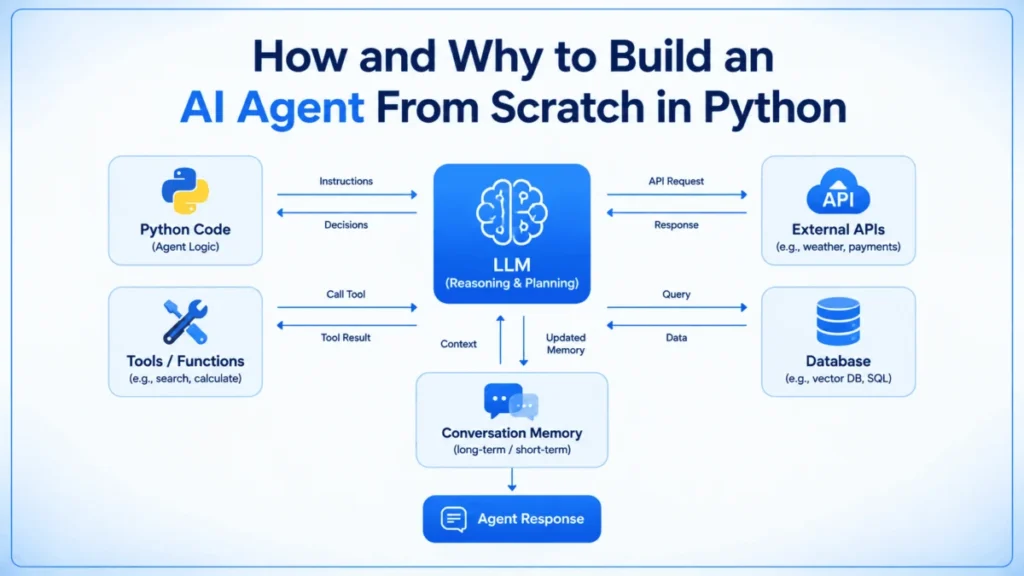
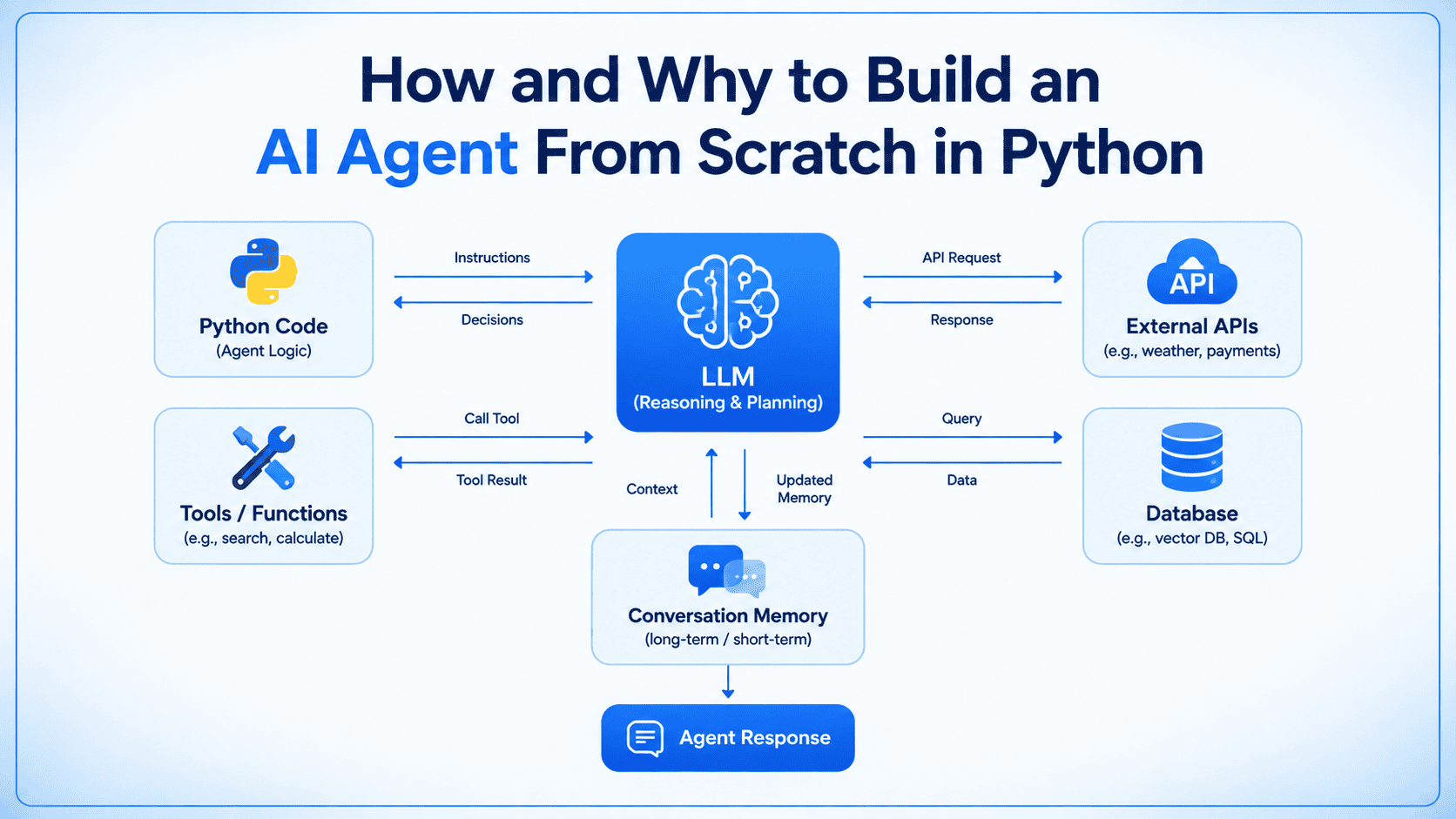
In the rapidly evolving landscape of artificial intelligence, the term "AI Agent" has become a buzzword that often obscures more than it reveals. At its core, an AI agent is simply a Large Language Model (LLM) equipped with the agency to interact with the world beyond its training data. While popular frameworks like LangChain or AutoGPT offer powerful abstractions for developers, they often hide the mechanical "nuts and bolts" that drive these systems.
To truly understand how AI agents function, one must look past the heavy libraries and return to the foundation: plain Python and direct API calls. By building an agent from scratch, developers can strip away the layers of complexity, exposing the fundamental loop that allows an LLM to reason, execute code, and retrieve real-time data.
The Evolution of the "Agentic" Workflow
The Limits of Static Models
A standard call to an LLM is a request-response transaction. You provide a prompt—such as a request to draft an email or summarize a document—and the model uses its internal knowledge base to generate a response. This works perfectly for static tasks. However, the paradigm breaks down the moment a task requires external data.
If a user asks, "What is the current status of order #4471?" the model faces an impasse. Because the status of an order exists in a live database rather than the model’s static training weights, the LLM will either hallucinate a plausible-sounding answer or admit its ignorance. This is the "agentic gap."
Bridging the Gap: Tool Calling
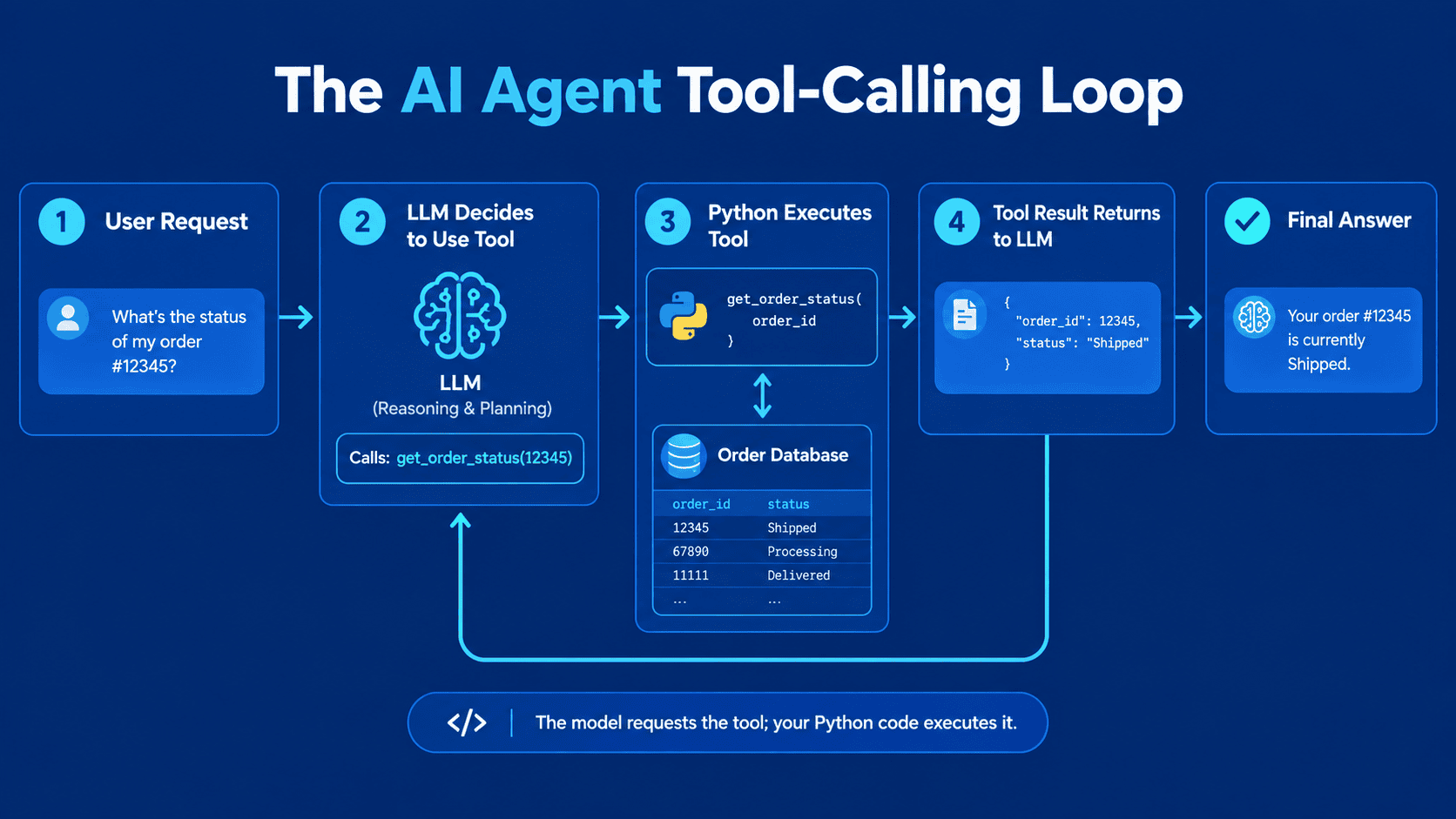
An AI agent closes this gap through Tool Calling. By providing the model with a defined schema for an external function, we grant it the ability to pause its generation, request data from a specific tool (such as a database query or an API call), and incorporate that output into its final answer. This is not magic; it is a controlled feedback loop between the model and the application code.
Core Architecture: Building the Logic
To build an agent, we require three essential components:
- The Model Interface: A wrapper around the Anthropic API that sends and receives messages.
- The Tool Schema: A structured description of functions (e.g.,
get_order_status) that tells the model what capabilities are available. - The Execution Loop: A mechanism that orchestrates the "conversation" between the model’s intent and the system’s execution capabilities.
Setting Up the Environment
To begin, you will need Python 3.10 or later and the Anthropic SDK. Security is paramount when handling API keys; rather than hardcoding credentials, always use environment variables.
export ANTHROPIC_API_KEY="your-key-here"Note: As of late 2026, model deprecation cycles are frequent. Ensure you are using the most current model identifier provided by your API documentation.
Defining the Tool
The schema is the "language" through which the model understands your functions. It must include the function name, a clear natural-language description, and a JSON-schema definition of the required inputs.
get_order_status_schema =
    "name": "get_order_status",
    "description": "Looks up the current status of a customer order by its ID.",
    "input_schema":
        "type": "object",
        "properties":
            "order_id": "type": "string", "description": "The order ID to look up"
        ,
        "required": ["order_id"]
The Mechanics of the Execution Loop
The magic happens in the "round trip." When the model identifies that it needs information, it does not provide an answer; instead, it returns a tool_use signal. The Python script intercepts this signal, executes the local function, and feeds the result back into the message history as a tool_result.
Handling Multiple Steps
In complex scenarios, an agent may need to call multiple tools sequentially. A robust agent loop handles this by:
- Sending the user’s prompt to the model.
- Checking the
stop_reasonof the response. - If the reason is
tool_use, iterating through the tool blocks, executing the corresponding Python functions, and appending the output. - Repeating until the model reaches a final text answer.
This loop must be protected by a max_iterations counter. Without it, a model caught in a logic loop could consume your API budget indefinitely.
The Importance of Memory
A stateless model is a forgetful one. To create a conversational experience, the agent must retain the history of the interaction. By encapsulating the messages list within an Agent class, we ensure that every subsequent turn includes the context of previous tool outputs.
This allows for nuanced interactions:
- User: "What is the status of order #4471?"
- Agent: (Executes tool, gets "Shipped") "Order #4471 has been shipped via UPS."
- User: "And when will it arrive?"
- Agent: (Looks at memory) "It is expected in 2 days."
Implications for Future Development
Building an agent from scratch reveals that "agentic AI" is not a proprietary black box, but a deliberate orchestration of software components. This approach has significant implications for enterprise development:
1. Transparency and Debugging
Frameworks can sometimes obscure why a model failed to execute a task. When you write the loop yourself, debugging becomes a simple matter of inspecting the messages list. You can see exactly what the model saw, why it chose a specific tool, and where the data integration failed.
2. Security and Control
By building the agent manually, you maintain granular control over which tools the model can access. You can implement validation checks on every input the model generates before passing it to your database or API, effectively creating a "human-in-the-loop" or "code-in-the-loop" security layer that is harder to enforce within heavy, opaque frameworks.
3. Scalability Concerns
While the "from scratch" approach is excellent for learning and building specialized, lightweight agents, it does not inherently solve long-term memory or scaling issues. In production, as conversations grow beyond the model’s context window, developers must implement summarization strategies or vector databases to retrieve relevant historical data without exceeding token limits.
Summary: The Path Forward
The journey from a basic LLM prompt to a fully autonomous agent is one of modularity. You start with a model, add a tool, create a loop, and finally, inject memory. Once you master this pattern, the complexity of the "agent" is effectively removed.
For developers looking to take the next steps, consider the following avenues:
- Context Management: Explore how to prune or summarize long conversation histories to keep your agent within the context window.
- Tool Complexity: Experiment with tools that perform web searches, write files, or interact with external SaaS platforms like Slack or GitHub.
- Evaluation: Implement unit tests for your tools to ensure the model receives the expected output format every time.
By stripping away the abstraction layers, you are not just learning how to use a tool; you are gaining the ability to architect the intelligence of the future. The code is yours, the logic is transparent, and the potential for expansion is limited only by the functions you decide to give your agent.