Escalating Dissent: Student Organizations Demand Rollback of Electoral Roll Revisions in Mumbai
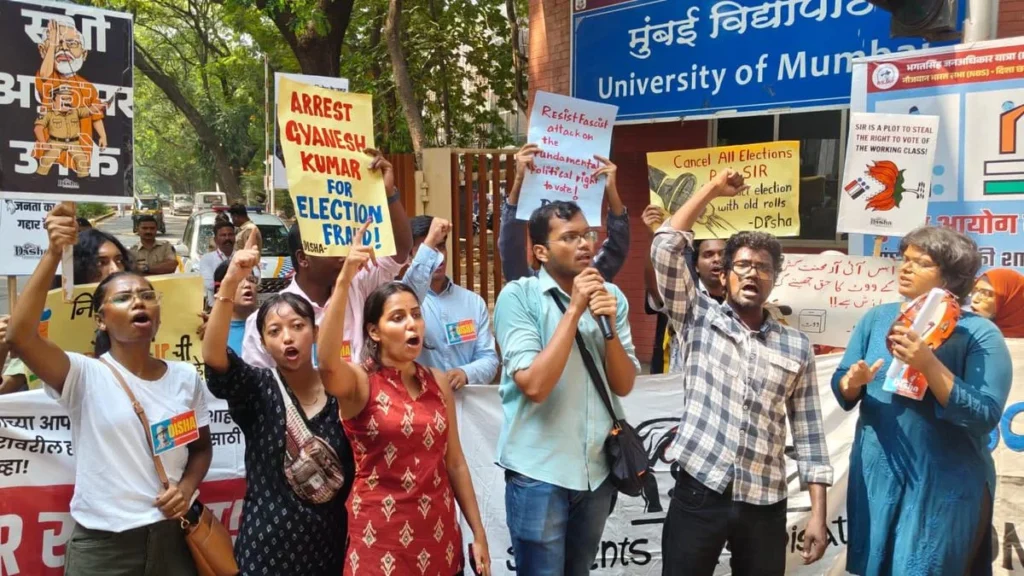
MUMBAI — The University of Mumbai’s Kalina campus became the epicenter of a burgeoning democratic movement on Friday, October 23, 2026, as students, activists, and working professionals converged to voice their vehement opposition to the Election Commission of India’s (ECI) Special Intensive Revision (SIR) of electoral rolls.
Organized by the Disha Students’ Organisation and the Bhagat Singh Jan Adhikar Yatra (BSJAY), the protest marked a significant escalation in the ongoing nationwide discourse regarding the integrity of the electoral process under the leadership of Chief Election Commissioner (CEC) Gyanesh Kumar. The demonstrators leveled serious allegations of systemic bias, demanding not only the immediate withdrawal of the SIR exercise but also the resignation and subsequent arrest of the CEC, alongside a call for the repeal of the 2023 legislation governing the appointment of Election Commissioners.
The Core Grievances: A Threat to Franchise?
At the heart of the protest lies the contentious Special Intensive Revision (SIR) exercise. Critics argue that the process—ostensibly designed to update voter rolls—functions as a bureaucratic hurdle that disproportionately disenfranchises the most vulnerable sections of society.
Dr. Pooja, coordinator of the BSJAY, painted a grim picture of the potential impact on India’s democratic fabric. Addressing the crowd, she asserted that the SIR threatens the voting rights of Muslims, Dalits, Adivasis, and the working class. "The Election Commission, which is mandated to be an independent guardian of our democracy, is increasingly being perceived as an extension of the ruling party’s agenda," Dr. Pooja stated. She further argued that the 2023 law regarding the appointment of Election Commissioners has fundamentally eroded the neutrality of the body, effectively shielding it from accountability.
The protesters specifically criticized the ECINET platform and the opaque nature of the revision process. Abhinash Kumar, a volunteer with the Disha Students’ Organisation, highlighted the practical difficulties faced by long-standing voters. "We are witnessing a scenario where citizens who have voted for decades are being treated as new applicants," he noted, referring to the cumbersome requirements of Form 6. "Why should an established voter be forced to undergo a fresh, exclusionary registration process? This is not an update; it is a purge."
A Chronology of Growing Discontent
The protest on October 23 is not an isolated incident but the latest chapter in a series of demonstrations that have rippled across India throughout 2026.
- Early 2026: Concerns regarding the SIR exercise began to surface in several states, with activists noting irregularities in local voter lists.
- May 27, 2026: The Supreme Court of India delivered a landmark ruling on the SIR exercise conducted in Bihar. While the court upheld the Election Commission’s authority to revise electoral rolls, it placed a crucial caveat: the ECI’s scrutiny is strictly limited to determining electoral eligibility and cannot serve as a mechanism for final citizenship determination. Despite this, critics argue that the ECI has overstepped these boundaries in practice.
- October 10, 2026: A major protest took place in the capital, signaling the start of a broader, more coordinated national campaign seeking the resignation of CEC Gyanesh Kumar.
- October 23, 2026: The Mumbai demonstration consolidated these efforts, bridging the gap between student movements and labor activism.
Documentation and The "Hidden" Hurdles
The technical critique of the SIR process centers on the shift in documentation requirements. Participants at the Mumbai protest argued that the ECI has introduced a labyrinthine set of proofs required for re-enrolment that are often inaccessible to the urban poor and those in informal employment.
"The documentation burden is a silent barrier," noted Sahil Parsekar, a former Mumbai University student and volunteer with the Cockroach Janta Party (CJP). "If you are a migrant worker or living in a transitory settlement, meeting these rigid criteria is nearly impossible. By requiring fresh registration for people already on the rolls, the EC is effectively outsourcing disenfranchisement to the paperwork."
The speakers at the rally consistently returned to the argument that the current methodology is designed to "cleanse" the rolls of demographic groups that may not favor the incumbent government, a charge that the ECI has yet to address with substantive transparency.

Official Stance and Legal Context
While the ECI maintains that the SIR is a routine administrative measure aimed at cleaning up electoral rolls—removing the deceased, those who have shifted residence, and preventing duplicate entries—the protesters argue that the administrative veneer hides a political objective.
The Supreme Court’s May 2026 ruling is frequently cited by the government to defend the legitimacy of the exercise. However, legal experts present at the protest pointed out that the court’s ruling did not grant the ECI a blank check. "The court was clear that citizenship verification is not the ECI’s job," stated one legal activist during the rally. "Yet, the operational reality on the ground feels like an NRC-lite exercise. That is the core of the constitutional violation."
The protest also targeted the 2023 legislation regarding the appointment of Election Commissioners. By changing the composition of the selection panel, critics argue the government has ensured that the ECI is no longer an impartial referee, but a participant in the political contest.
Implications for Indian Democracy
The implications of this movement are profound. If a significant segment of the electorate—particularly marginalized communities—begins to lose faith in the integrity of the voter list, the legitimacy of the entire electoral outcome is called into question.
Broadening the Scope of Protest
The demonstrators are consciously attempting to move the discourse beyond university campuses. Dhananjay Tawde, a member of the Disha Students’ Organisation, called for "indefinite sit-ins" across city centers and working-class neighborhoods. The movement is attempting to frame the SIR not as a technical issue for election wonks, but as a fundamental struggle for the right to participate in governance.
Solidarity as a Shield
One of the most notable features of the October 23 protest was the emphasis on solidarity. Addressing the alleged detention of activists during previous protests, Sahil Parsekar urged participants to treat the movement as a collective endeavor. "They can arrest individuals, but they cannot arrest the conversation," he said. He encouraged students to take the debate into their homes, workplaces, and even into conversations with political opponents, emphasizing that the issue of electoral integrity should transcend party lines.
The Cultural Dimension
The protest was marked by a distinct blend of political activism and cultural expression. Performances of political rap, group songs, and the invocation of revolutionary figures like Ashfaqulla Khan served to unify a diverse crowd. Rahul, from the Naujawan Bharat Sabha, reminded attendees that the current fight is a continuation of the spirit of India’s freedom struggle, emphasizing the need for unity against what he termed "divisive politics."
Conclusion: A Call for Transparency
As the sun set on the Kalina campus, the resolve of the protesters remained undiminished. The demands are clear:
- Immediate cessation of the current SIR exercise.
- An independent, transparent audit of the electoral rolls.
- The resignation of CEC Gyanesh Kumar to restore public trust in the ECI.
- A repeal of the 2023 Election Commission appointment law to return to a more inclusive and neutral selection process.
The protest highlights a growing chasm between the administrative logic of the Election Commission and the democratic aspirations of the youth. As the movement gains momentum in Mumbai and beyond, the Election Commission faces mounting pressure to address these grievances. Whether the authorities choose to engage in a dialogue or continue to rely on administrative force remains to be seen. However, one thing is certain: the debate over the sanctity of the electoral roll has moved from the margins to the center of India’s political stage, and it shows no signs of dissipating.