From Prototypes to Production: 5 Python Foundations Every AI Engineer Must Master
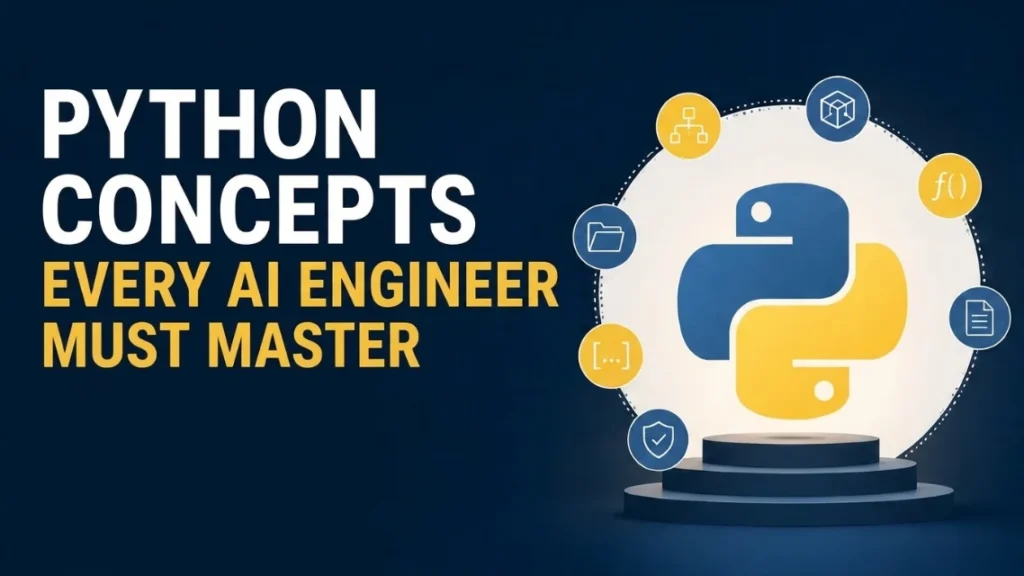
In the rapidly evolving landscape of artificial intelligence, the gap between a successful Jupyter Notebook experiment and a scalable, production-ready system is often measured by the quality of the underlying software architecture. While many practitioners enter the field with a focus on model architecture and loss functions, the reality of deploying AI at scale demands a shift in how Python is utilized.
Transitioning from local scripts to enterprise-grade AI systems requires moving beyond basic syntax toward the professional engineering constructs that power the world’s most sophisticated deep learning frameworks. Mastering these concepts is no longer optional; it is the prerequisite for managing massive datasets, ensuring low-latency inference, and building robust, maintainable AI infrastructure.
1. Generators and Lazy Evaluation: Memory-Efficient Data Pipelines
The most common point of failure for production AI systems is the "Out of Memory" (OOM) error. When dealing with multi-terabyte datasets—such as high-resolution video for computer vision or massive corpora for Large Language Model (LLM) fine-tuning—loading data into memory as a list is a catastrophic design choice.
The Problem with Eager Loading
Standard Python lists are "eager," meaning they allocate memory for the entire dataset the moment it is loaded. If your script attempts to ingest 50,000 document payloads simultaneously, Python will force a massive allocation of RAM, often exceeding the capacity of even the most powerful GPU instances.
The Power of yield
Generators provide a mechanism for "lazy evaluation." By utilizing the yield keyword, a function becomes an iterator that computes values only when requested. This keeps the memory footprint flat, regardless of whether you are processing ten records or ten million.
Performance Implications:
In comparative benchmarks using tracemalloc, moving from a list-based approach to a generator-based stream can reduce peak RAM consumption by over 50%. For an AI engineer, this means the difference between a system that crashes under load and one that can stream data continuously from cloud storage buckets or distributed file systems without ever saturating the host’s memory.
2. Context Managers: Hardening Hardware Resource Management
AI applications are heavy consumers of state-bound resources. Whether you are managing connections to vector databases, toggling model layers between training and evaluation modes, or clearing GPU caches to prevent memory fragmentation, the management of these states is critical.
The Risk of Manual Cleanup
Writing manual setup and teardown logic—often involving try-finally blocks—is prone to human error. If an exception occurs during inference, and the teardown logic is bypassed, you may be left with a model permanently stuck in "training mode," leading to incorrect gradient updates or memory leaks in your CUDA device.
The with Statement Advantage
Context managers provide a clean, declarative syntax for resource management. By implementing the __enter__ and __exit__ methods, you ensure that even if an execution block encounters a catastrophic failure, the environment is restored to its original state. This is standard practice in frameworks like PyTorch, where torch.no_grad() is used to prevent the expensive accumulation of gradients during inference.
3. Asynchronous Programming: Scaling Agentic Workflows
With the rise of LLM-based agentic workflows, the primary bottleneck in production is no longer the CPU—it is the network. When an agent must query multiple external APIs, vector stores, or retrieval systems, sequential execution causes the application to sit idle while waiting for HTTP responses.
The Latency Bottleneck
In a synchronous loop, if each API call takes 100ms, processing 20 prompts sequentially takes two seconds. In production, this latency is unacceptable for real-time user experiences.
Concurrency with asyncio
By adopting asyncio, developers can dispatch all network requests concurrently. Python does not wait for one response to finish before sending the next; instead, it manages the I/O loop, resuming tasks as data becomes available. This effectively collapses the total wait time to that of the single slowest request, often yielding a 20x improvement in performance for high-traffic agent systems.
4. Pydantic and Dataclasses: Strict Validation in a Dynamic World
One of the greatest dangers in AI engineering is the "silent failure"—a scenario where a configuration typo, such as a missing parameter or an incorrect data type, passes through the system undetected until the model produces garbage output.
From Dictionaries to Schema Validation
Using raw Python dictionaries for model configurations is a dangerous practice in production. Pydantic changes this by enforcing strict type checking and constraint validation at the instantiation level.
Key Benefits:
- Type Coercion: Pydantic can automatically convert string-based inputs (e.g., "64" from a web form) into integers.
- Runtime Constraints: You can define bounds (e.g.,
learning_ratemust be between 0 and 1) that trigger immediate exceptions if violated. - Schema Generation: Pydantic automatically generates JSON schemas, which are essential for LLM tool-calling and API documentation.
By treating configuration as a formal contract rather than a loose container, engineers prevent the most common class of "configuration bugs" that plague ML production runs.
5. Magic Methods: Building Native-Feeling Abstractions
To create custom AI infrastructure that feels like a native part of the Python ecosystem, you must master "dunder" (double underscore) magic methods. These methods allow your custom objects to interact seamlessly with external libraries.
Implementing the Protocol
If you are building a custom dataset class, you should implement __len__ and __getitem__. This allows your dataset to be passed directly into PyTorch’s DataLoader, which expects standard sequence behaviors. Similarly, implementing __call__ transforms an object into an executable function, which is the standard pattern for neural network modules.
Why It Matters for Deep Learning
In deep learning, model(x) is preferred over model.forward(x). This is not merely stylistic; nn.Module overrides __call__ to trigger essential hooks for gradient tracking and debugging. Bypassing these by calling forward() directly can lead to silent errors that are notoriously difficult to debug. By aligning your custom classes with these protocols, you ensure that your code is not just functional, but compatible with the broader AI tooling ecosystem.
Implications for the Modern AI Engineer
The shift from experimental research to production engineering requires a change in mindset. The five concepts discussed—generators, context managers, async I/O, Pydantic validation, and magic methods—are the bedrock of professional AI software development.
Moving Toward Stability
By adopting these practices, engineers ensure their systems are:
- Resilient: Memory usage remains predictable under heavy load.
- Robust: Hardware states are managed correctly, preventing resource leaks.
- Performant: Network-bound bottlenecks are eliminated through concurrency.
- Verifiable: Configuration and input data are strictly validated.
- Extensible: Custom abstractions integrate cleanly with industry-standard libraries.
As AI systems continue to grow in complexity, the ability to write "clean" code is no longer just a matter of developer preference—it is a competitive necessity. Those who master these native Python mechanisms will find themselves better equipped to build the next generation of scalable, reliable, and high-performance AI applications.