Hyderabad Brought to a Standstill: Monsoon Deluge Collides with Ganesh Chaturthi Celebrations
By Staff Reporter
September 22, 2026
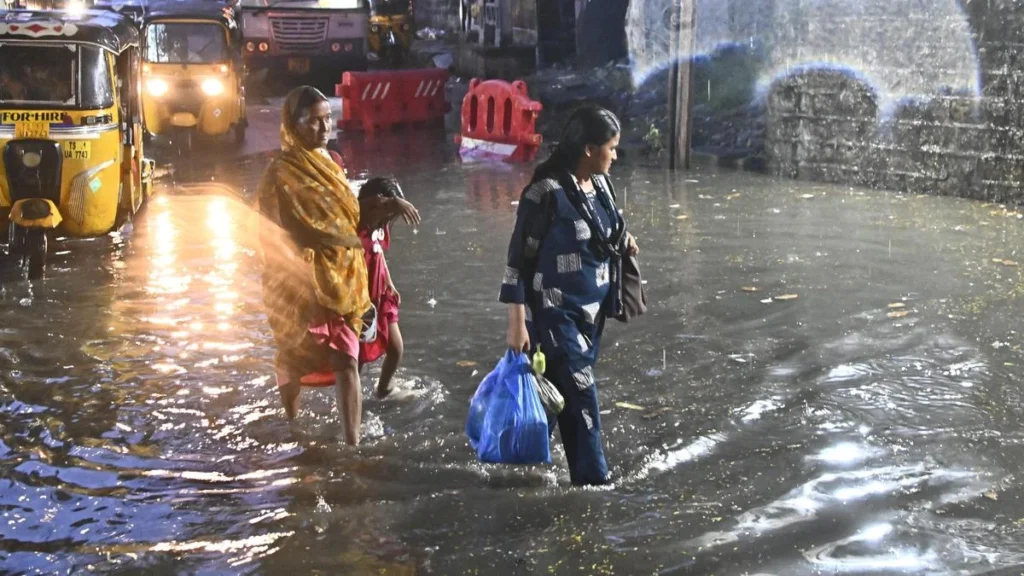
Hyderabad faced a grueling evening on Monday as a sharp, intense spell of moderate-to-heavy rainfall battered the city, throwing civic life into disarray. The sudden downpour, which struck during the critical evening peak hours, exacerbated the already chaotic traffic situation caused by the ongoing Ganesh Chaturthi immersion festivities. As commuters navigated flooded arterial roads and waterlogged flyovers, the city’s disaster management machinery—led by the Disaster Response Force (DRF) and the Hyderabad Disaster Response and Asset Protection Agency (HYDRAA)—was pushed into emergency mode to restore normalcy.
The Perfect Storm: When Precipitation Meets Procession
The meteorological event, while brief in duration, was significant in its impact due to the timing. Monday evening marked a high-intensity phase for the Ganesh Chaturthi celebrations, with heavy vehicles carrying massive idols toward the Hussain Sagar lake and other water bodies for immersion.
The synergy between the rainfall and the religious processions created a "perfect storm" for traffic gridlock. Thousands of devotees, vehicles transporting idols, and regular office-goers competing for road space found themselves trapped in a standstill as roads transformed into shallow channels of water. The disruption was not merely limited to minor traffic congestion; it paralyzed critical transit corridors across the city, extending commute times for thousands by several hours.
Chronology of the Deluge
The rainfall began in the early evening, intensifying rapidly by 6:00 p.m. By the time the city reached the height of the evening rush hour, the cumulative effect of the rain had overwhelmed the city’s drainage infrastructure in low-lying areas.
- 6:00 PM – 7:30 PM: The initial wave of rain hit the central and western parts of the city. Traffic density began to climb as office workers sought to reach home simultaneously with the arrival of heavy immersion vehicles.
- 7:30 PM – 9:00 PM: The situation reached a breaking point. Major bottlenecks were reported at the Tolichowki flyover, where vehicles remained stationary for long stretches. The stretch from Rethibowli to Nanal Nagar became a choke point, while the Chaderghat bridge area saw significant waterlogging, impeding the flow of traffic towards Malakpet.
- 9:00 PM onwards: As the intensity of the rain began to taper off, the focus shifted from traffic management to crisis mitigation. Emergency crews were deployed to clear fallen debris and pump out water from key junctions, including the vital transit points of Panjagutta, Khairatabad, and Lakdikapul.
Data Breakdown: Mapping the Rainfall Intensity
According to data provided by the Telangana Development Planning Society (TDPS), the distribution of the rainfall was widespread, with central and western Hyderabad receiving the brunt of the precipitation. By 9:00 p.m., the recorded figures painted a clear picture of the storm’s trajectory:
| Location | Rainfall Recorded (mm) |
|---|---|
| Khairatabad | 32.8 mm |
| Allwyn Colony | 28.5 mm |
| Kukatpally | 25.5 mm |
| Kavadiguda | 25.0 mm |
| Adibatla | 23.5 mm |
| Moosapet | 23.0 mm |
| Amberpet | 22.0 mm |
| Borabanda | 22.0 mm |
| Moosarambagh | 21.0 mm |
| Musheerabad | 19.8 mm |
| Yousufguda | 17.8 mm |
The concentration of over 30 mm in areas like Khairatabad—a hub for major idol immersion activities—proves that the rainfall was not just statistically significant, but geographically targeted toward the city’s most sensitive zones during this festival week.
The Infrastructure Struggle: A Detailed Assessment of Bottlenecks
The city’s topography, combined with aging drainage systems, turned several junctions into islands. The most severely affected corridors included:
The Western Corridor
The Shaikpet flyover towards Tolichowki experienced a total breakdown in movement. The Banjara Hills stretch leading to the Panjagutta flyover was similarly affected, with vehicles struggling to maintain traction on the slick, water-covered asphalt.
Central and Southern Hubs
The movement from Panjagutta towards Khairatabad, stretching down to Lakdikapul and the Secretariat, saw vehicles moving at a snail’s pace. In the south, the Moosarambagh area, historically prone to waterlogging, faced significant inundation, causing secondary traffic diversions that hampered surrounding neighborhoods.

The Koti Incident
A localized but hazardous incident occurred on Bank Street in Koti. Near the State Bank of India branch, tree branches collapsed under the weight of the rain and wind, partially blocking the road. This caused a domino effect in traffic flow, forcing police to divert vehicles through narrow inner lanes, which were already struggling to cope with the sheer volume of commuters.
Official Response: Crisis Management and Regulation
In the wake of the disruptions, the Hyderabad, Malkajgiri, and Cyberabad police commissionerates activated emergency protocols. Traffic personnel were deployed in high-visibility jackets at all major junctions, braving the downpour to manually regulate flow and prevent the gridlock from turning into a complete standstill.
The Hyderabad Disaster Response and Asset Protection Agency (HYDRAA) emerged as the primary responder for infrastructure-related issues. DRF teams were dispatched across the city equipped with pumps and debris-clearing tools. Their primary objective was twofold: clearing the storm-water drains blocked by silt and waste, and removing fallen branches or debris that posed a risk to public safety.
"The teams were mobilized instantly upon receiving reports of water stagnation," a spokesperson for the disaster response unit noted. "Given the volume of heavy vehicles associated with the immersion processions, our priority was to ensure that the main arterial roads remained clear enough to prevent the processions from being stalled for extended periods, which could have led to a law-and-order situation."
Implications: A City at a Crossroads
The events of September 22 serve as a stark reminder of the vulnerability of Hyderabad’s urban infrastructure. As the city continues to expand, the intersection of seasonal weather volatility and massive public events highlights several systemic concerns:
1. Urban Drainage Vulnerability
Despite periodic desilting drives, the intensity of modern monsoonal bursts often exceeds the capacity of the current drainage network. The data shows that even moderate rainfall (sub-40 mm) can lead to significant surface water retention, suggesting that the drainage capacity in high-growth areas like Kukatpally and Borabanda requires urgent augmentation.
2. The Logistics of Immersion
While the Ganesh Chaturthi festivities are a cultural cornerstone of Hyderabad, the logistics of transporting massive idols through the city during the monsoon season present a unique challenge. The reliance on large, slow-moving vehicles during peak traffic hours necessitates a more robust traffic management strategy that can account for both weather-related disruptions and religious processions.
3. Disaster Preparedness
The rapid deployment of HYDRAA and the DRF reflects a maturing disaster response ecosystem in the city. However, the reliance on reactive measures—pumping water after it accumulates—points to the need for a more proactive approach, such as real-time water-level sensors in flood-prone areas and improved real-time traffic information systems for the public.
Conclusion: Looking Ahead
As the city attempts to recover from the night’s disruptions, the focus shifts toward the remaining days of the festival season. With the meteorological department indicating the potential for further rain in the coming days, civic authorities have advised citizens to plan their travel during the evening hours with extreme caution.
The events of Monday evening serve as a barometer for Hyderabad’s civic resilience. While the coordinated efforts of the traffic police and disaster response teams prevented a total collapse of movement, the recurring nature of these delays suggests that Hyderabad’s infrastructure development must accelerate to keep pace with its rapid urbanization. For the citizens of Hyderabad, the night of September 22 was a test of patience—a reminder that in a city of millions, the margin for error during extreme weather events remains dangerously thin.