Internal Strife in West Bengal: Mamata Banerjee’s TMC Challenges ‘Rebel’ Faction Before Election Commission
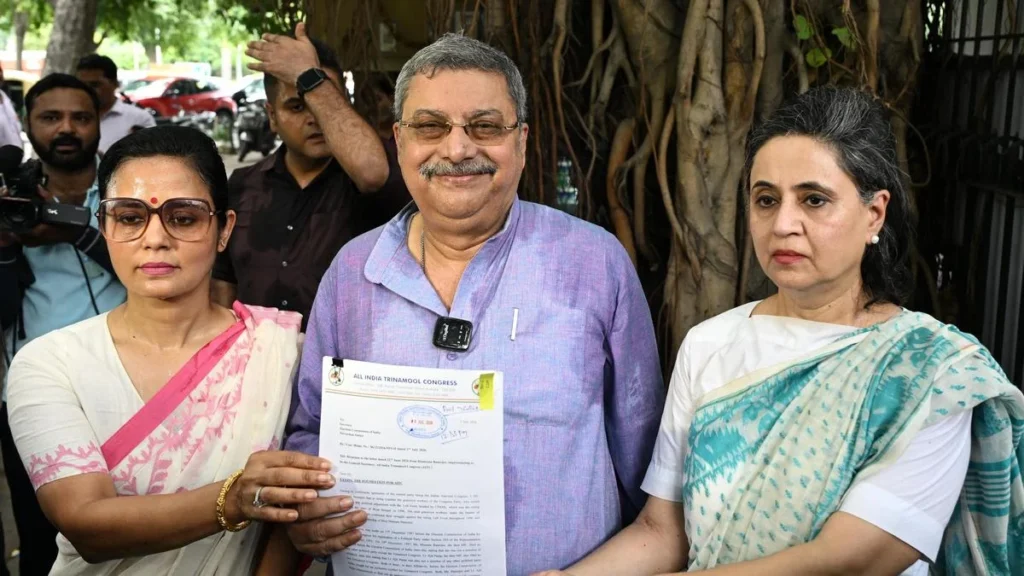
NEW DELHI – The internal power struggle within the All India Trinamool Congress (AITC) reached a critical juncture on Monday, July 6, 2026, as a delegation representing the Mamata Banerjee-led faction formally submitted a comprehensive rebuttal to the Election Commission of India (ECI). The submission serves as a firm rejection of claims made by a breakaway group led by Ritabrata Banerjee, which has sought to seize control of the party’s organizational apparatus.
The ongoing battle, which has gripped West Bengal’s political landscape for months, centers on the legitimacy of current party leadership and the validity of organizational timelines. As both factions vie for recognition from the national poll body, the future of the state’s primary opposition remains precariously balanced.
The Core Conflict: A Battle for Institutional Legitimacy
The confrontation between the two factions reached a fever pitch following a June 22 "special session" organized by the rebel faction. During this session, the breakaway group claimed to have reconstituted the party’s organizational committees, effectively declaring themselves the "real" AITC.
The Mamata Banerjee faction, represented in New Delhi by senior MPs Kalyan Banerjee, Mahua Moitra, and Sagarika Ghosh, has dismissed these claims as a "great fraud" and a violation of the party’s foundational statutes. Speaking to the media after the ECI meeting, Kalyan Banerjee emphasized that the party has provided a "very detailed reply" to the Commission, systematically dismantling the rebels’ arguments.
At the heart of the dispute is the tenure of the AITC National Working Committee. The rebel faction contends that the mandate of the current leadership expired in 2025. The Mamata faction, however, cites specific constitutional amendments to refute this, asserting that the party’s organizational hierarchy remains legally intact until 2027.

Chronology of the Disenchantment
The current crisis did not emerge in a vacuum. The relationship between the party leadership and the rebel group has been deteriorating since early 2026, leading to a series of legal and procedural standoffs:
- Early 2026: Tensions escalate over candidate selection and internal policy disagreements ahead of the West Bengal Assembly elections.
- May 2026: Despite internal friction, the rebels participate in the West Bengal Assembly elections under the official TMC banner, utilizing candidacy papers endorsed by Mamata Banerjee.
- June 22, 2026: The rebel faction holds a "special session" to announce a new organizational structure, claiming the previous mandate had expired in 2025.
- Late June 2026: The Election Commission intervenes, requesting both sides to submit their respective claims regarding authorized signatories and the status of organizational polls.
- July 2026: The rebel group meets with the full bench of the ECI to argue their case for legitimacy.
- July 6, 2026: The Mamata Banerjee faction submits its formal counter-claim to the ECI, challenging the legality of the rebels’ actions and calling for their immediate resignation.
The Legal Argument: Constitutional Tenure and Procedures
The primary point of contention is whether the party leadership is currently operating on an expired mandate. The rebel group argues that the committee’s term concluded in 2025. However, Kalyan Banerjee provided a detailed breakdown of the party’s constitutional history to clarify the timeline.
"The party constitution has been amended consistently over the years," explained the TMC MP. "The tenure was initially three years, extended to four years in 2000, and eventually moved to five years in 2006. These changes were duly communicated to the Election Commission."
According to the leadership, the most recent organizational election took place in 2022. Under the current five-year constitutional provision, the committee’s term is legally set to expire in 2027. The Mamata faction argues that the rebels’ contention is not only "incorrect" but fundamentally unsupported by the party’s own internal governing documents.
Furthermore, the Mamata camp has pointed to a glaring contradiction in the rebels’ behavior: if the party truly ceased to exist or if the committee’s tenure had expired in 2025, the rebels would have had no legal basis to contest the 2026 Assembly elections under the TMC symbol.

"If they claim the party organization became defunct in 2025, then their own participation in the 2026 polls becomes illegal," said Ms. Banerjee. "By their own logic, they should have resigned from their positions long ago."
Procedural Irregularities and "Fraudulent" Practices
The Mamata Banerjee-led group has accused the rebels of bypassing the mandatory multi-tier organizational process required for any legitimate restructuring. According to the party constitution, any changes to the organizational hierarchy must move upward from the block level, through district and state committees, before reaching the AITC National Working Committee level.
"There was no media notification, no proper circulation, and no notice provided to the ex-officio members," said the leadership. They allege that the rebels conducted their "special session" in a vacuum, ignoring the basic democratic requirements stipulated in the AITC constitution.
By failing to follow these protocols, the Mamata camp argues that the rebels’ attempt to reconstitute the party is "non-est" and legally void. They have also accused the faction of attempting to forcibly seize control of various party offices, allegedly leveraging support from elements within the state administration to solidify their claims.
Implications for West Bengal Politics
The resolution of this dispute by the Election Commission carries significant weight for the political climate in West Bengal. The ECI is currently tasked with evaluating the validity of organizational polls and determining which faction holds the right to the party’s official symbols and resources.

1. Political Stability
For the TMC, the crisis represents a challenge to the centralized authority that has defined the party since its inception. If the ECI rules in favor of the Mamata Banerjee faction, it will effectively solidify her grip on the party and likely lead to the formal expulsion or marginalization of the rebel leaders. Conversely, a ruling that validates the rebels’ claims could lead to a protracted period of administrative paralysis.
2. Legal Precedents
The case will likely serve as a benchmark for how political parties in India handle internal leadership transitions and disputes over organizational tenure. The ECI’s focus on the party’s internal constitution and the history of amendments highlights the importance of keeping statutory filings up to date.
3. Impact on Governance
The uncertainty regarding who controls the "real" AITC is already impacting legislative functions. With the rebel faction attempting to occupy party offices, the state government faces potential disruption in its daily operations. The public, meanwhile, remains caught in the middle, awaiting a resolution that clarifies which group holds the mandate to govern and represent the party’s voters.
Conclusion: The Path Forward
As the ECI reviews the voluminous submissions from both sides, the atmosphere in New Delhi and Kolkata remains tense. The Mamata Banerjee faction remains confident that the constitutional documentation will vindicate their position, while the rebels continue to push for a broader restructuring of the party.
For now, the focus shifts to the Election Commission’s bench. The Commission’s decision will not only resolve the identity crisis within the Trinamool Congress but will also dictate the future trajectory of the opposition in West Bengal. As the party enters a period of intense scrutiny, the leadership has made one thing clear: they view the rebels’ actions as a direct threat to the democratic foundation of the AITC and are prepared to defend their mandate through every available legal channel.

The coming weeks will prove decisive as the ECI determines whether the organizational structure established in 2022 remains the sole legitimate authority, or if the "rebel" faction has successfully navigated a path to usurp the legacy of the All India Trinamool Congress.