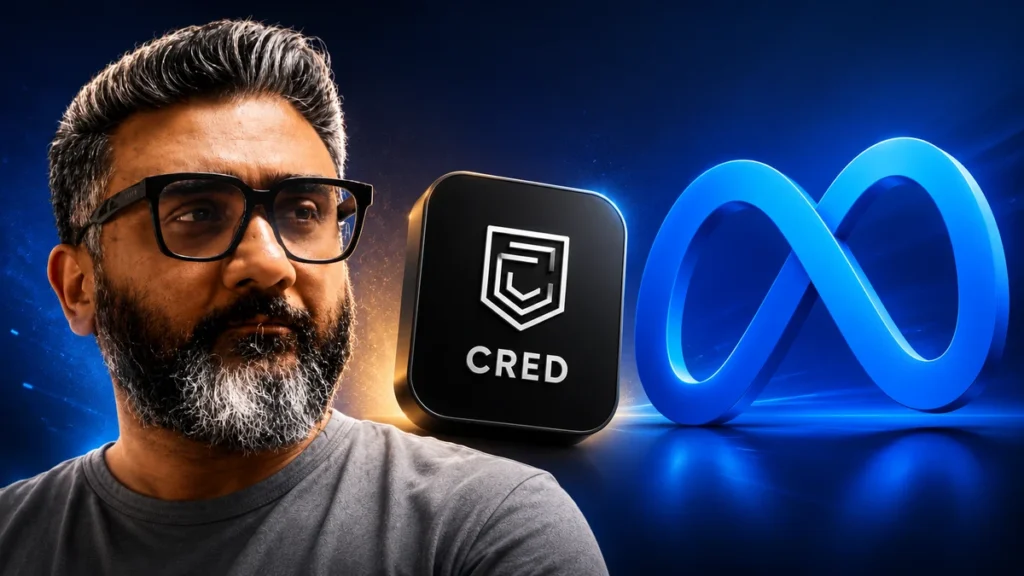
MUMBAI / SILICON VALLEY — In a move that signals a profound shift in its global monetization strategy, Meta Platforms Inc. has announced the appointment of Kunal Shah, the prominent Indian entrepreneur and founder of fintech unicorn CRED, as the new Global Head of WhatsApp.
The appointment, effective immediately, marks one of the most high-profile executive transitions in the global technology sector in recent years. Shah, widely recognized for his deep expertise in consumer behavior, digital payments, and community-driven business models, will oversee WhatsApp’s global operations, product development, and its rapidly expanding business messaging and fintech divisions.
The decision highlights Meta’s intent to transition WhatsApp from a dominant, free-to-use communication utility into a highly monetized, transactional engine. By bringing in Shah—a veteran of India’s highly competitive fintech landscape—Meta is signaling that the future of WhatsApp lies at the intersection of communication, commerce, and financial services.
The Main Facts: A New Era for the World’s Most Popular Messenger
Under the terms of the appointment, Kunal Shah will relocate his strategic focus between Silicon Valley and Bengaluru, managing WhatsApp’s global footprint of over 2.5 billion monthly active users. Shah succeeds Will Cathcart, who has led WhatsApp since 2019 and will transition into a broader advisory role within Meta’s product infrastructure team.
Shah’s mandate is clear: accelerate WhatsApp’s monetization engine, particularly in emerging markets such as India, Brazil, Indonesia, and Latin America, while scaling high-margin enterprise solutions globally.
Key Highlights of the Appointment:
Global Mandate: Shah will assume full operational control of WhatsApp’s global product roadmap, including core messaging, WhatsApp Business, and WhatsApp Pay.
Fintech Focus: Leveraging Shah’s extensive background in credit, payments, and premium consumer engagement, Meta plans to integrate deeper financial services directly into the messaging interface.
India at the Center: With India representing WhatsApp’s largest user base (exceeding 500 million users), appointing an Indian tech pioneer underscores the country’s role as the primary laboratory for Meta’s transactional innovations.
CRED’s Leadership Transition: Following the announcement, CRED confirmed that Shah will transition to a non-executive chairman role, with the current executive leadership team taking over day-to-day operations at the fintech company.
Chronology: The Evolution of WhatsApp’s Monetization Journey
To understand the significance of Kunal Shah’s appointment, it is essential to trace how WhatsApp evolved from a simple ad-free utility to the cornerstone of Meta’s commercial ambitions.
[2009] WhatsApp founded by Jan Koum and Brian Acton as a simple, ad-free SMS alternative.
  │
[2014] Meta (then Facebook) acquires WhatsApp for $19 Billion; commits to user privacy.
  │
[2018] WhatsApp Business App launches; Founders depart over monetization disagreements.
  │
[2020] WhatsApp Pay launches in India after prolonged regulatory clearances.
  │
[2022] "Click-to-WhatsApp" ads become a major revenue driver for Meta's advertising suite.
  │
[2024] Meta deepens AI integration, introducing Meta AI tools for merchants on WhatsApp.
  │
[2026] Kunal Shah appointed Global Head to transform WhatsApp into a global fintech & commerce "Super-App".
The Early Years (2009–2014)
When Jan Koum and Brian Acton founded WhatsApp in 2009, their philosophy was famously summarized in a note kept on Koum’s desk: "No Ads! No Games! No Gimmicks!" The platform focused strictly on reliability, speed, and privacy. This singular focus attracted hundreds of millions of users globally. In 2014, Mark Zuckerberg recognized the platform’s potential as the world’s default communication layer and acquired it for a historic $19 billion.
The Monetization Friction (2015–2019)
As Meta sought ways to recoup its massive investment, tensions arose regarding how to generate revenue without alienating users. The co-founders opposed targeted advertising and data-sharing initiatives, eventually leading to their high-profile departures in 2017 and 2018. Following their exit, Meta pivoted toward business-to-consumer (B2C) messaging, launching the WhatsApp Business app and the WhatsApp Business API.
The Transactional Shift (2020–2025)
With the launch of WhatsApp Pay in India and Brazil, Meta attempted to mimic the success of WeChat in China, where messaging and commerce are entirely integrated. However, regulatory hurdles and stiff competition from local players like PhonePe and Google Pay slowed initial adoption. Meta counteracted this by focusing on "Click-to-WhatsApp" ads, allowing businesses to run ads on Facebook and Instagram that open a direct chat window on WhatsApp. By 2025, this ad format had grown into a multi-billion-dollar business, proving that conversational commerce was highly lucrative.
Supporting Data and Strategic Philosophy: The Digital Glue
Every business Meta builds or acquires is centered around community and advertisers. Take Facebook for instance: Mark Zuckerberg built it while he was at Harvard, creating a new urban town square on the internet. The web-based application caught the zeitgeist and moved from strength to strength.
Back then, the platform solved a distance problem. Friends who relocated after college connected with each other on the platform. Families that moved to a different country shared important moments with relatives in their home countries. The medium acted as digital glue that connected physical relationships online, and in that process created a new way for people to communicate with each other.
As WhatsApp transitions into its next phase, the "distance problem" has already been solved. The new challenge is the "transaction and trust problem." Consumers in emerging economies trust peer-to-peer messaging implicitly, but transacting with businesses remains fragmented.
Kunal Shah’s track record at CRED—a platform built on the premise of rewarding high-trust, creditworthy individuals—aligns perfectly with this philosophy. Shah’s unique understanding of consumer psychology, high-value engagement, and financial ecosystems makes him uniquely suited to transform WhatsApp’s massive user base into an active commercial ecosystem.
Market Dynamics and WhatsApp’s Reach:
Global Monthly Active Users (MAUs): 2.5 Billion+
Daily Active Messages Sent: Over 140 Billion
India Market Share: 500 Million+ users, making it the single largest market.
WhatsApp Business MAUs: Exceeded 200 million globally by late 2025.
The Revenue Gap: While Facebook and Instagram generate high average revenue per user (ARPU) through traditional feed-based advertising, WhatsApp’s ARPU has historically remained low. Shah’s primary task is to bridge this gap through premium features, business subscriptions, micro-transactions, and financial service partnerships.
Official Responses: Executive Perspectives
The announcement has elicited enthusiastic responses from Meta’s top leadership and the global technology community, highlighting the shared vision for WhatsApp’s future.
Mark Zuckerberg, Founder and CEO of Meta, expressed his confidence in Shah’s leadership in a public post:
"Kunal has spent his career building products that understand human behavior and financial trust at scale. As we enter WhatsApp’s next chapter, our focus is on building tools that allow people to not only chat but seamlessly buy, sell, and access financial services. Kunal’s entrepreneurial vision and deep understanding of consumer dynamics will be invaluable as we scale WhatsApp’s global business messaging and payment ecosystems."
Kunal Shah shared his perspective on his new role and the democratization of digital access:
"WhatsApp is the digital glue of the modern world. It has connected families, bridged communities, and democratized access to communication. The next frontier is to democratize economic opportunity. By integrating seamless commerce, payments, and financial products into a platform that billions of people already trust and use daily, we can create unprecedented economic mobility. I am thrilled to join Mark and the incredibly talented team at Meta to build this future."
Industry analysts have also weighed in on the appointment. Sanchit Vir Gogia, Chief Analyst at Greyhound Research, noted:
"This is a masterstroke by Meta. For years, WhatsApp has struggled to monetize its massive user base in emerging markets. By appointing Kunal Shah, Meta is bringing in a leader who doesn’t just think about technology, but deeply understands the economics of trust and transactions. This signals that WhatsApp is no longer content being just a messaging app; it wants to be the ultimate transaction layer of the internet."
Implications: How This Appoints Redefines the Tech Landscape
The appointment of Kunal Shah as Global Head of WhatsApp has far-reaching implications for Meta, the global fintech ecosystem, and the competitive landscape of digital commerce.
1. The Realization of the "Super-App" Vision
For years, Western tech giants have watched the success of WeChat in China with envy. WeChat operates as an all-in-one operating system where users chat, order food, pay utility bills, secure loans, and book travel. Attempts to build a similar super-app in the West have failed due to fragmented consumer habits and regulatory barriers.
Under Shah’s stewardship, WhatsApp is positioned to become the first truly global super-app outside of China. By leveraging WhatsApp’s existing trust infrastructure, Meta can integrate micro-loans, insurance, mutual funds, and retail commerce directly into the chat interface, bypassing traditional app stores and complex web funnels.
India will serve as the primary testing ground for Shah’s new strategies. With the Unified Payments Interface (UPI) already deeply integrated into WhatsApp, the platform has the potential to disrupt established payment players.
If Shah can successfully convert a fraction of WhatsApp’s 500 million Indian users into active financial services consumers, it could reshape the competitive dynamics of the Indian fintech sector, putting pressure on established players like Paytm, PhonePe, and Google Pay.
3. Regulatory and Privacy Scrutiny
Any attempt to deepen financial integration and commercial tracking within WhatsApp will inevitably draw regulatory scrutiny. Antitrust bodies in the United States, the European Union, and India have closely monitored Meta’s data-sharing practices across its family of apps.
Shah will have to navigate complex regulatory landscapes, such as the Digital Markets Act (DMA) in Europe and the Reserve Bank of India’s (RBI) stringent data localization and financial licensing guidelines, ensuring that monetization efforts do not compromise user privacy and security.
4. Impact on CRED and the Startup Ecosystem
Shah’s transition to Meta is a landmark moment for the Indian startup ecosystem. It demonstrates that global tech giants are looking to Indian entrepreneurial talent not just to manage regional offices, but to lead global product strategies.
At CRED, Shah’s transition to a non-executive role will test the institutional depth of the company he built. CRED has spent years assembling a robust executive layer; the company will now have to prove it can sustain its high-margin financial services business and continue to innovate without its founder at the daily helm.
Conclusion: Bridging Trust and Transaction
The appointment of Kunal Shah as the Global Head of WhatsApp represents a convergence of communication, trust, and commerce. Just as Facebook once solved the distance problem by acting as digital glue for physical relationships, WhatsApp under Shah’s leadership aims to solve the transaction problem by acting as the commercial glue for global trade.
By combining the unprecedented scale of WhatsApp with the sophisticated consumer-engagement insights that defined CRED, Meta is making its most decisive bet yet on the future of conversational commerce. If successful, Shah’s tenure will not only redefine WhatsApp but will also establish a new paradigm for how humanity interacts, transacts, and conducts business in the digital age.