Navigating the Agentic AI Frontier: A Decision-Tree for Production-Grade Architecture
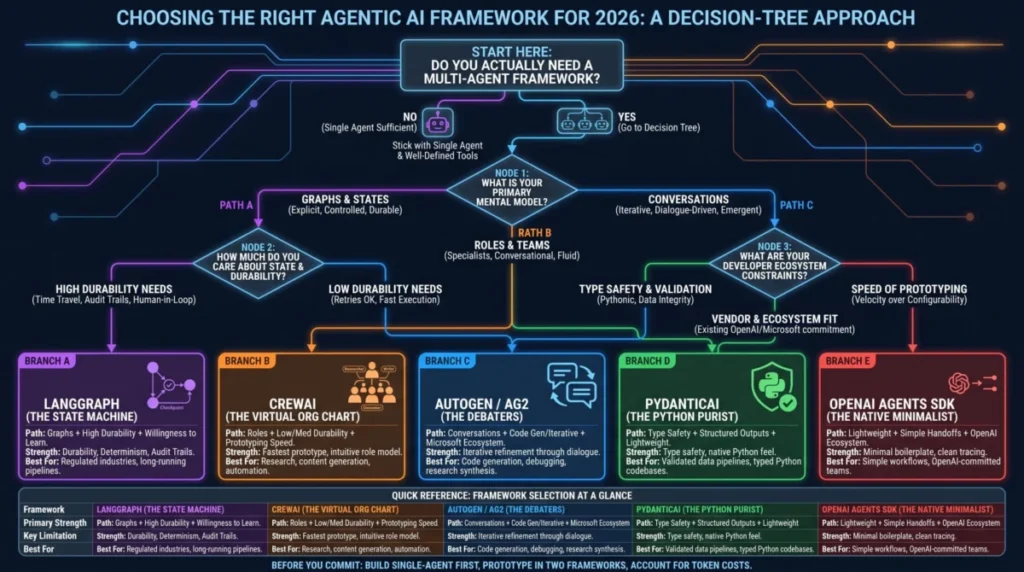
The landscape of agentic AI has evolved from experimental sandboxes to a critical component of modern software engineering. By 2026, the question for development teams is no longer whether they can build an autonomous agent, but which orchestration framework will ensure their systems remain stable, scalable, and maintainable in a production environment.
Choosing an agentic framework is a high-stakes architectural decision. Unlike general-purpose libraries, these frameworks dictate how your application thinks, coordinates, and—most importantly—how it recovers from failure. As systems transition from R&D into core business operations, the "easiest to start" metric has become a poor proxy for long-term viability. This guide provides a structured, decision-tree approach to selecting the right framework based on the harsh realities of production workflows.
1. The Reality of Modern Agentic Systems
The maturation of the agentic space has introduced a new level of complexity. In 2023, developers were often satisfied with simple "chaining" of LLM calls. Today, production systems must manage persistent state, human-in-the-loop (HITL) interventions, and multi-step reasoning chains that can run for minutes or hours.
The most common trap for engineering teams is "orchestration bloat." Many developers reach for complex multi-agent frameworks when a single, well-architected agent using a robust tool-calling interface would suffice. A single agent is easier to debug, monitor, and cost-optimize. Before committing to a multi-agent architecture, teams must ask if the task truly requires the emergent behavior of a team, or if it is simply a linear process masquerading as an autonomous one.
2. Chronology: From Scripting to Orchestration
The history of agentic AI frameworks is a story of increasing abstraction:
- Phase 1: Direct Prompting (2022–2023): Developers used raw API calls to models like GPT-4, manually managing context windows and simple tool calls.
- Phase 2: The Rise of Frameworks (2023–2024): The emergence of LangChain and early versions of AutoGen allowed for "chained" logic, moving away from brittle, hard-coded scripts toward semi-autonomous workflows.
- Phase 3: Production Maturity (2025–2026): We are currently in an era of "opinionated orchestration." Modern frameworks like LangGraph and PydanticAI have introduced concepts like persistence, type safety, and graph-based state management, mirroring the requirements of traditional backend infrastructure.
3. The Decision Tree: Determining Your Path
To select the appropriate framework, architects must navigate three fundamental nodes that define the nature of their workload.
Node 1: The Mental Model
How do you conceptualize the system’s workflow?
- Graphs and States: Your workflow is a deterministic process with defined transitions and retry logic.
- Roles and Teams: You view work as a collaborative effort between specialized agents (e.g., a "researcher" and a "writer").
- Conversational Loops: Your output is the result of an iterative dialogue where agents critique and refine one another’s work.
Node 2: Durability and Persistence
Does your system need to "pause and resume"? If your workflows involve financial transactions, regulatory compliance, or long-running research, you require high durability. If your tasks are fire-and-forget, ephemeral, and low-latency, you require low durability.
Node 3: Ecosystem and Constraints
Does your team prioritize type safety, vendor-specific performance (e.g., Azure OpenAI), or rapid prototyping velocity? These constraints often override raw performance benchmarks.
4. Framework Deep-Dive: The Five Pillars
LangGraph: The State Machine
LangGraph is designed for developers who treat AI workflows as robust software engineering. By modeling agents as nodes in a directed graph, it provides explicit control over state.
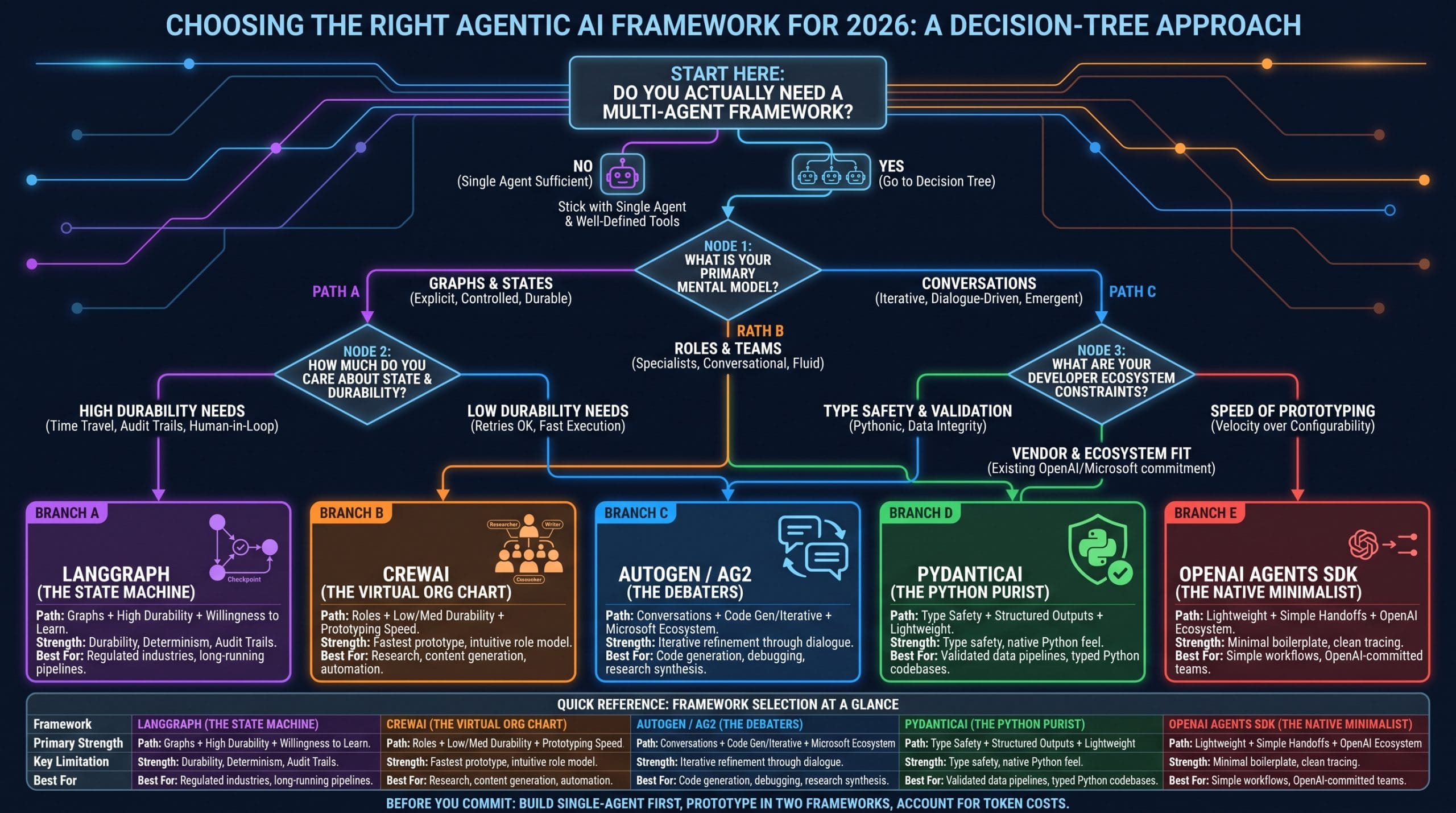
- Implication: It is the industry standard for high-stakes, regulated industries. Its ability to "time-travel"—inspecting and modifying state at any point in the chain—makes it the only choice for workflows requiring auditability.
CrewAI: The Virtual Org Chart
CrewAI simplifies the complexity of multi-agent systems by using a management metaphor. You define "agents" with specific roles and "tasks" with clear goals.
- Implication: It is unrivaled in prototyping speed. It is ideal for teams building internal tools where the overhead of defining complex graph transitions would impede development.
AutoGen (AG2): The Debaters
AG2 excels at iterative refinement. By facilitating a natural language dialogue between agents (e.g., a coder and a debugger), it creates a robust feedback loop.
- Implication: It is particularly powerful for code generation tasks. However, it requires careful prompt engineering to prevent "conversational drift," where agents get stuck in unproductive loops.
PydanticAI: The Python Purist
PydanticAI bridges the gap between AI and traditional software development by enforcing strict data schemas.
- Implication: It is the most "developer-friendly" option for teams already using Pydantic. It treats agents as functions with typed inputs and outputs, ensuring data integrity at the boundary of every tool call.
OpenAI Agents SDK: The Native Minimalist
Released in early 2025, this SDK offers the cleanest integration for developers fully invested in the OpenAI ecosystem.
- Implication: While it lacks the breadth of community plugins found in LangGraph or CrewAI, its performance and tracing capabilities for simple, OpenAI-centric workflows are unmatched.
5. Supporting Data: Comparative Framework Analysis
| Framework | Primary Strength | Key Limitation | Best For |
|---|---|---|---|
| LangGraph | Durability & Audit Trails | Verbose Setup | Regulated/Enterprise |
| CrewAI | Prototyping Velocity | Lack of Granular Control | Research & Content |
| AutoGen | Iterative Refinement | Conversational Drift | Code & Data Analysis |
| PydanticAI | Type Safety | No Built-in Orchestration | Typed Python Apps |
| OpenAI SDK | Minimal Boilerplate | High Vendor Lock-in | Rapid MVP Development |
6. Operational Implications and Costs
A critical oversight in the adoption of multi-agent frameworks is the hidden cost of token amplification.
In a single-agent system, token usage is proportional to the task. In a multi-agent system, the "hand-offs," internal debates, and state-management prompts can consume tokens at an exponential rate. Organizations must model their projected API costs based on the number of "turns" their chosen framework requires to reach a resolution.
Furthermore, observability remains the "Achilles’ heel" of agentic AI. As these systems move to production, teams must implement rigorous logging. For instance, in LangGraph, developers should leverage built-in checkpointing to store the state of every node. Without this, debugging a 2 a.m. production failure becomes an exercise in frustration.
7. Official Perspectives and Best Practices
Industry leaders emphasize that the best framework is the one that minimizes "black box" behavior.
- Start Minimal: Begin with a single-agent architecture. Only introduce multi-agent orchestration when the complexity of the task requires specialized sub-agents.
- Define Boundaries: Use typed schemas (as seen in PydanticAI) to constrain what agents can pass to each other. This prevents "hallucinated inputs" from propagating through your pipeline.
- Human-in-the-Loop (HITL): For any system that touches external APIs or financial data, incorporate mandatory human approval steps within your orchestration layer. Frameworks like LangGraph are built specifically to facilitate these "interrupts."
Conclusion
The agentic AI space is no longer about which framework has the most GitHub stars; it is about which framework provides the best primitives for your specific production requirements. Whether you choose the deterministic, state-heavy approach of LangGraph or the rapid, team-based structure of CrewAI, your goal remains the same: building a system that is predictable, observable, and resilient.
By applying the decision tree outlined in this guide, developers can cut through the noise of the 2026 market and architect systems that are not just clever, but truly production-ready. Define your constraints, validate your data, and prioritize the long-term maintainability of your agentic workflows.