Navigating the Agentic Frontier: A Strategic Framework for Production-Grade AI
The landscape of artificial intelligence has shifted beneath our feet. What was once a collection of experimental scaffolding in 2023 has matured into a robust, albeit crowded, ecosystem of orchestration frameworks. For developers and CTOs in 2026, the question is no longer "Can we build an agent?" but rather "Which architectural foundation will sustain our production systems for the next decade?"
Choosing an agentic framework is a high-stakes decision. Unlike choosing a front-end library, your agentic framework dictates how your system reasons, handles failure, and manages state. Selecting the wrong tool can lead to fragile systems that collapse under the weight of edge cases, or worse, introduce "black box" behaviors that are impossible to audit.
The State of the Industry: From Toys to Infrastructure
The maturity of the AI sector has been marked by a clear divide: the "toy project" era of basic chat-wrappers has ended. We have entered the age of industrial-grade agentic orchestration. Modern frameworks—LangGraph, CrewAI, AG2, PydanticAI, and the OpenAI Agents SDK—each come with strong, often conflicting, opinions on how agents should think, coordinate, and recover from errors.
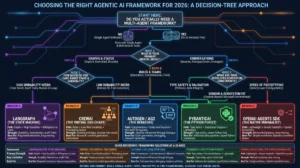
Most existing benchmarks, however, are misleading. GitHub stars, leaderboard rankings, and "time-to-hello-world" metrics fail to capture the reality of production operations. They do not tell you how a system behaves at 2 a.m. on a Sunday when a model returns a malformed JSON object, or how it handles a recursive loop in a critical compliance workflow. To build a resilient system, developers must move beyond surface-level comparisons and evaluate frameworks through a rigorous, requirement-first decision tree.
Chronology: The Evolution of Agentic Orchestration
To understand where we are, we must look at the trajectory of the last three years:
- 2023 – The Era of Prompt Chaining: Development was characterized by linear sequences. Frameworks like the original LangChain introduced the world to "chains," but these lacked true autonomy.
- 2024 – The Rise of Autonomous Loops: Developers began experimenting with "ReAct" patterns and feedback loops. The first wave of multi-agent frameworks appeared, focusing on emergent behavior and iterative task completion.
- 2025 – The Standardization of State: With the release of state-management-heavy tools and the OpenAI Agents SDK, the industry pivoted toward durability. The focus shifted from "can it solve the problem?" to "can it reliably report its progress and state?"
- 2026 – The Production Maturity Phase: We are now in a period of consolidation. The focus has moved toward type safety, auditability, and integration into existing enterprise CI/CD pipelines.
The Fundamental Question: Is Multi-Agent Necessary?
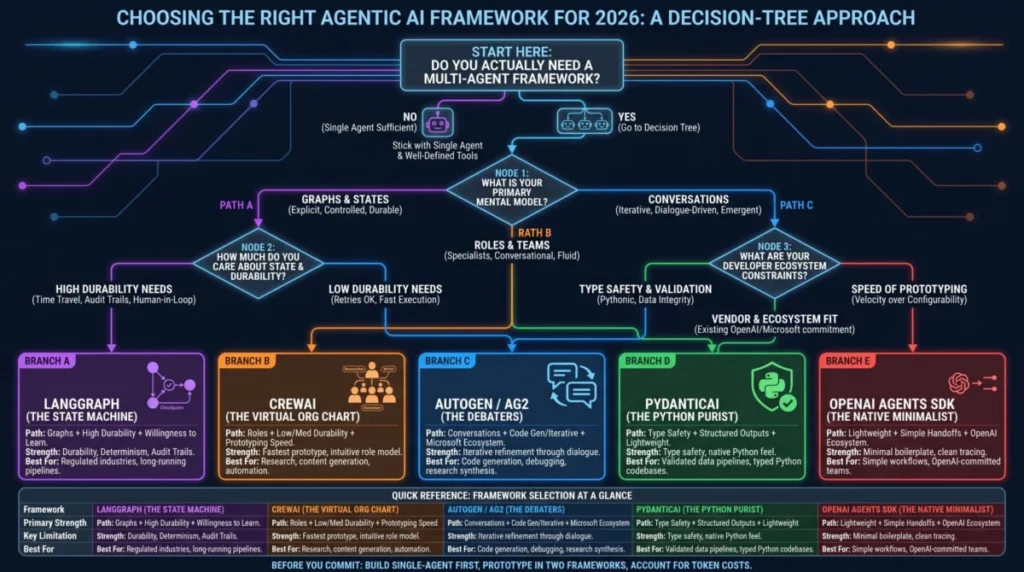
Before evaluating these frameworks, there is a "Node Zero" in the decision process: Do you actually need a multi-agent system?
The most common error in contemporary AI engineering is premature optimization via complexity. Multi-agent systems introduce overhead in token consumption, debugging, and latency. A single, well-architected agent with a robust system prompt and a clear suite of tools can often outperform a sprawling team of agents.
Reach for multi-agent orchestration only if:
- Task Divergence: The problem requires distinct, non-overlapping skill sets (e.g., one agent for secure database access, another for creative synthesis).
- Constraint Isolation: You need to sandbox specific capabilities for security reasons.
- Iterative Refinement: The task requires a "debate" or "critique" loop that naturally evolves the output quality over multiple turns.
If your requirements do not hit these markers, start with a monolithic agent. It is easier to debug, cheaper to run, and significantly more predictable.
The Decision Matrix: Evaluating Your Architectural Needs
If you have confirmed that your workload demands a multi-agent architecture, you must evaluate it against three specific nodes of architectural requirement.
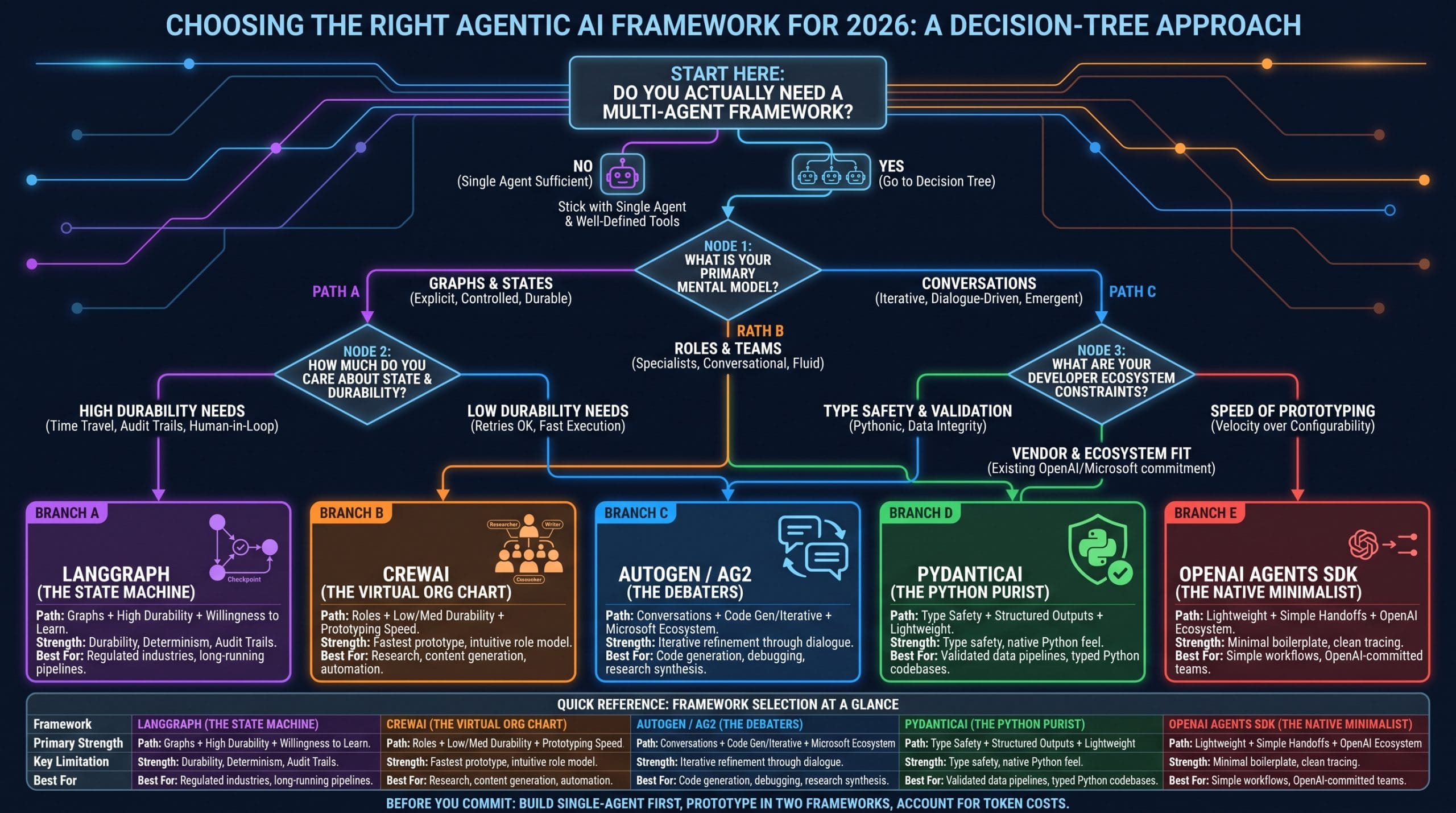
Node 1: The Mental Model
How do you visualize the workflow?
- Graphs/States: If your workflow is a series of deterministic steps with clear "if-this-then-that" logic, you are a Graph Thinker.
- Roles/Teams: If your system functions like a group of colleagues passing tasks back and forth, you are a Role Thinker.
- Conversations: If your goal is for agents to "hash out" a problem through dialogue, you are a Dialogue Thinker.
Node 2: Durability Requirements
Does your system need to survive a server restart?
- High Durability: You need state persistence, audit trails, and "human-in-the-loop" approval gates. This is mandatory for finance, legal, and healthcare.
- Low Durability: If a failure allows you to simply restart the task from scratch, you can prioritize speed over persistence.
Node 3: Ecosystem Constraints
- Python/Type-Safety: Does your codebase rely on strict Pydantic models for data validation?
- Vendor Lock-in: Is your organization committed to Azure/Microsoft, or do you require model-agnostic neutrality?
Framework Deep-Dive: A Strategic Assessment
1. LangGraph: The Gold Standard for Durability
LangGraph is the premier choice for production-grade, state-heavy systems. By modeling workflows as directed graphs, it allows for "time travel"—the ability to inspect, modify, and resume an agent’s state at any point in time.
- Implications: It is the only choice for regulated industries where "why did the agent do this?" must be answered by an audit trail.
- Trade-off: The verbosity is high. It requires a significant upfront investment in defining schemas and edges.
2. CrewAI: The Prototyping Powerhouse
CrewAI excels at the "Virtual Organization" metaphor. It is the fastest path to a working multi-agent prototype.
- Implications: It is ideal for rapid iteration in R&D or content generation.
- Trade-off: Because coordination is based on fluid role handoffs, it can be difficult to constrain if the system begins to drift or loop.
3. AG2 (Formerly AutoGen): The Iterative Debater
Built on the premise that agents should talk until they agree, AG2 is the leading framework for code generation and technical problem-solving.
- Implications: Tight integration with Microsoft/Azure ecosystems makes it a default choice for enterprises already in the Microsoft stack.
- Trade-off: The conversational nature of the framework introduces unpredictability that can be difficult to manage in strict, deterministic production environments.
4. PydanticAI: The Python Purist’s Choice
PydanticAI isn’t trying to be a massive orchestrator; it is trying to be the best way to integrate LLMs into a typed Python codebase.
- Implications: It turns agent interactions into standard Python function calls with strict data validation. It feels less like an "AI framework" and more like a standard software library.
- Trade-off: It lacks the built-in orchestration layer for long-running, multi-step workflows.
5. OpenAI Agents SDK: The Minimalist’s Path
For teams exclusively using OpenAI models, the official SDK offers the cleanest, most performant integration.
- Implications: It is highly optimized for performance and includes excellent native tracing.
- Trade-off: It creates deep vendor lock-in and is not designed for complex, non-linear orchestration patterns.
Strategic Implications and Operational Costs
When transitioning these systems to production, developers must account for the "Agent Tax." Multi-agent systems significantly increase token usage. A simple task that costs $0.01 per run with a single agent can easily jump to $0.05 or $0.10 when delegated across a crew of four agents due to the constant handoffs and context repetition.
Furthermore, operational complexity grows exponentially. A multi-agent system is a distributed system; it will face network latency, model provider outages, and "hallucination propagation," where one agent’s error cascades into another’s task.
Final Recommendations for CTOs and Lead Engineers
- Prioritize Observability: No matter the framework, ensure you have robust tracing. If you cannot visualize the agent’s internal "thought process," you are flying blind in production.
- Validate at the Boundary: Use Pydantic or similar tools to enforce strict data schemas at every handoff point between agents. Never trust a "black box" output to be ready for the next agent.
- Dual-Path Prototyping: If you are undecided between two frameworks, dedicate a "spike" to build the same core logic in both. The framework that causes the least friction with your team’s existing coding style is almost always the correct choice for long-term maintenance.
The agentic AI landscape is moving fast, but the principles of good software engineering remain constant. By prioritizing determinism, auditability, and cost-efficiency over the "latest" trend, you ensure that your production systems are not just clever, but reliable.