Madras High Court Dismisses AIADMK Plea Against Tamil Nadu Assembly’s Mekedatu Resolution
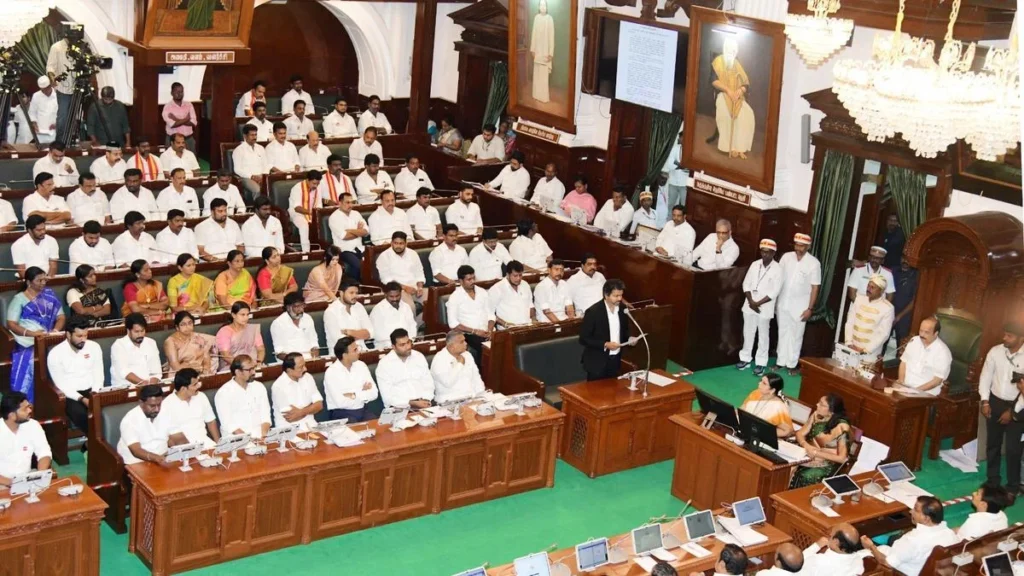
Chennai, September 23, 2026 – In a significant judicial intervention regarding legislative procedure and inter-State water disputes, the Madras High Court on Wednesday dismissed a writ petition filed by AIADMK whip Agri S.S. Krishnamurthy. The petition had sought to challenge the procedural validity of an amendment to a legislative resolution passed on June 19, 2026, which formally opposed the Karnataka government’s proposed Mekedatu balancing reservoir project across the Cauvery River.
The First Division Bench, comprising Chief Justice Sushrut Arvind Dharmadhikari and Justice G. Arul Murugan, ruled against the petitioner after reviewing video evidence that clarified the sequence of events within the Tamil Nadu Legislative Assembly. The verdict serves as a definitive closure to a controversy that had questioned the integrity of the resolution’s passage.
The Core Conflict: Procedural Integrity vs. Political Allegation
The crux of the legal challenge rested on the claim that the Tamil Nadu Legislative Assembly had acted in a manner inconsistent with its own standing orders. Agri S.S. Krishnamurthy, representing the opposition, contended that the resolution initially circulated to members on June 18, 2026, was fundamentally altered at the eleventh hour.
According to the petitioner, the unamended resolution was designed to express categorical opposition to the Mekedatu dam. However, he alleged that during the proceedings on June 19, an amendment—urging the Union government to constitute a tribunal under the Inter-State River Water Disputes Act, 1956—was inserted at the behest of the Leader of the Opposition, Udhayanidhi Stalin, and accepted by Chief Minister C. Joseph Vijay without adequate debate.
The petitioner argued that because the amendment was introduced suddenly, members did not have the opportunity to scrutinize or debate the shift in strategy. Consequently, he requested that the court quash the amended portion of the resolution and uphold the original version as the valid expression of the House.

Chronology of the Mekedatu Dispute
The timeline of this legislative friction highlights the sensitivity of the Cauvery water-sharing issue:
- June 18, 2026: The Tamil Nadu Legislative Assembly receives notice of a proposed resolution aimed at opposing the Karnataka government’s Mekedatu project. The draft is circulated among MLAs.
- June 19, 2026: During the Assembly session, Chief Minister C. Joseph Vijay moves the resolution. Following a suggestion from Leader of the Opposition Udhayanidhi Stalin, an amendment is proposed to include a formal request for the establishment of a specialized tribunal. The resolution, as amended, is passed unanimously.
- Late June – July 2026: Political murmurs grow regarding the nature of the amendment. The AIADMK leadership prepares a legal challenge, asserting that the legislative process was compromised.
- August 2026: Agri S.S. Krishnamurthy files a writ petition in the Madras High Court, seeking to invalidate the amendment and restore the original text of the resolution.
- September 23, 2026: The First Division Bench of the Madras High Court hears the case. Advocate General (A-G) Vijay Narayan presents digital evidence, leading to the dismissal of the petition.
The Role of Digital Evidence in Judicial Review
In a modern twist to traditional legislative litigation, the Madras High Court relied heavily on primary audiovisual evidence. Advocate General Vijay Narayan, representing the State, moved to debunk the petitioner’s claims by playing official video recordings of the Assembly proceedings.
The footage demonstrated that the Leader of the Opposition had indeed requested the inclusion of the tribunal clause. More crucially, the video showed that Chief Minister C. Joseph Vijay accepted the suggestion, and Speaker J.C.D. Prabhakar subsequently put the amended resolution to a vote.
The A-G’s argument was precise: the legislative record showed no dissent from the floor. None of the MLAs, including the petitioner, raised an objection when the Speaker called for a vote on the modified text. The court, having observed the transparency of the process through the video clips, found no merit in the claim that the resolution was passed in a surreptitious or irregular manner.
Implications for Inter-State Water Diplomacy
The dismissal of the petition has immediate implications for the ongoing tussle over the Cauvery River. By upholding the validity of the amended resolution, the court has effectively solidified Tamil Nadu’s official stance: that the dispute must be elevated to a formal tribunal.

Legal Implications
For the judiciary, this case reaffirms the principle of non-interference in the internal proceedings of the Legislative Assembly, provided the procedures conform to the fundamental requirements of parliamentary democracy. The court’s refusal to interfere in the "internal affairs" of the House is a victory for the principle of separation of powers.
Political Implications
For the DMK-led government under Chief Minister C. Joseph Vijay, the court’s decision provides a significant political boost. It validates the collaborative approach taken between the ruling party and the opposition (in this specific instance) to present a unified front to the Centre.
For the AIADMK, the failed petition represents a setback in their attempt to portray the current government’s handling of the Mekedatu issue as "weak" or "procedurally flawed." The party will now have to contend with the fact that their own members were present in the House during the vote and did not challenge the resolution at the time of its adoption.
The Mekedatu Project: A Persistent Flashpoint
The Mekedatu project remains one of the most contentious infrastructure proposals in South India. Karnataka maintains that the project, which includes a balancing reservoir, is essential to provide drinking water to Bengaluru and its surrounding areas, as well as to generate hydroelectric power.
Conversely, Tamil Nadu has consistently argued that the construction of any dam on the Cauvery at Mekedatu would severely restrict the flow of water to the lower riparian State, particularly during the crucial summer months and lean periods. Tamil Nadu’s insistence on a tribunal is rooted in the belief that the dispute has reached an impasse that cannot be resolved through bilateral talks alone.

The inclusion of the demand for a tribunal in the now-validated Assembly resolution signals a shift in Tamil Nadu’s tactical approach—moving from mere protest to demanding a formalized legal adjudication process by the Union government.
Conclusion: Upholding Legislative Finality
The decision delivered by Chief Justice Dharmadhikari and Justice Arul Murugan serves as a cautionary tale for political parties regarding the documentation and challenging of legislative actions. By proving that the Assembly followed its own rules and that members had the opportunity to object, the State government successfully defended the integrity of its legislative output.
As the matter now shifts back to the arena of inter-State relations and the potential involvement of the Union government, the Tamil Nadu Legislative Assembly stands united by a resolution that has survived a rigorous legal audit. Whether the Centre will heed the demand for a new tribunal remains to be seen, but the procedural hurdle that threatened to derail the State’s unified stance has been decisively cleared.
The Madras High Court’s ruling stands as a testament to the importance of the official legislative record, proving that in the digital age, the "video evidence of the House" is the final arbiter of truth in parliamentary disputes.