Navigating the Reasoning Frontier: Chain of Thought vs. Tree of Thoughts in AI Agent Design
In the rapidly evolving landscape of artificial intelligence, the quest to build machines that "think" before they act has become the primary objective for developers. Large Language Models (LLMs), for all their linguistic fluency, possess an inherent architectural flaw: they are probabilistic engines designed to predict the next token. Without specific intervention, they prioritize speed and coherence over deep, logical deliberation. This often results in "hallucinations"—confident, well-structured answers that are fundamentally incorrect.
To bridge this gap, researchers have developed sophisticated reasoning frameworks: Chain of Thought (CoT) and Tree of Thoughts (ToT). These methodologies do not simply ask an AI to provide an answer; they force the model to construct a scaffold of logic before reaching a conclusion. As we transition from simple chatbots to autonomous AI agents capable of executing multi-step workflows, understanding the distinction between these two frameworks has become a prerequisite for effective system architecture.
The Core Problem: Why Models Need Help
To understand the necessity of these techniques, one must first recognize the "linear trap" of LLMs. When a standard model is asked a complex question—such as a multi-stage programming task or a nuanced strategic analysis—it typically generates a response in a single, unbroken stream. Because the model cannot "see" the future, it commits to a trajectory early in its output.
If the first sentence of that reasoning process contains a subtle error, the subsequent logic will inevitably be built upon that faulty foundation. The model lacks the innate capacity for self-correction. It will continue to generate text that sounds authoritative, masking the underlying logic failure. Both CoT and ToT serve as structural overlays that mandate an intermediate reasoning phase, effectively turning a "reflexive" machine into a "reflective" one.
Chain of Thought: The Linear Paradigm
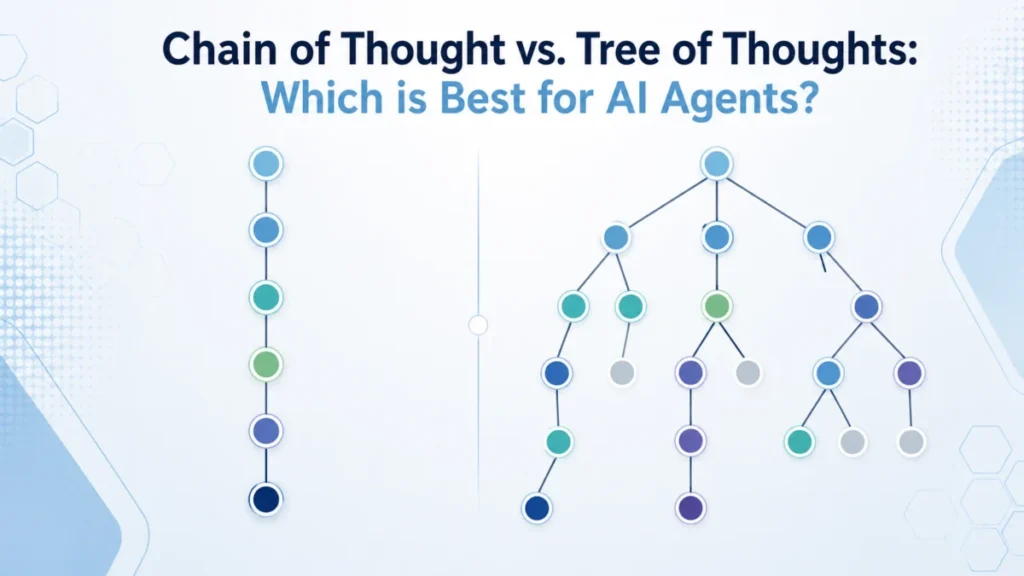
Chain of Thought (CoT) is the foundational reasoning framework for modern LLMs. It functions by prompting the model to decompose a complex task into a sequential series of steps.
Chronology of Implementation
The concept gained mainstream attention with the "Let’s think step by step" prompt, a phrase that famously unlocked significant performance gains in models like GPT-3.5. By encouraging the model to vocalize its internal logic, the error rate in arithmetic and logical reasoning tasks dropped precipitously.
Mechanism and Audits
In a CoT implementation, the system treats reasoning as a linear progression:
- Decomposition: The problem is broken down into constituent parts.
- Sequential Inference: Step A leads to Step B, which leads to Step C.
- Synthesis: A final answer is derived from the established sequence.
Because this process is transparent, it is highly "auditable." Developers can trace the model’s logic line by line, making it easier to debug why a specific conclusion was reached. However, the limitation remains rigid: linearity. There is no mechanism to re-evaluate a step once the model has moved on to the next, nor is there a way to compare two competing paths. It is a "one-shot" approach to reasoning.
Tree of Thoughts: The Branching Revolution
If CoT is a student showing their work on a page, Tree of Thoughts (ToT) is a grandmaster evaluating multiple potential moves in a chess match. ToT introduces non-linearity, allowing the system to branch out, evaluate, and backtrack.
The Logic of Search Algorithms
ToT treats reasoning as a search problem. Instead of a single path, the system generates multiple "thought candidates" at each juncture. A meta-evaluator—often another LLM prompt or a programmed heuristic—scores these candidates based on their probability of leading to a correct solution.
- Branching: The system creates a map of possibilities rather than a single line.
- Evaluation: Paths are pruned or prioritized based on their "success potential."
- Backtracking: If a path hits a logical dead-end, the agent reverts to a previous, more promising branch to attempt a different approach.
Supporting Data on Efficiency
Research into ToT indicates that while it is significantly more resource-intensive, it drastically outperforms CoT on problems requiring high-level planning or creative synthesis. Studies show that for tasks involving complex, open-ended problem solving (such as the "Game of 24" or creative writing puzzles), ToT can improve success rates by as much as 40-70% compared to standard CoT, provided the system has enough computational budget to support the repeated model calls.
Implications for AI Agent Architecture
The choice between CoT and ToT is not merely an academic exercise; it dictates the operational cost and reliability of AI agents in enterprise environments.
The "Cost-Performance" Trade-off
AI agents are increasingly used to automate complex workflows—such as analyzing financial reports, drafting legal contracts, or managing cloud infrastructure.
- The Cost of ToT: ToT can require dozens of model calls to resolve a single query. This increases latency, consumes significantly more compute (and therefore capital), and complicates the user experience if not properly managed.
- The Speed of CoT: CoT is the "workhorse." It is fast, efficient, and sufficient for 90% of routine tasks. For an agent that is simply retrieving data or summarizing emails, the overhead of ToT is unnecessary and counterproductive.
The Hybrid Future: Official Industry Stance
Leading AI architects are moving toward a tiered reasoning model. In this architecture, the agent assesses the complexity of the incoming task.
- Low Complexity: If the task is simple, the agent defaults to a standard, fast Chain of Thought path.
- High Complexity: If the agent identifies ambiguity or a high risk of "compounding errors," it switches to a Tree of Thoughts approach, allocating more compute to explore multiple solutions before finalizing an action.
Choosing the Right Framework
To determine which framework is appropriate for your agent, consider these three pillars:
1. The Nature of the Task
Is there a singular, objective path to the answer? If yes, use Chain of Thought. If the problem is "search-heavy"—meaning there are many ways to reach the goal and several ways to fail—use Tree of Thoughts.
2. The Cost of Error
In a system where an AI is suggesting a restaurant, a small logic error is trivial. In a system where an AI is writing code for a production server or calculating tax liabilities, an early error is catastrophic. When the cost of an error is high, the investment in ToT’s backtracking capabilities is not just justified—it is essential.
3. Resource Constraints
Latency is the silent killer of AI adoption. If your user requires a response in under two seconds, ToT is likely unfeasible. However, for "offline" agent tasks, such as overnight batch processing of data, the extra time required for ToT is a minor trade-off for the superior accuracy it provides.
Conclusion
The distinction between Chain of Thought and Tree of Thoughts represents a maturation in how we design AI. We are moving away from the era of "one prompt, one answer" and into an era of "reasoned decision-making."
Chain of Thought offers the speed and simplicity required for everyday interactions, acting as a reliable, linear guide for AI agents. Tree of Thoughts provides the structural depth required for complex, high-stakes environments, offering the resilience of a system that can admit a mistake and try again.
As AI agents continue to move from experimental sandboxes into the core of enterprise operations, the most successful systems will be those that do not force a choice between these two. Instead, they will treat reasoning as a dynamic, scalable resource—deploying the linear efficiency of CoT for the routine, and the branching intelligence of ToT for the extraordinary. By mastering both, developers can create agents that are not just fluent, but truly capable of navigating the complex, often non-linear, reality of human problem-solving.