One Year of Innovation: Reflecting on the Evolution of the AWS Builder Center
It has been exactly one year since the launch of the AWS Builder Center, a platform that has rapidly transformed from a simple community hub into a cornerstone of the global cloud computing developer ecosystem. Since its inception on July 9, 2025, the platform has sought to bridge the gap between complex cloud architecture and practical, hands-on learning. As of July 2026, the Builder Center has not only reached its first anniversary but has established itself as an essential utility for architects, engineers, and students alike.
A Chronology of Rapid Growth
The journey of the AWS Builder Center is a testament to the velocity of the modern developer landscape. When the platform debuted, its primary value proposition was focused on community engagement—offering wishlist voting, standardized profiles, and a basic toolbox. However, the roadmap for the following twelve months was ambitious, aiming to transition the site into a comprehensive ecosystem.
The First 365 Days
- Q3 2025: The Foundation. The launch focused on community-driven development, allowing builders to influence the feature set through wishlist voting.
- Q4 2025: Expanding the Library. The introduction of the "Builders’ Library" served as the primary knowledge repository, allowing for the cataloging of best practices.
- Q1 2026: Gamification and Engagement. March 2026 marked a pivotal shift toward user retention through the implementation of a badge and streak system, incentivizing consistent contribution.
- Q2 2026: Seamless Accessibility. The integration of GitHub and Amazon authentication streamlined the barrier to entry, while the launch of "Spaces" allowed for the formation of niche community groups.
- Q3 2026: The Anniversary Milestone. To commemorate the one-year mark, AWS introduced Sandbox Environments, arguably the most significant feature release to date.
Supporting Data: By the Numbers
The metrics behind the Builder Center suggest a thriving community that values high-quality, peer-reviewed content. In a retrospective published by Jeff Barr, the data underscores a platform that has moved beyond its experimental phase into a powerhouse of technical knowledge sharing.
Engagement Statistics
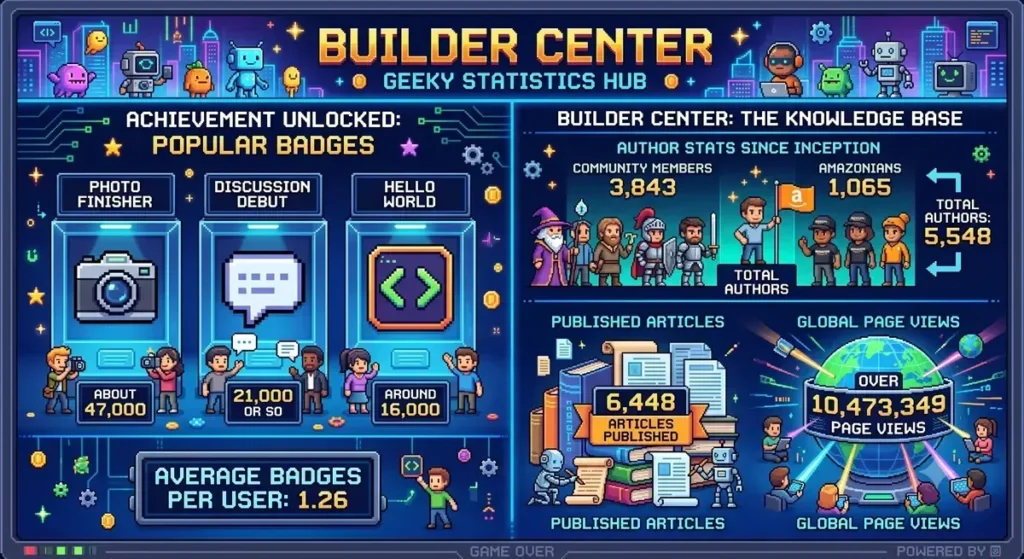
- Authorship: A total of 5,548 unique authors have contributed to the platform.
- Knowledge Output: Collectively, these contributors have published 6,448 articles.
- Reach: The platform has garnered over 10.4 million page views in its first year, indicating a massive appetite for peer-to-peer technical guidance.
- Gamification Success: Since its launch in March 2026, users have earned 99,226 badges, highlighting the effectiveness of the platform’s engagement-focused design.
- Community Influence: Out of 565 community-submitted wishes, 10 have already been shipped into production, with another 20 currently in the near-term development pipeline.
Top-Performing Content
The platform’s success is heavily driven by its most popular articles, which reflect the current trends in cloud computing, such as AI integration and legacy migration:
- "Building an AWS Study Buddy with MCP + Strands Agents SDK" by Dineshraj Dhanapathy: This article surged to over 50,000 views, proving that developers are eager to learn how to integrate Multi-Context Protocol (MCP) with AWS-based agentic frameworks.
- "Migrating an EOL Linux Server to AWS in 8 Hours with Kiro" by Chris Miller: With over 45,000 views, this piece highlights the persistent demand for practical, time-sensitive migration strategies.
- "AIdeas: NeuroVoice – Multimodal AI for Early Screening of Neurological Diseases" by Yash Aggarwal: Reaching over 38,000 views, this article showcases the growing intersection of cloud technology and high-impact healthcare solutions.
The Landmark Feature: Sandbox Environments
The headline addition for the anniversary week, introduced by Rick Suttles, is the "Sandbox Environments" feature. This is a critical development for the democratization of cloud learning. Previously, learners often faced the hurdle of setting up personal AWS accounts, managing billing configurations, and ensuring manual cleanup of resources to avoid unexpected costs.
Sandbox Environments remove these frictions by providing a free, pre-provisioned AWS account tailored for specific workshop exercises. Each environment is active for an 8-hour window, after which the account and its associated resources are automatically de-provisioned. This "zero-friction" approach allows developers to focus entirely on the workshop material rather than the administrative overhead of cloud management. With a limit of one active sandbox at a time and one per week, AWS has struck a balance between accessibility and resource sustainability.
Official Perspectives: A Vision for the Future
In his anniversary retrospective, Jeff Barr reflected on the ethos of the platform. "The Builder Center was created to empower those who build," Barr noted. The focus has consistently been on reducing the ‘time-to-first-value’ for developers. By offering granular data on AWS capabilities across 37 regions and 1,500+ services, the Builder Center acts as a connective tissue for the AWS ecosystem.
The leadership at AWS views the first year as a proof-of-concept for a new way of fostering community. By integrating "Spaces" for group collaboration and "Availability Notifications," the platform has evolved from a passive documentation site into a proactive tool that alerts developers when their specific areas of interest are updated or expanded.
Implications for the Developer Community
The success of the AWS Builder Center carries significant implications for the future of technical education and community management.
1. The Rise of "Just-in-Time" Learning
The shift toward sandboxes and short-form workshop content suggests that the modern developer prefers "just-in-time" learning—acquiring the specific skills needed for a task immediately before execution. The 8-hour sandbox model perfectly supports this methodology.
2. Peer-to-Peer Authority
The high viewership of user-contributed articles suggests that developers trust their peers as much as, if not more than, formal documentation. The Builder Center has effectively legitimized community-led tutorials, creating a verified path for developers to become thought leaders within the AWS ecosystem.
3. Accelerated Feature Adoption
By allowing users to vote on "wishes" and having those features subsequently developed, AWS has created a feedback loop that accelerates product development. This keeps the AWS platform aligned with the real-world needs of its user base, rather than relying solely on top-down feature releases.

Looking Ahead
As the AWS Builder Center moves into its second year, the focus will likely remain on scalability and the refinement of its collaborative tools. With thousands of contributors and a rapidly expanding repository of knowledge, the platform is well-positioned to remain the primary destination for developers looking to master the complexities of the cloud.
For those yet to participate, the message is clear: the Builder Center is no longer a peripheral resource; it is an essential part of the professional development toolkit. Whether you are navigating a complex migration, exploring the frontiers of multimodal AI, or simply looking to refine your cloud architecture skills, the platform offers the environment, the data, and the community to support your growth.
As Esra, a key contributor to the platform, aptly put it, the Builder Center is a place to "meet other builders, contribute solutions, and find resources that help you keep building." With the summer months providing a natural cadence for learning and reflection, there has never been a better time to engage with the tools and community that are shaping the future of cloud computing.
For further exploration of these updates and to participate in upcoming community events, developers are encouraged to visit the AWS Builder Center regularly. As the platform continues to evolve, the barrier to entry for complex cloud projects will only continue to lower, ensuring that the next generation of builders is better equipped than ever before.