Central Delhi Plunged into Digital Darkness: Mobile Internet Suspended Amid Mass Protests Over NEET Irregularities
NEW DELHI — In a dramatic escalation of public unrest over national examination scandals, the Indian government enforced a complete mobile internet blackout across Central Delhi on July 20, 2026. The communications shutdown, the first of its scale in the national capital since the historic farmers’ agitation of 2021, was implemented as thousands of demonstrators converged on Jantar Mantar and Sansad Marg.
The protests, spearheaded by student organizations, opposition youth wings, and activist groups—including the "Cockroach Janta Party" (CJP)—demanded the immediate resignation of Union Education Minister Dharmendra Pradhan. The agitation stems from systemic irregularities, paper leaks, and grading discrepancies in the National Eligibility cum Entrance Test (NEET), which has thrown the futures of millions of medical aspirants into jeopardy.
Main Facts of the Blackout and Protests
The digital clampdown began in the early afternoon of July 20, 2026, catching protestors, journalists, and local businesses off guard. For several hours, mobile data services (5G and 4G) were completely inaccessible across major administrative and commercial zones in Central Delhi, including Connaught Place, Parliament Street, Jantar Mantar, and India Gate.
Key Details of the Incident:
- The Trigger: Mass mobilization of students and political activists marching toward Parliament to protest the handling of the NEET-UG examination discrepancies.
- The Action: Security forces deployed water cannons, tear gas, and physical force to disperse crowd gatherings near the Parliament Street Police Station.
- The Blackout: Under directives from the Ministry of Home Affairs, telecom service providers suspended mobile internet services throughout the central district, severely disrupting real-time communication.
- The Impact on Press Freedom: Journalists on the ground were unable to broadcast live footage or transmit photographs of the police action, forcing media personnel and protestors to seek refuge in nearby commercial establishments to access private Wi-Fi networks.
Chronology of the Day: July 20, 2026
The tension in the capital had been building for weeks, but events on July 20 escalated rapidly from peaceful assembly to physical confrontation and digital censorship.
+-----------------------------------------------------------------------------------+
|                                 TIMELINE OF EVENTS                                |
+-----------------------------------------------------------------------------------+
| 09:00 AM | Protesters gather at Jantar Mantar; heavy police presence deployed.   |
| 11:30 AM | Cockroach Janta Party (CJP) begins march toward Parliament.            |
| 01:00 PM | Barricades breached near Sansad Marg; police use water cannons.       |
| 02:15 PM | Mobile internet services abruptly cut off across Central Delhi.       |
| 03:00 PM | Police initiate physical dispersal; journalists lose transmission.    |
| 06:30 PM | Protesters dispersed; mobile internet services gradually restored.     |
+-----------------------------------------------------------------------------------+
09:00 AM – The Gathering Storm
By early morning, hundreds of students and civil society members began assembling at Jantar Mantar, the designated protest site in the capital. Armed with placards reading "Justice for NEET Aspirants" and "Resign Dharmendra Pradhan," the crowd grew progressively larger as university delegations from Delhi University (DU), Jawaharlal Nehru University (JNU), and Jamia Millia Islamia arrived.
11:30 AM – The March Commences
Tensions flared when a large contingent of protesters, including members of the Cockroach Janta Party (CJP)—an activist group known for its highly visible, satirical protest methods—attempted to bypass police barricades and march toward Parliament House via Sansad Marg.
01:00 PM – Confrontation at the Barricades
As the marchers approached the Parliament Street Police Station, security personnel, including the Delhi Police and paramilitary units, formed human chains and deployed multi-layered iron barricading. When protesters attempted to scale the barriers, law enforcement responded with water cannons and mild lathi-charge (forceful dispersal using batons) to push back the crowd.
02:15 PM – The Digital Blackout
Without prior public notice, mobile signals dropped sharply across the entire Central Delhi district. Mobile internet services were severed, leaving thousands of people instantly disconnected. This measure effectively blinded the protest movement, preventing organizers from coordinating logistics and stopping the immediate dissemination of live updates.
03:00 PM – Forced Dispersal and Media Obstruction
With communications severed, police launched a coordinated drive to clear Sansad Marg. Because journalists could not upload live footage or send high-resolution images to their respective newsrooms, a critical information vacuum emerged. Reporters and photographers were forced to run into nearby cafes, hotels, and offices along Connaught Place, pleading with shop owners for Wi-Fi passwords to transmit images of injured protesters and police maneuvers.
06:30 PM – Restoration and Lingering Tensions
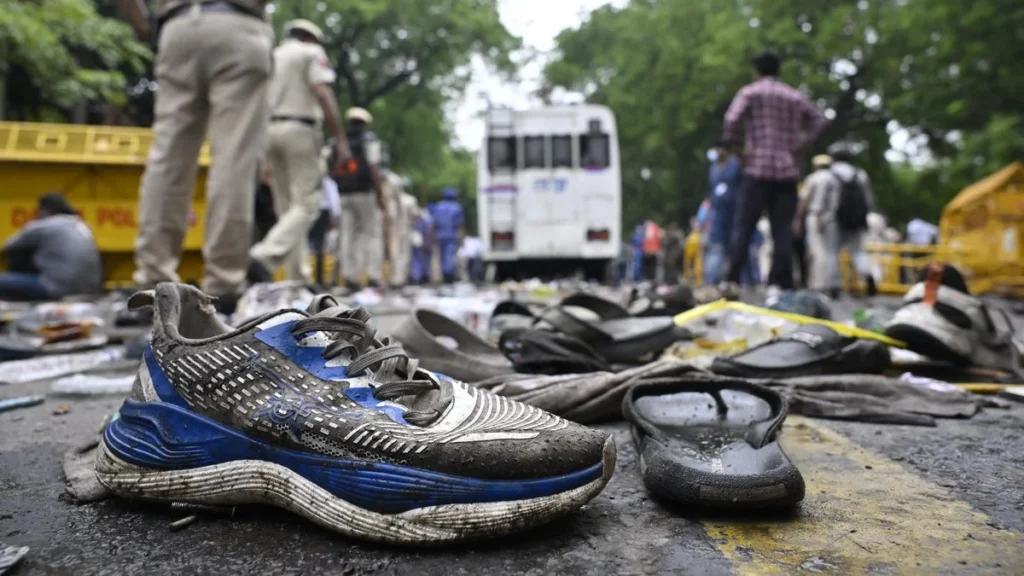
By evening, the streets of Sansad Marg were largely cleared, leaving behind scattered placards, torn banners, and a heavy security footprint. Mobile internet services were gradually restored in phases after 6:30 PM, revealing a wave of online outrage that had built up during the hours of enforced silence.
Supporting Data: Contextualizing India’s Internet Shutdowns
The decision to cut off mobile internet in the heart of the national capital is a rare and severe administrative measure. While India has earned a reputation as a global leader in internet shutdowns, such actions have historically been concentrated in regions experiencing active militancy, border conflicts, or severe communal violence, such as Jammu & Kashmir, Manipur, and parts of Rajasthan during state-level exams.
Comparative Scale of Delhi Shutdowns
Prior to the July 20, 2026 incident, the national capital had not witnessed a widespread communications blackout of this nature since the 2020–2021 Indian farmers’ protest.
| Date of Shutdown | Affected Areas in Delhi | Primary Cause / Context | Duration |
|---|---|---|---|
| January 26, 2021 | Singhu, Tikri, Ghazipur borders, and parts of Central Delhi | Farmers’ Republic Day Tractor Rally clashes | 48 Hours |
| February-March 2021 | Border regions of Delhi-NCR | Ongoing Farmers’ Protests | Intermittent |
| July 20, 2026 | Central Delhi (Lutyens’, Sansad Marg, Connaught Place) | Student protests over NEET irregularities | ~4.5 Hours |
Trends in Telecom Suspensions
According to data maintained by the Software Freedom Law Centre, India (SFLC.in), internet shutdowns had been on a general decline over the preceding two years (2024–2025) due to increased judicial scrutiny and public pushback. The sudden re-emergence of this tactic in a highly secure, central metropolitan area like New Delhi marks a sharp departure from recent trends, signaling a return to aggressive digital policing.
The Scale of the NEET-UG Crisis
The underlying cause of the protest—the National Eligibility cum Entrance Test (NEET-UG)—is one of the largest competitive exams in the world. In 2026, over 2.4 million students registered for the exam. Systemic failures, including allegations of paper leaks, grace mark manipulation, and institutional corruption, have affected families nationwide, transforming a localized administrative failure into a national crisis of trust.

Official Responses and Civil Society Backlash
The shutdown has triggered a fierce war of words between government representatives, law enforcement agencies, and digital rights advocates.
Government and Police Justification
An anonymous senior official within the Ministry of Home Affairs defended the temporary suspension of services, citing public safety and national security concerns:
"The measures taken were preventive and fully compliant with the Temporary Suspension of Telecom Services (Public Emergency or Public Safety) Rules, 2017. We received credible intelligence that anti-social elements were planning to mobilize massive crowds via social media platforms to storm restricted government buildings. Temporary suspension of data services was necessary to prevent panic, coordinate law and order, and maintain public peace."
The Delhi Police issued a brief statement confirming that several protesters were detained for violating prohibitory orders under Section 144 of the Bharatiya Nagarik Suraksha Sanhita (BNSS), which bans public gatherings in the area.
Condemnation from Digital Rights Advocates
Civil society organizations and digital rights groups quickly condemned the government’s actions, calling the shutdown disproportionate and authoritarian.
The Internet Freedom Foundation (IFF) issued a strongly worded statement:
"Shutting down the internet in the capital city to control a peaceful student protest is a disproportionate measure that violates the fundamental right to freedom of speech and expression. Such actions violate the supreme court’s guidelines laid down in the landmark Anuradha Bhasin v. Union of India judgment, which mandates that internet shutdowns must satisfy the tests of necessity and proportionality."
The Software Freedom Law Centre (SFLC) echoed these concerns, highlighting the economic and social damage caused by such blackouts:
"By turning off the internet, the state not only silences dissent but also halts daily life. Thousands of ordinary citizens, gig workers, and small business owners in Central Delhi were subjected to financial disruption today. The government cannot continue to use digital blackouts as a first-line tool for crowd control."
Implications: Democracy, Press Freedom, and Public Trust
The events of July 20, 2026, carry profound implications for the future of democratic dissent, media freedom, and administrative accountability in India.
A Chilling Effect on Independent Journalism
The primary casualty of the digital blackout was the free flow of information. By cutting off mobile networks, the state successfully delayed the broadcast of police actions, preventing immediate public scrutiny of the physical force used against student demonstrators. This creates a dangerous precedent where law enforcement can operate in an information vacuum, shielded from real-time accountability.
Economic and Social Toll on the Capital
Central Delhi is not just a political hub; it is also one of the country’s busiest commercial centers. The shutdown of mobile internet crippled UPI (Unified Payments Interface) transactions, disrupted ride-hailing services, halted delivery logistics, and caused significant revenue losses for businesses in Connaught Place. In an increasingly digitized economy, even a few hours of telecom suspension can cause immense economic friction.
The Growing Democratic Deficit
Using national security mechanisms to suppress protests regarding educational and administrative failures indicates a growing reliance on heavy-handed tactics over constructive dialogue. By treating student protesters demanding accountability as threats to public order, the state risks further alienating the youth demographic and deepening the crisis of trust surrounding India’s national examination bodies.