Security Breach at the Heart of Federal Infrastructure: CISA Faces Congressional Scrutiny Over Massive Credential Leak
In a profound irony that has sent shockwaves through Washington, the Cybersecurity and Infrastructure Security Agency (CISA)—the federal body tasked with safeguarding the nation’s most critical digital assets—is currently grappling with a catastrophic internal security failure. A CISA contractor, possessing administrative access to the agency’s development environment, inadvertently provided a roadmap for foreign adversaries by publishing highly sensitive credentials to a public GitHub repository.
The incident, which saw plaintext AWS GovCloud keys and an array of internal agency secrets exposed to the open internet, has prompted sharp rebukes from Capitol Hill. Lawmakers are now demanding a comprehensive accounting of how such a significant lapse could occur within an agency that sits at the vanguard of the United States’ cyber defense strategy.
The Scope of the Exposure: "Private-CISA"
The breach was first brought to light by KrebsOnSecurity, which identified a public GitHub repository titled "Private-CISA." Analysis of the repository revealed that a contractor had used the platform as a personal "scratchpad" to synchronize work files, effectively bypassing institutional security protocols.
The repository contained a treasure trove of sensitive information, including plaintext credentials to numerous internal CISA systems, Kubernetes configuration files, and AWS GovCloud keys. Forensic analysis of the repository’s commit history indicates that the contractor explicitly disabled GitHub’s built-in security features—designed to flag and block the publication of secret keys—to facilitate the upload of these files.
While CISA has publicly claimed that there is "no indication that any sensitive data was compromised," security experts remain deeply skeptical. The nature of the exposure suggests that the keys were not only accessible but potentially harvested by automated scanners operated by both security researchers and malicious state-sponsored actors.
Chronology of a Security Failure
The timeline of the "Private-CISA" incident reveals a pattern of negligence that spanned several months, raising questions about the efficacy of the agency’s oversight of its third-party workforce.
- November 2025: Initial creation of the "Private-CISA" repository. Experts believe the contractor began using the platform at this time to sync work files between home and office environments.
- Late April 2026: The repository is updated with its most sensitive data, including critical AWS tokens and administrative credentials.
- May 18, 2026: KrebsOnSecurity publicly reports the existence of the repository following an investigation into the leaked data.
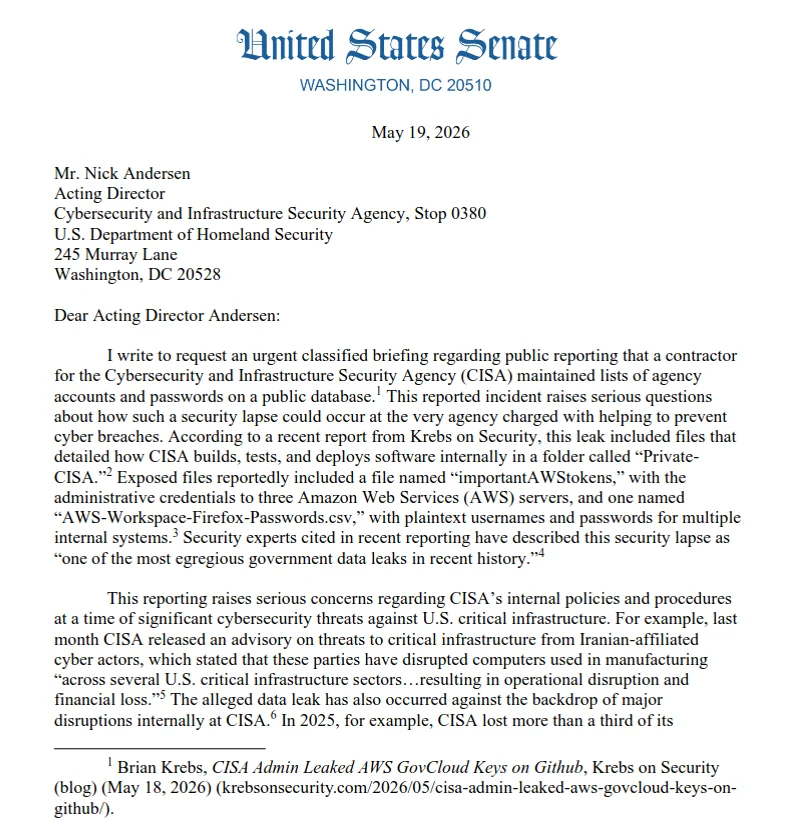
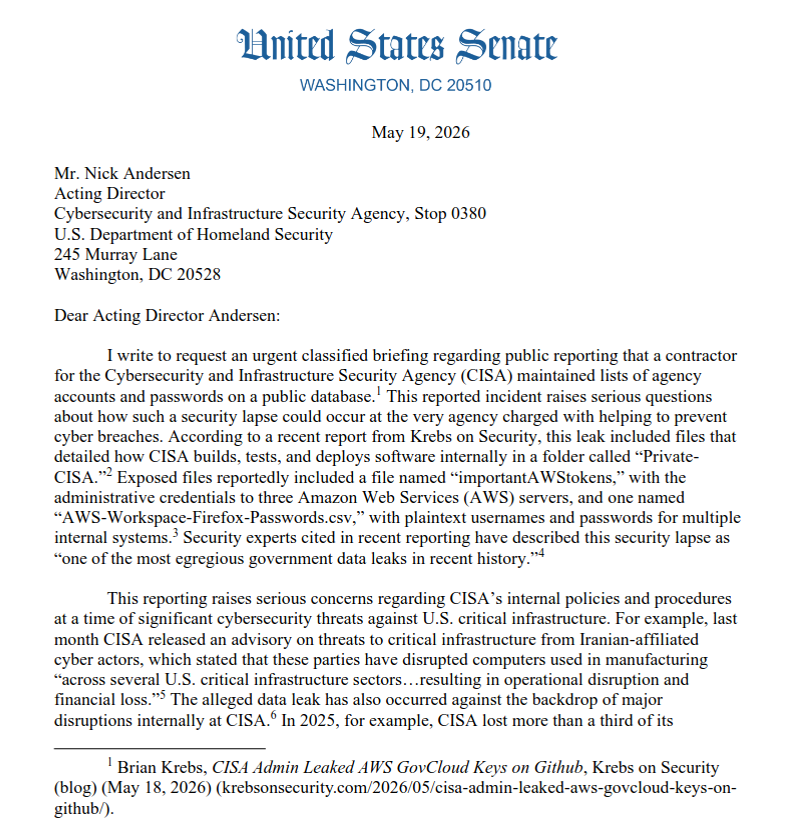
- May 19, 2026: In response to the disclosure, Sen. Maggie Hassan (D-NH) and House Homeland Security Committee leadership issue formal letters to CISA’s Acting Director, Nick Andersen, demanding answers regarding the extent of the breach and the agency’s failure to prevent it.
- May 20, 2026: Dylan Ayrey, founder of Truffle Security, identifies that a critical RSA private key remains active. This key provided full access to the "CISA-IT" GitHub organization. CISA finally moves to invalidate this specific credential after being notified by security researchers.
Technical Implications: A "Keys to the Kingdom" Scenario
The severity of the leak cannot be overstated. By failing to rotate the exposed RSA private key promptly, CISA effectively left the doors to its digital house wide open for days after the initial discovery.
Dylan Ayrey, whose firm Truffle Security specializes in identifying leaked secrets, noted that the exposed RSA key granted broad administrative rights. "An attacker with this key could read source code from every repository in the CISA-IT organization, including private repositories," Ayrey explained. "They could register rogue self-hosted runners to hijack CI/CD pipelines, access repository secrets, and modify admin settings, including branch protection rules."
CI/CD (Continuous Integration and Continuous Delivery) pipelines are the backbone of modern software development. By hijacking these pipelines, an attacker could inject malicious code into software updates destined for other government agencies, potentially turning CISA’s own infrastructure into a vehicle for a massive supply-chain attack.
While CISA has stated they are "actively responding and coordinating with vendors" to rotate the remaining exposed credentials, the delay in response has left the agency vulnerable. The "firehose" of public GitHub data is monitored by cybercriminal syndicates and intelligence services from countries like Russia, China, and Iran. The reality, as noted by security analysts, is that if the credentials were exposed, they were likely scraped by hostile actors within minutes of the commit.
Congressional Outcry and Institutional Instability
The political fallout has been swift. Sen. Maggie Hassan’s letter to Acting Director Nick Andersen highlights a growing anxiety that CISA’s ability to function as a lead agency is being undermined by internal volatility.
The agency is currently operating in a weakened state. Following a series of forced early retirements, buyouts, and resignations initiated under the current administration, CISA has lost nearly one-third of its workforce and the majority of its senior leadership. This "brain drain" has left the agency with significant gaps in expertise and oversight.
Rep. Bennie Thompson (D-MS) and Rep. Delia Ramirez (D-Ill) articulated this fear in their joint correspondence, suggesting that the "Private-CISA" leak is a symptom of a broader "diminished security culture."
"It’s no secret that our adversaries seek to gain access to and persistence on federal networks," the representatives wrote. "The files contained in the ‘Private-CISA’ repository provided the information, access, and roadmap to do just that."
The "Human Problem" of Cybersecurity
Industry experts warn that while CISA faces scrutiny, this incident highlights a systemic issue that technology alone cannot solve. James Wilson, editor of the Risky Business security podcast, pointed out that while corporations can implement strict policy-based controls, they often fail to account for the "shadow IT" practices of employees and contractors.
"This is a human problem," noted Adam Boileau, Wilson’s co-host. "You have hired a contractor who has decided, of their own volition, to use a personal platform to synchronize work files. There is no technical control that can effectively stop a user from opening a personal account and uploading proprietary information if they are intent on doing so."
The incident raises a difficult question for the federal government: How do you enforce security protocols in an era of remote, distributed work where contractors often prioritize convenience over established security mandates? The answer, according to many in the cybersecurity field, requires a fundamental shift in how agencies manage third-party access and how they audit the digital hygiene of their personnel.
Conclusion: A Wake-Up Call
As of the latest reports, CISA continues to work on the remediation process, scrubbing the digital landscape for the fallout of this massive exposure. However, the damage to the agency’s reputation—and the potential danger to the nation’s infrastructure—remains a lingering concern.
The "Private-CISA" incident serves as a stark reminder that even the most well-defended organizations are only as secure as their weakest link. When that link is an administrative-level contractor who decides to bypass security protocols, the result is a catastrophic exposure that takes weeks, if not months, to fully contain. For CISA, the task ahead is not just to rotate keys and fix passwords, but to rebuild a culture of security that has clearly been eroded by political turmoil and internal instability.
Congress is expected to hold hearings on the matter in the coming weeks, where the agency will be pressed to explain why internal monitoring systems failed to detect the repository for months and why the response to the initial disclosure was not more urgent. In the high-stakes world of federal cybersecurity, the CISA leak is not just a footnote—it is a glaring red flag that the nation’s digital defenses are in urgent need of repair.