Strengthening Global Resilience: Amazon Cognito Launches Multi-Region Replication and Customer Managed Keys
In an era where digital infrastructure is the backbone of the global economy, the tolerance for downtime has reached an all-time low. For web and mobile application developers, maintaining seamless user authentication—even in the face of rare regional service interruptions—is no longer a luxury; it is a critical business requirement. As the digital landscape shifts toward agentic AI, complex microservices architectures, and automated machine-to-machine (M2M) communications, the need for robust, cross-region identity management has become paramount.
Responding to these evolving demands, Amazon Web Services (AWS) has announced two significant enhancements to Amazon Cognito: native multi-Region replication and enhanced support for customer managed keys (CMKs). These updates represent a paradigm shift in how developers can architect for high availability and stringent security compliance without the burden of maintaining custom, error-prone replication middleware.
Main Facts: A New Standard for Identity Resiliency
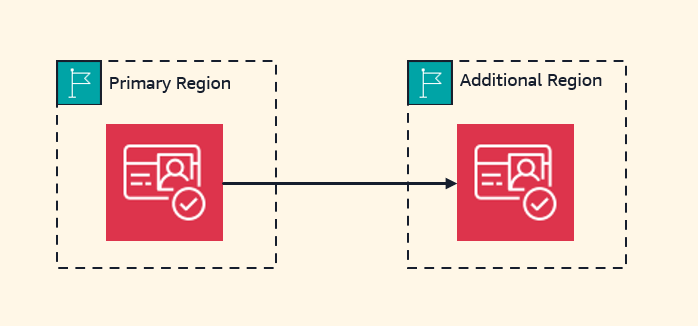
The core of the announcement centers on the ability to maintain a synchronized, read-only copy of user data and machine secrets in a secondary AWS Region. Previously, organizations aiming for high availability were forced to engineer bespoke solutions to keep user pools in sync. This often involved complex, manual export/import processes that introduced significant security risks, data inconsistency, and, most critically, a poor user experience—often forcing password resets or re-authentications during a failover event.
With this update, Amazon Cognito automates the synchronization process. The primary Region remains the source of truth, while the secondary Region acts as a standby, ready to handle authentication requests at a moment’s notice.

Key Capabilities Include:
- Automatic Data Synchronization: User profiles, credentials, and pool configurations are automatically replicated from the primary to the secondary Region.
- Uninterrupted Sessions: Because both regions recognize access tokens issued by the other, existing sessions remain valid during a failover, eliminating the need for users to log in again.
- Comprehensive Authentication Support: The feature supports all major authentication methods, including federated sign-in (Google, Apple, Amazon, Facebook), SAML, OIDC integrations, and standard API authorization flows.
- Enhanced Encryption Control: By integrating with AWS Key Management Service (AWS KMS), developers can now use customer managed keys to encrypt data at rest, providing an essential layer of control for regulated industries.
Chronology: The Evolution of the Feature
The journey toward this release has been driven by years of feedback from developers managing enterprise-scale applications. Historically, Amazon Cognito users had to operate within a single-Region silo, creating a "single point of failure" for authentication.
- The Pre-Replication Era: Developers relied on manual scripts to replicate user data. This was highly discouraged for production workloads due to the risk of data drift and exposure.
- The "Custom-Build" Period: Many engineering teams invested months of development time creating custom microservices to broadcast authentication events to multiple regions. This required maintaining complex state machines and handling edge cases in token validation.
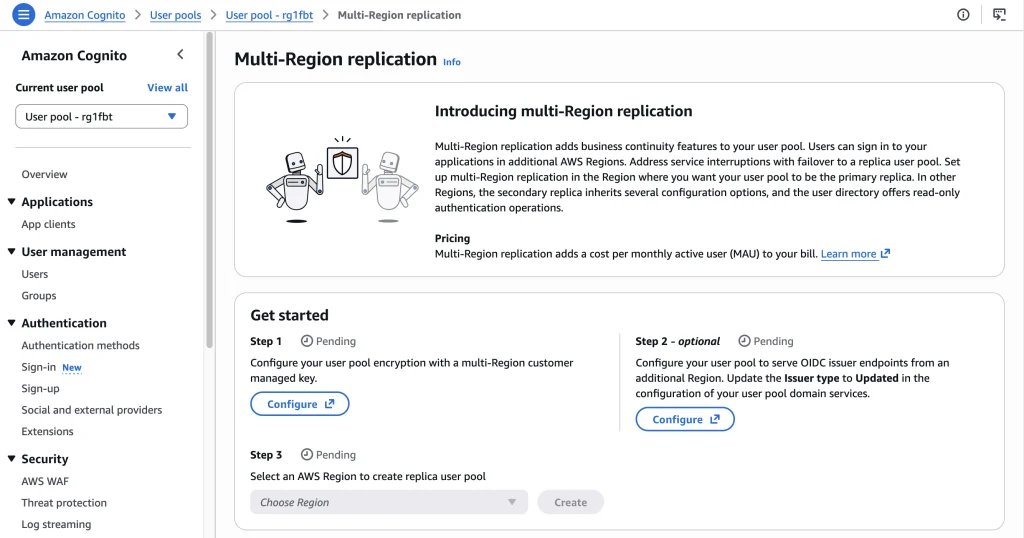
- The Announcement (Current State): AWS has internalized these patterns, transforming a complex, manual, and risky architecture into a three-step configuration process within the AWS Management Console.
- Operational Integration: The rollout includes full integration with AWS KMS, allowing for a phased transition where security-conscious organizations can first implement CMKs before enabling cross-region data replication.
Supporting Data and Technical Implementation
The implementation process has been designed for simplicity, emphasizing a "configuration-first" approach. The process involves three distinct phases:

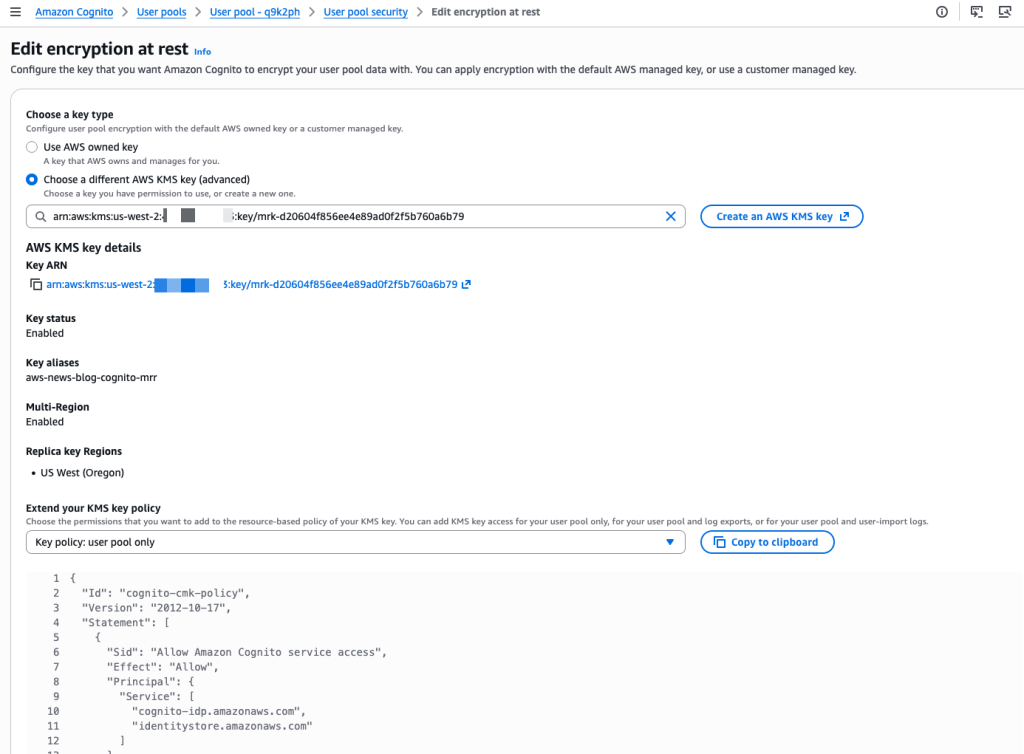
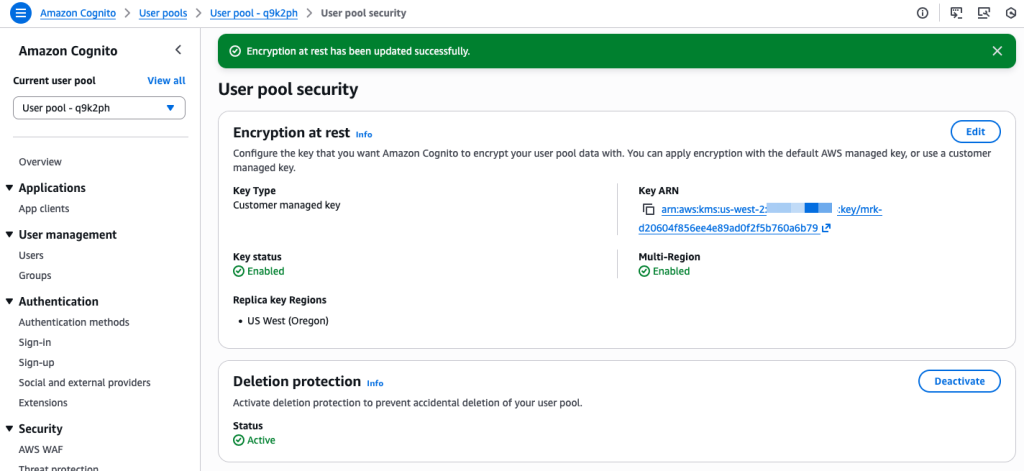
1. Encryption Strategy
Before replication begins, developers must establish a multi-Region customer managed key in AWS KMS. This key ensures that data is encrypted consistently regardless of which Region it resides in. The process involves updating the KMS key policy to permit Amazon Cognito to perform cryptographic operations on behalf of the user pool.
2. OIDC Endpoint Configuration
One of the most critical aspects of this update is the handling of OpenID Connect (OIDC) endpoints. Developers are required to configure multi-Region OIDC endpoints. This step is non-negotiable; it requires redeploying server-side applications and updating client-side code (mobile apps on iOS and Android) to recognize the new issuer endpoints. Failure to update these endpoints during a failover would result in a complete loss of authentication capability.
3. Replication and Activation
Once the encryption and endpoints are set, the developer selects the target secondary Region. The service then initiates a background synchronization. The time required for this process scales linearly with the size of the user pool. Once the status changes to "Active," the secondary Region is ready to handle traffic.
Implications for Modern Architectures
The impact of this update extends far beyond simple uptime. It fundamentally changes how architects approach three key areas:
Business Continuity and Disaster Recovery (BCDR)
For mission-critical applications, the cost of downtime is measured in thousands—if not millions—of dollars per minute. By providing a managed, native way to maintain authentication availability, Amazon Cognito lowers the barrier to achieving a "Multi-Region Active-Passive" posture. Organizations no longer need to fear the "all-or-nothing" risks associated with a regional service impairment.
Regulatory Compliance
Industries such as financial services and healthcare are bound by strict data sovereignty and encryption standards. The ability to use customer managed keys (CMKs) provides a verifiable audit trail and ownership of the encryption process. This is a massive boon for compliance officers who require granular control over how sensitive user data is secured.

Operational Overhead
Perhaps the most understated benefit is the reduction in "undifferentiated heavy lifting." DevOps and Platform Engineering teams can now offload the maintenance of replication logic to AWS. This frees up talent to focus on feature development rather than the maintenance of complex identity synchronization infrastructure.
Official Perspectives and Strategic Outlook
While AWS has not released a specific "spokesperson" statement, the guidance provided by developer advocates highlights a clear strategy: "Identity is the perimeter." By reinforcing the identity layer, AWS is effectively hardening the entire application stack.

The documentation and console workflows emphasize that this feature is not "set and forget." It requires a proactive approach to monitoring. Developers are encouraged to implement health checks (such as Route 53 health check IDs) and to perform "game day" drills to test their failover strategy during off-peak hours.
Pricing Considerations
AWS has opted for a tiered pricing model to ensure the service remains cost-effective for different scales of operation:

- Essentials Tier: $0.0045 per monthly active user (MAU) per replica Region.
- Plus Tier: $0.006 per MAU per replica Region.
- M2M Authentication: A 30% surcharge on standard volume-based pricing for successful tokens.
This usage-based pricing ensures that organizations only pay for the resiliency they actually consume, aligning the cost of the service with the value it provides to the application’s user base.
Conclusion: A New Baseline for Identity
The launch of multi-Region replication and CMK support for Amazon Cognito marks a pivotal moment for developers working on high-scale, high-availability systems. It addresses the most painful aspects of identity management—resilience, security, and operational complexity—with a refined, managed solution.

As organizations continue to accelerate their move toward distributed, global architectures, the ability to ensure that users (and machines) can authenticate regardless of regional status will be a defining characteristic of successful platforms. By offloading the complexity of replication to the infrastructure layer, AWS is enabling developers to build not just better applications, but more resilient and secure digital experiences.
For developers, the call to action is clear: review your existing authentication architecture, evaluate your compliance requirements for data encryption, and begin planning the transition to a multi-Region identity posture. In the modern cloud, resilience is not an accident—it is an architectural choice.