Strengthening Resilience: Amazon Cognito Launches Multi-Region Replication and Enhanced Encryption Controls
In an era where digital continuity is not merely an operational goal but a business imperative, the reliability of authentication services has become the backbone of modern software architecture. Recognizing the growing complexity of microservices, agentic AI, and global user bases, Amazon Web Services (AWS) has announced two significant enhancements to Amazon Cognito: native multi-Region replication and robust support for customer managed keys (CMKs).
These updates address long-standing challenges for developers attempting to build high-availability systems, effectively removing the burden of custom-built, error-prone replication logic. By enabling automated synchronization of user profiles and machine-to-machine (M2M) secrets, AWS is setting a new standard for identity management resilience.
The Evolution of Authentication Resilience
For years, web and mobile application developers have navigated a difficult trade-off between architectural simplicity and regional redundancy. Previously, achieving high availability for authentication meant building and maintaining custom, bespoke replication pipelines to ensure user data remained consistent across geographic boundaries.
The risks associated with these manual workarounds were significant. Beyond the engineering overhead, manual import and export processes introduced substantial security vulnerabilities, including potential data exposure and the high likelihood of synchronization drift. When a regional service interruption occurred, the failure was often compounded by the need for forced password resets, re-authentication mandates, and complex reconfigurations of OAuth-protected resources. For machine-to-machine communications, the friction was even greater, requiring secondary-region app client creation and the subsequent update of every backend service reliant on access tokens.

The new multi-Region replication feature for Amazon Cognito fundamentally shifts this paradigm, providing a managed, automated, and secure path to regional failover.
Understanding the Mechanics: How Multi-Region Replication Functions
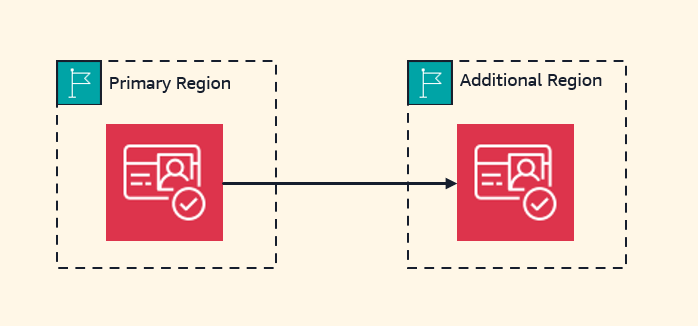
At its core, the new Amazon Cognito replication functionality provides a streamlined, one-way synchronization process. User data—including profiles, credentials, and pool configurations—is automatically mirrored from a primary AWS Region to a chosen secondary Region.

Key Operational Characteristics:
- Read-Only Secondary Availability: The secondary Region operates in a read-only state. This focus ensures that the secondary site is dedicated exclusively to maintaining authentication integrity during a failover, preventing data conflict or split-brain scenarios.
- Session Persistence: A critical advantage of this update is the continuity of user experience. Because both the primary and secondary regions recognize access tokens issued by either site, currently signed-in users remain authenticated without interruption during a transition.
- Comprehensive Support: The system supports all major authentication methods, including federated sign-in via third-party providers (Apple, Google, Amazon, Facebook), SAML integrations, OIDC, and standard API authorization flows.
- Constraint Management: While the system excels at maintaining authentication availability, it is important to note that administrative actions—such as new user registrations or profile updates—are generally unavailable in the secondary Region during a failover event, prioritizing data consistency over write-availability.
Chronology of Implementation: A Step-by-Step Guide
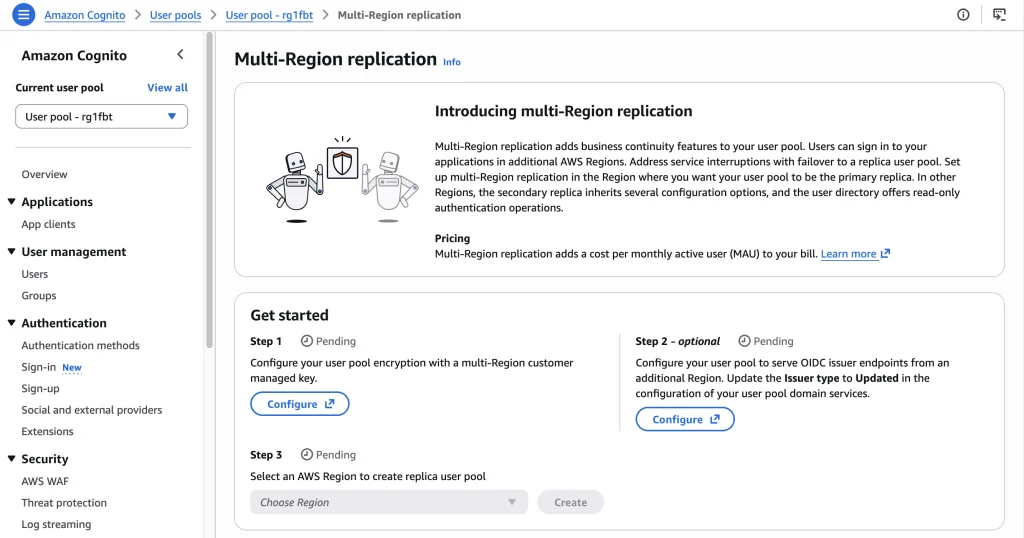
For developers, the integration process is designed to be intuitive, requiring three primary phases within the AWS Management Console.
Phase 1: Establishing the Foundation with KMS
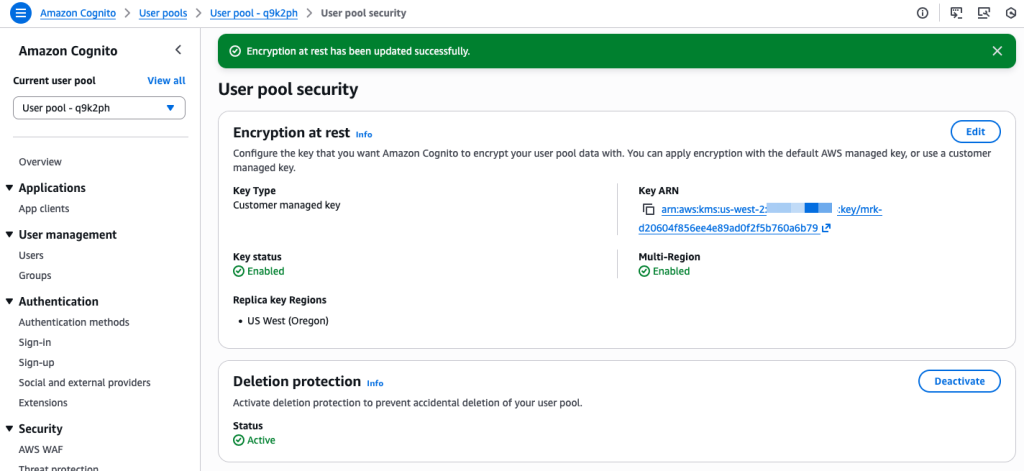
Before initiating replication, organizations must establish a multi-Region customer managed key (CMK) via AWS Key Management Service (KMS). This ensures that all user data remains encrypted at rest with a consistent strategy across geographic locations. Developers must also ensure that the key policy is explicitly configured to permit Amazon Cognito the necessary permissions to access and utilize these keys.
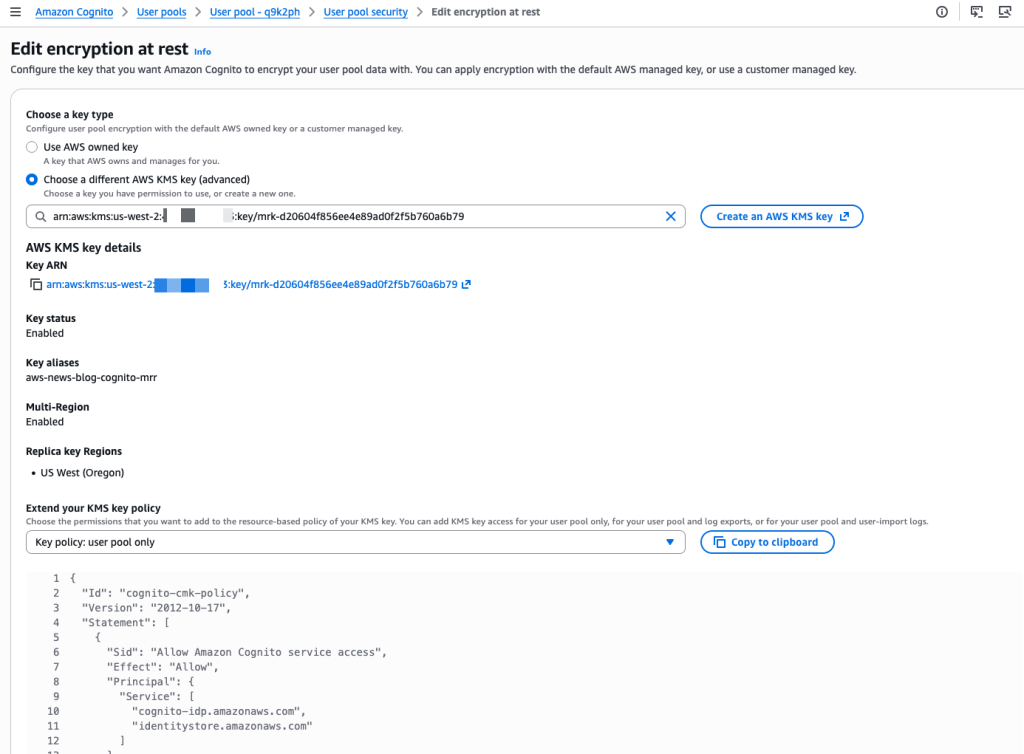
Phase 2: OIDC Endpoint Configuration
The second step involves configuring the OIDC issuer type. This is a vital configuration step that requires developers to update their client applications to point toward the new, synchronized endpoints. Failure to update these endpoints in the application code or mobile app manifests will result in routing errors during a failover. Once the endpoints are confirmed, the console generates the necessary URLs, facilitating a seamless transition of traffic.
Phase 3: Activation and Monitoring
Finally, the developer selects the target replication Region. The service performs an initial synchronization of the user pool, with the duration of this process scaling according to the volume of user data. Once the status transitions to "Active," the secondary Region is ready to handle authentication requests. It is recommended that teams manually verify their surrounding infrastructure—such as AWS WAF configurations, Lambda triggers for custom authentication, and log streaming—to ensure they are mirrored correctly in the new Region.
Supporting Data and Strategic Implications
The shift toward multi-Region replication is not just an infrastructure upgrade; it is a strategic move to lower the Total Cost of Ownership (TCO) for identity management.
Economic Considerations
Amazon Cognito’s pricing for this feature is tiered, reflecting the scale of the customer’s deployment:

- Essentials Tier: $0.0045 per monthly active user (MAU) per replica Region.
- Plus Tier: $0.006 per MAU per replica Region.
- M2M Authentication: A 30% surcharge on top of standard volume-based pricing for successful token issuance.
Regulatory and Compliance Advantages
The inclusion of customer managed keys is a major win for highly regulated sectors, such as financial services and healthcare. By allowing organizations to maintain control over the lifecycle and management of their encryption keys, AWS enables these entities to satisfy stringent data residency and security compliance requirements, providing an audit trail and level of control that was previously difficult to achieve in a fully managed service.
Designing a Failover Strategy
While Amazon provides the tools for replication, the responsibility for health monitoring and traffic routing remains with the developer. A robust failover strategy should include:

- Automated Health Checks: Implementing monitors that track error rates and latency patterns specifically within the authentication pathway.
- Traffic Management: Utilizing Amazon Route 53 health check IDs to automatically redirect traffic to the secondary endpoint upon detecting a failure.
- Controlled Testing: The best practice remains testing these failover procedures during off-peak hours by shifting a small, non-disruptive percentage of traffic to the replica region to ensure the configuration is operational.
Looking Ahead: The Future of Identity Resilience
The introduction of these features marks a turning point for Amazon Cognito, moving it from a standard identity provider to a highly resilient global service. By reducing the operational burden of managing complex, cross-Region data synchronization, AWS allows engineering teams to focus on core product innovation rather than infrastructure maintenance.
As organizations continue to integrate more AI-driven automation and globally distributed microservices, the ability to maintain a consistent, secure, and resilient identity layer will remain paramount. Whether you are operating in the US East, Asia Pacific, or European markets, the new multi-Region capabilities offer a standardized, scalable, and secure path forward, ensuring that even in the face of regional disruptions, user trust and system availability remain unshaken.

For developers, the call to action is clear: review your current high-availability documentation, explore the AWS Management Console to evaluate your specific regional requirements, and begin the transition toward a more resilient identity architecture today.