Taming the Debt: AWS Unveils Autonomous “Continuous Modernization” to Combat Software Decay
In the modern enterprise landscape, software development is often described as a race against entropy. As engineering teams push to ship features faster, the underlying architecture frequently falls victim to "technical debt"—a buildup of deprecated frameworks, outdated dependencies, and legacy runtimes that ultimately stifle innovation and bloat IT budgets. Today, Amazon Web Services (AWS) is taking a major step toward solving this systemic issue with the preview launch of AWS Transform – Continuous Modernization.
This new capability, integrated into the existing AWS Transform suite, promises to move beyond the fragmented, manual tooling that has historically plagued development teams. By providing autonomous, scalable detection and remediation of technical debt, AWS is offering a glimpse into a future where software maintenance is no longer a reactive, soul-crushing chore, but an automated operational standard.
The Growing Crisis of Technical Debt
Engineering organizations currently allocate an estimated 30% of their total IT budgets to maintenance and infrastructure upkeep. Historically, the process of managing this has been reactive and siloed. Teams often deploy a disparate patchwork of point solutions: one tool to scan for security vulnerabilities, another to check for dependency updates, and a third to monitor code quality.
This "stitching" approach has created a significant visibility gap. When management asks for the state of an organization’s codebase, they often rely on self-reported status updates from team leads—reports that are frequently outdated, overly optimistic, or blind to hidden regressions.
The situation has been further complicated by the rapid adoption of AI-assisted coding. While generative AI tools allow developers to write code at an unprecedented pace, they also accelerate the accumulation of technical debt. If developers are churning out features faster than they can maintain the underlying environment, the "debt" accumulates at an exponential rate, eventually creating a bottleneck that can paralyze entire engineering departments. AWS Transform – Continuous Modernization is designed specifically to intercept this cycle, providing a centralized "ground truth" for the entire enterprise codebase.
Chronology: From Migration to Autonomous Remediation
The journey to this announcement is rooted in the broader evolution of the AWS Transform portfolio.
- Early Phase (The Migration Era): AWS Transform began as a high-level solution designed to help enterprises move out of physical data centers and modernize legacy Windows or mainframe applications.
- Expansion Phase (The Maintenance Era): As customers successfully migrated to the cloud, the focus shifted to the "undifferentiated heavy lifting" of software maintenance—tasks like Java version upgrades, runtime patching for AWS Lambda, and managing library deprecations.
- The Present (The Autonomous Era): With the introduction of the continuous modernization preview, AWS has transitioned from providing tools that assist in modernization to providing a system that autonomously manages the lifecycle of the code.
By building upon the foundation of its earlier migration tools, AWS has leveraged its deep understanding of enterprise architecture to create a system that doesn’t just flag issues but actively works to resolve them.
Supporting Data: How the System Functions
The technical architecture of AWS Transform – Continuous Modernization relies on three core pillars: continuous analysis, autonomous remediation, and deep integration with existing security protocols.
1. Continuous Analysis and Policy Enforcement
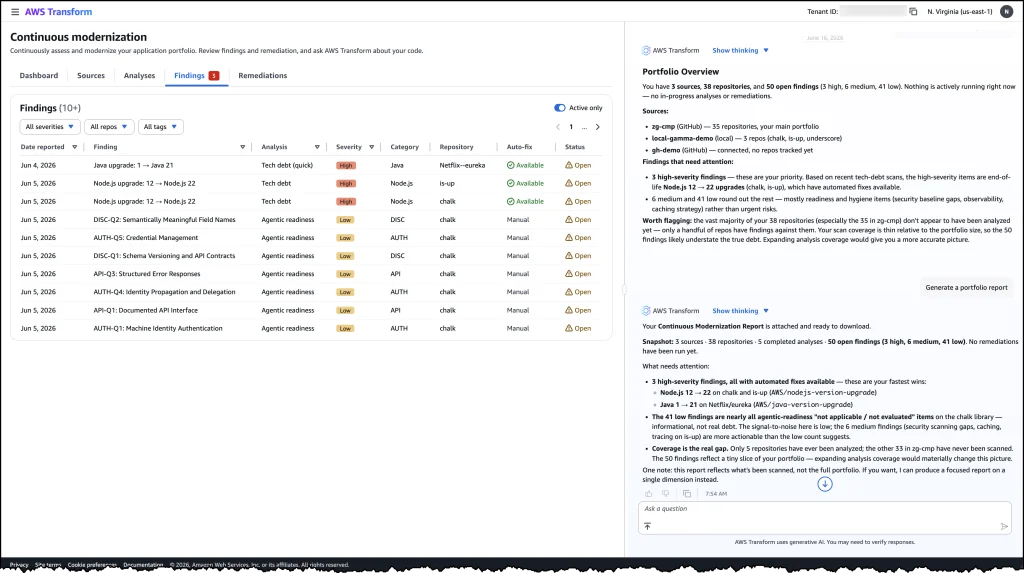
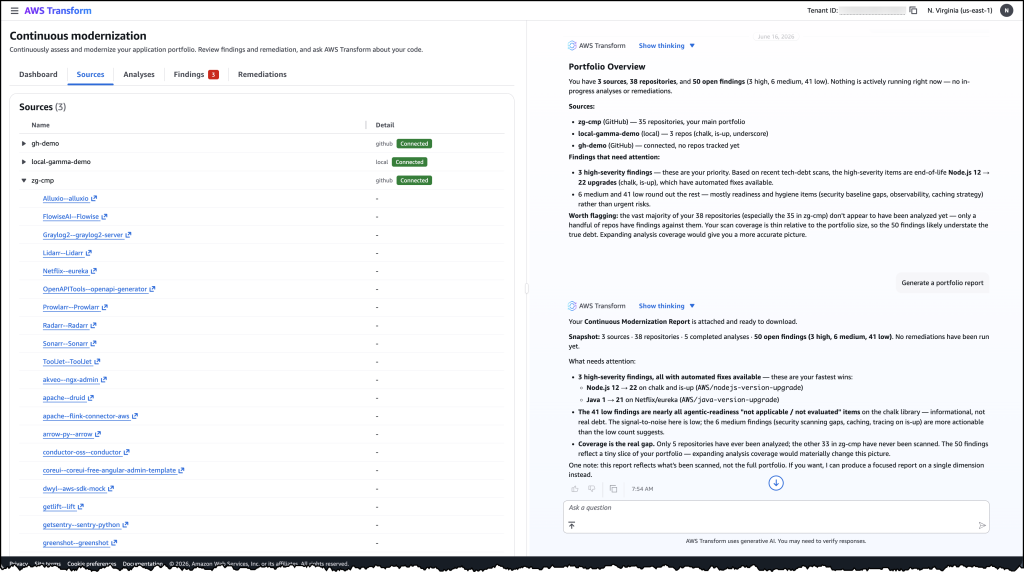
The system operates by scanning repositories against user-defined baselines. Instead of weeks of manual auditing, AWS Transform generates findings in a matter of hours. The platform ships with pre-configured policies targeting common technical debt, such as End-of-Life (EOL) dependencies or deprecated framework versions.
However, the true power lies in its extensibility. Platform teams can codify their organization’s unique standards—such as specific logging patterns, approved internal libraries, or proprietary security policies—and apply them globally. This turns subjective "best practices" into objective, enforced requirements that are tracked across thousands of repositories simultaneously.

2. Autonomous Remediation at Scale
Once a violation of the baseline is identified, the system moves to the remediation phase. AWS Transform generates automated pull requests (PRs) for the affected repositories. Each PR is accompanied by clear, actionable documentation explaining why the change is necessary and how it resolves the debt.
This workflow is designed to respect the autonomy of development teams. A team can review and merge the PR, or opt for a different approach. Regardless of the choice, the system continuously monitors the repository. If the team resolves the debt in their own way, the system recognizes the compliance and clears the finding, ensuring that "ground truth" is maintained without manual status check-ins.
3. Security Integration
AWS has wisely integrated this capability with the AWS Security Agent. By funneling security vulnerabilities into the same dashboard as general technical debt, the platform ensures that critical security patches are prioritized alongside routine maintenance. This unified workflow prevents security teams from operating in a vacuum and ensures that developers have a single, prioritized queue of work to address.
Implications for the Engineering Lifecycle
The introduction of this tool signals a fundamental shift in how platform and engineering teams will interact in the coming years.
The End of "Status Check-in" Culture
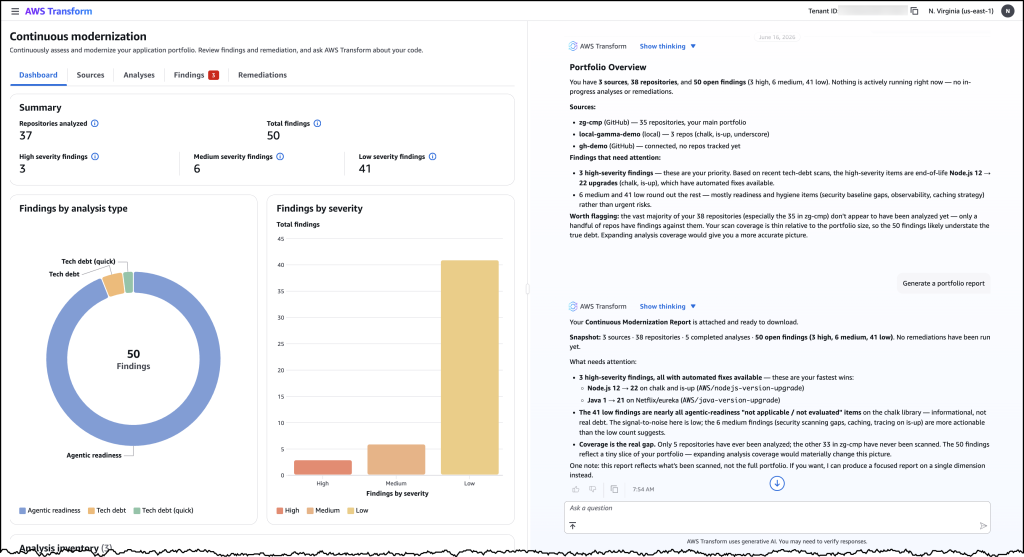
For many organizations, a significant portion of a manager’s week is spent gathering updates on whether a project is "up to date." AWS Transform eliminates this by providing a real-time dashboard that displays the health of the entire portfolio. Managers no longer need to chase team leads; they can simply look at the dashboard to see which repositories are compliant and which are falling behind.
Balancing "Continuous" vs. "Campaign" Modes
AWS has identified two distinct ways organizations handle modernization, and the new tool supports both:
- Continuous Mode: Best for the "day-to-day" maintenance—security patches, library updates, and adherence to evolving internal standards. This ensures that the codebase never drifts too far from the desired baseline.
- Campaign Mode: Best for large-scale, one-off projects, such as a major framework migration (e.g., moving from one version of Spring Boot to another) across hundreds of microservices.
By offering both, AWS provides a versatile toolkit that can scale from a small startup to a global enterprise with tens of thousands of repositories.
Official Perspective and Future Outlook
While AWS is currently positioning this as a preview, the move is a clear shot across the bow of legacy software governance tools. By integrating with existing coding agents and supporting industry-standard tools like GitHub, AWS is ensuring that this capability fits into the developer’s existing workflow rather than forcing a change in process.
The ability to integrate via the AWS Transform Kiro Power, MCP (Model Context Protocol), and skills for existing coding agents indicates that AWS is positioning this tool to be at the heart of the AI-driven development stack. As coding agents become more prevalent, they will inevitably create more code, which will require more maintenance. AWS is effectively building the "garbage collector" for the AI era of software development.
For the CIO or CTO, the value proposition is clear: the cost of technical debt is no longer just a "hidden tax" on developer velocity; it is an addressable, quantifiable, and manageable line item. By automating the mundane, repetitive tasks of code maintenance, engineering organizations can shift their human capital back to where it belongs: building the next generation of customer-facing features.
As the preview progresses, it is expected that AWS will gather feedback from early adopters to refine the autonomous remediation patterns. For now, however, the message from AWS is unequivocal: in an age where the pace of software change is accelerating, the only way to keep up is to build systems that modernize themselves. The era of the "forever-legacy" application may finally be drawing to a close.