Taming the Debt: AWS Unveils Autonomous Modernization to Solve the Enterprise Software Crisis
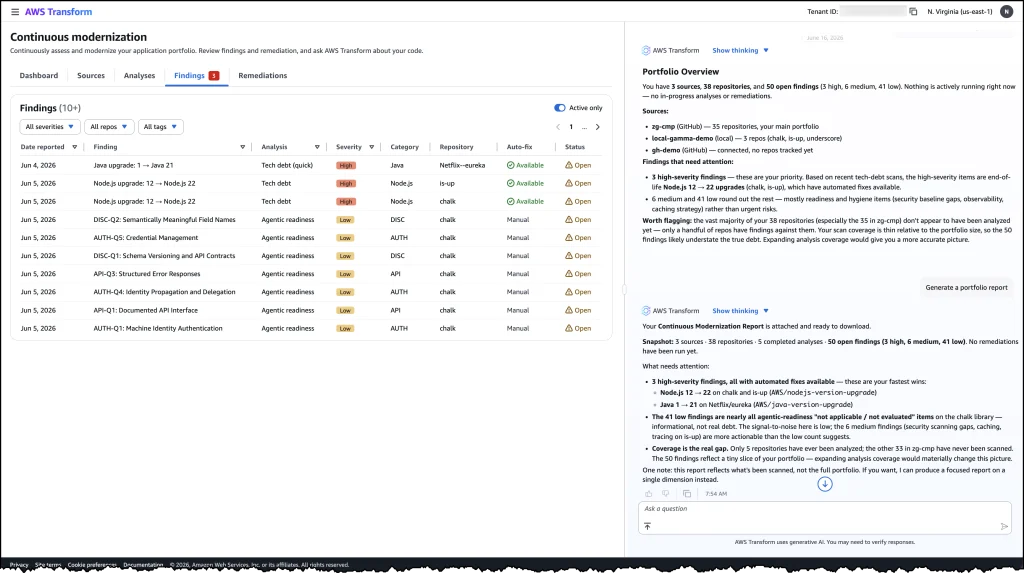
In a landmark development for enterprise software management, Amazon Web Services (AWS) has announced the preview release of AWS Transform – Continuous Modernization. This new capability, integrated into the existing AWS Transform suite, marks a fundamental shift in how organizations handle the perennial challenge of technical debt. By introducing autonomous, continuous analysis and automated remediation, AWS is aiming to eliminate the manual toil that currently consumes nearly a third of IT budgets globally.
The announcement addresses a growing friction point in the modern development lifecycle: while AI-assisted coding tools are accelerating the pace of software creation, they are simultaneously causing technical debt—such as deprecated frameworks, outdated Java versions, and security vulnerabilities—to accumulate at an unprecedented rate. AWS Transform is designed to act as a systemic counterbalance, providing the visibility and automation required to keep massive, distributed codebases compliant and modern.
The Anatomy of the Technical Debt Crisis
A Fragmented Landscape of Point Tools
For years, engineering organizations have attempted to manage technical debt through a patchwork of disparate tools. A typical enterprise stack might include one solution for dependency tracking, another for security vulnerability scanning, and a third for general code quality.
This siloed approach creates a "manual cycle" that is inefficient and prone to error. Engineering leaders, forced to rely on self-reported status updates from teams, often find that their understanding of the codebase lags behind reality. By the time a vulnerability or an outdated framework is identified, it has often propagated across dozens, or even hundreds, of repositories.
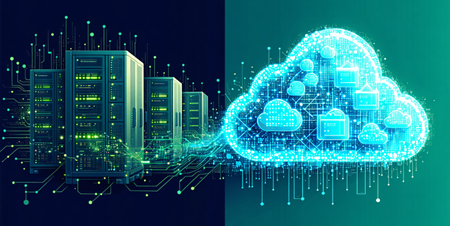
The introduction of generative AI into the software development lifecycle (SDLC) has exacerbated this. With AI agents writing code faster than ever, the window for human oversight has shrunk, leading to a "debt explosion." AWS Transform – Continuous Modernization seeks to solve this by moving away from episodic, reactive maintenance toward a model of persistent, autonomous governance.
Chronology: From Migration to Autonomous Remediation
The evolution of AWS Transform reflects the company’s shifting strategy regarding application lifecycle management.
- Phase 1: The Migration Era: AWS Transform began as a specialized toolset designed to help enterprises move out of legacy data centers and modernize mainframe or Windows-based applications. The focus was on "heavy lifting"—moving entire monoliths into the cloud.
- Phase 2: The Maintenance Shift: As more workloads moved to the cloud, AWS identified that the "undifferentiated heavy lifting" wasn’t just in migration; it was in the daily maintenance of those applications. This included routine but critical tasks like updating Lambda runtimes and patching libraries.
- Phase 3: The Autonomous Frontier (Current): With the launch of the continuous modernization preview, AWS has transitioned into the era of autonomous remediation. By connecting directly to source control systems, the platform no longer just flags issues; it proactively generates the pull requests (PRs) necessary to resolve them, turning "analysis" into "execution."
Supporting Data: The Case for Automation
Engineering organizations currently spend an estimated 30% of their total IT budget on maintaining existing software rather than building new features. This "maintenance tax" is not merely financial; it is a significant drain on developer morale and innovation velocity.
According to AWS, the new continuous modernization capability provides several quantifiable benefits:

- Speed to Insight: Traditional scanning can take weeks to reconcile across large organizations. AWS Transform performs these scans in hours.
- Compliance at Scale: By enforcing organizational baselines (e.g., approved versions of Java or specific security patches) across thousands of repositories, teams can ensure that 100% of their codebase adheres to internal policies.
- Reduced Context Switching: By providing developers with ready-to-merge PRs, the tool removes the burden of investigating how to fix a debt item, allowing them to focus on high-value business logic.
Operational Mechanics: How it Works
The platform operates on a two-pillar system: Continuous Analysis and Autonomous Remediation.
Continuous Analysis
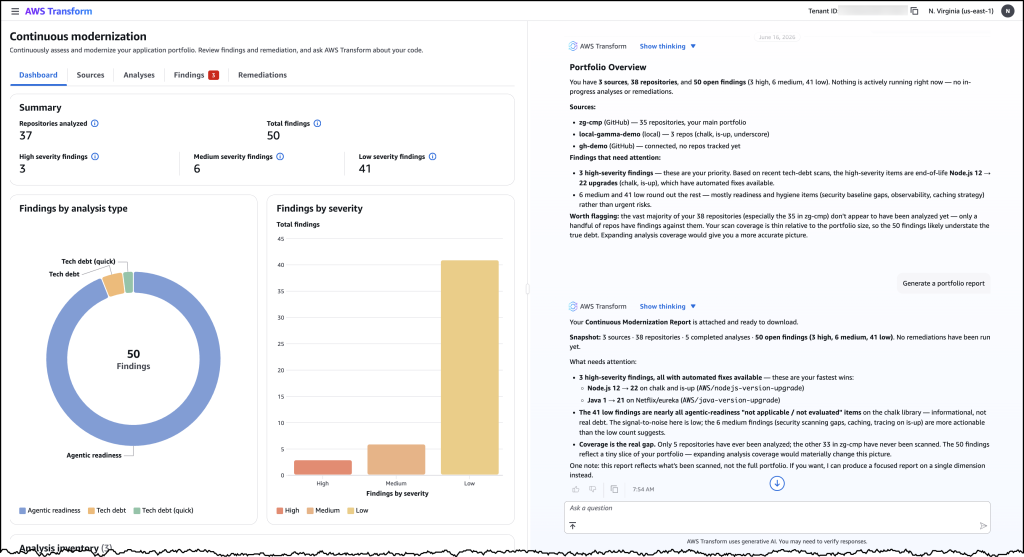
The system automatically scans repositories against user-defined baselines. If a repository drifts—for example, by utilizing a version of a library that has reached its end-of-life—the system triggers an alert. Unlike manual audits, this is a "ground truth" system. It does not rely on developer surveys; it inspects the actual code. Organizations can codify their own internal standards as policies, effectively turning "tribal knowledge" about preferred logging patterns or internal libraries into enforceable, automated rules.
Autonomous Remediation
Once a violation is identified, the system initiates the remediation phase. It automatically generates a pull request tailored to the specific repository. For example, if a team is lagging on a Java upgrade, the system doesn’t just email a ticket; it opens a PR with the necessary code changes. The owning team retains the final authority—they can review, test, and merge the PR, or decline it. Once the fix is merged, the system verifies the change, closing the loop without human intervention.
Implications for Security and Modernization Strategy
The integration with AWS Security Agent is perhaps the most significant implication for CSOs (Chief Security Officers). By bringing security findings into the same workflow as technical debt, organizations can prioritize security patches alongside routine maintenance. This prevents a "security-first" vs. "feature-first" conflict, as vulnerabilities are treated as part of the overall technical debt backlog.
Two Modes of Modernization
AWS has structured the tool to handle two distinct types of work:
- Continuous Mode: Designed for the "always-on" maintenance of dependencies, patches, and standards. This keeps the organization in a "steady state" of health.
- Campaign Mode: Targeted at larger, project-based efforts. When an organization decides to switch frameworks or upgrade a major runtime across the entire company, the "campaign" feature allows for a coordinated, bulk-remediation effort that can be monitored in real-time through the AWS Transform dashboard.
Official Perspective: The Future of the Platform Team
In the vision laid out by AWS, the role of the platform team is shifting from "enforcement" to "enablement." By using AWS Transform to codify standards, platform teams can focus on defining what the organization’s technical standards should be, while the tool handles the how of the implementation.
"We are moving from a world where we hope developers follow best practices to a world where best practices are the path of least resistance," noted a representative from the AWS Transform team during the launch. By automating the mundane, repetitive tasks that cause developer burnout, AWS is attempting to reallocate that 30% of IT budget back into innovation.
Conclusion: A New Baseline for Enterprise Development
The preview of AWS Transform – Continuous Modernization is a clear signal that the industry is hitting a wall regarding manual software maintenance. As codebases continue to grow in complexity and size, human-centric management is no longer viable.
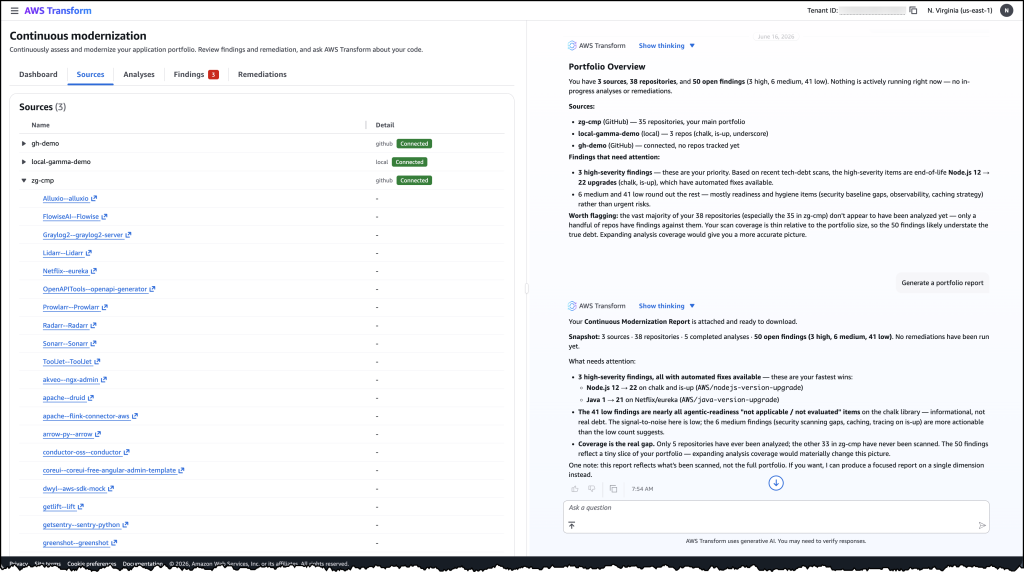
By bridging the gap between detection and remediation, AWS is providing a blueprint for the "Self-Healing Enterprise." While the tool is currently in preview, the potential to reclaim thousands of developer hours and significantly reduce the security surface area of the enterprise makes it one of the most critical updates to the AWS ecosystem this year.
For organizations looking to get started, the integration is available via the AWS Transform web application, the Kiro Power tool, and through integration with existing coding agents via MCP (Model Context Protocol). As organizations begin to deploy these autonomous agents, the definition of "technical debt" may finally move from a permanent, unsolvable burden to a manageable, automated routine.