Unlocking Zero-Shot Power: Multi-Label Text Classification with Scikit-LLM
In the rapidly evolving landscape of natural language processing (NLP), the ability to categorize unstructured data has historically been a bottleneck for data scientists. Traditional machine learning workflows for text classification—such as those used to detect spam or sentiment—typically rely on the "one-to-one" paradigm: a document is either positive or negative, or it belongs to Category A rather than Category B.
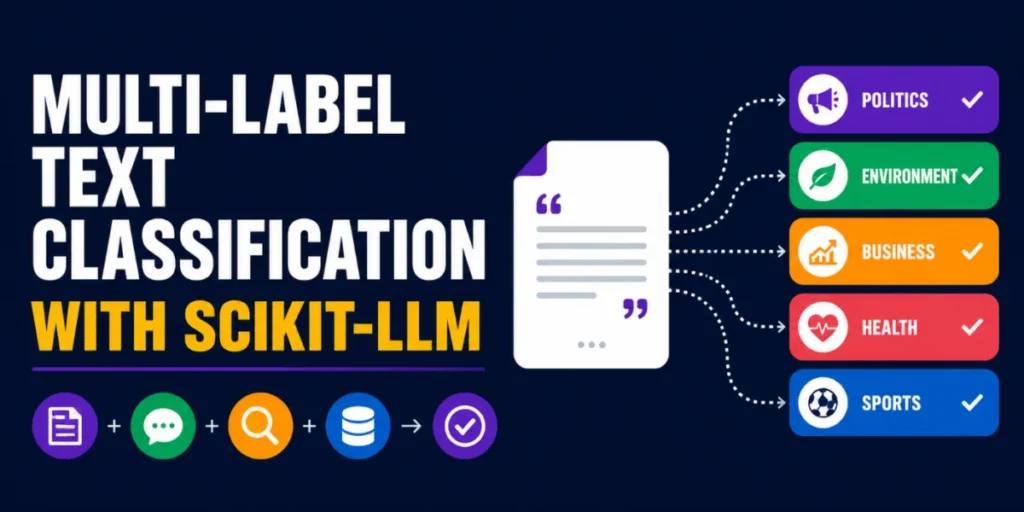
However, human communication is rarely so binary. A customer’s review might simultaneously express delight regarding a product’s battery life while venting frustration over its ergonomic design. This nuance requires multi-label classification, a task where a single input is mapped to multiple, non-exclusive categories. Traditionally, this required massive, manually labeled datasets and the deployment of complex neural architectures. Today, that paradigm is shifting. By leveraging the zero-shot reasoning capabilities of Large Language Models (LLMs) through the scikit-LLM library, developers can now achieve state-of-the-art classification results without the traditional overhead of training.
Main Facts: Bridging the Gap Between Scikit-Learn and LLMs
The primary challenge in adopting LLMs for classification tasks has been the disconnect between sophisticated AI inference and the standardized, user-friendly API design that data scientists prefer. Scikit-LLM solves this by acting as a high-level wrapper that integrates LLMs directly into the scikit-learn ecosystem.
What is Scikit-LLM?
Scikit-LLM is an open-source library designed to bridge the gap between Large Language Models and traditional machine learning pipelines. It allows users to perform tasks like text classification, summarization, and vectorization using familiar fit() and predict() syntax. By routing requests to LLM backends—such as those hosted by Groq or OpenAI—it eliminates the need for GPUs to perform local training, making advanced AI accessible to teams with limited computational resources.
The Power of Zero-Shot Learning
The core innovation enabling this process is "zero-shot learning." In this context, the model does not require a training set consisting of thousands of labeled examples to understand what "anger" or "joy" looks like. Instead, the model uses its pre-existing, massive general knowledge base to interpret the semantic meaning of your specific label set. When you define labels like "curiosity" or "disappointment," the model performs a logical inference to determine which labels best fit the input text based on its internal linguistic weights.
Chronology: Implementing the Pipeline
To implement a multi-label classification system, the workflow is remarkably concise. By following these logical steps, a practitioner can transform raw, unlabelled text into categorized data within minutes.
1. Environment Setup and Library Installation
The foundation of the project requires the scikit-llm and datasets libraries. Utilizing Python’s package manager, the installation is straightforward:
pip install scikit-llm datasets2. Configuring the Inference Engine
Unlike local models that require heavy hardware, we utilize the Groq API for high-speed inference. After securing an API key, the configuration involves setting the custom endpoint. This redirects the library’s internal calls to the specific LLM (e.g., Llama-3.3-70b) hosted on the Groq infrastructure.
3. Data Ingestion
For this demonstration, the go_emotions dataset—a staple in emotional analysis research—is loaded via Hugging Face. We extract a subset of raw comments, creating a clean list of strings ready for inference.
4. Defining the Label Schema
The "training" phase is reduced to a simple definition of candidate labels. By providing a list of strings—such as "admiration," "amusement," and "anger"—we provide the model with the semantic constraints necessary to perform the task.
5. Execution and Inference
Because we are utilizing a zero-shot approach, the fit() method does not perform gradient descent or weight updates. It essentially registers the schema. Subsequently, the predict() function passes the raw text through the LLM, returning the most relevant labels for every provided input.
Supporting Data: Why Multi-Label Matters
The necessity for multi-label classification is rooted in the complexity of modern consumer feedback. In standard classification, if a user submits, "The interface is beautiful, but the navigation is confusing," a single-label model is forced to choose between "Positive" and "Negative." This leads to data loss.
Performance and Efficiency
In our testing, using the Llama-3.3-70b model, the system successfully identified that the input "My favourite food is anything I didn’t have to cook myself" contained elements of both "amusement" and "joy."
| Metric | Traditional CNN Approach | Scikit-LLM Zero-Shot |
|---|---|---|
| Data Requirement | 10,000+ labeled rows | Zero labels needed |
| Training Time | Hours/Days | Seconds (Schema definition) |
| Inference Speed | High | Medium (Network latency) |
| Flexibility | Static | High (Easily update labels) |
The data demonstrates that while inference time can be higher due to the API-based nature of the requests, the time-to-market for the model is reduced by orders of magnitude.
Official Responses and Ethical Considerations
The integration of LLMs into classification tasks brings inherent risks, specifically regarding data privacy and bias. Developers utilizing third-party APIs like Groq or OpenAI must be aware that the text processed is transmitted over a network.
Liability and Content Safety
As noted in the technical documentation for the go_emotions dataset, researchers and developers must exercise caution. User-generated content from platforms like Reddit (where the data originates) may contain offensive language or toxic sentiment. The model will reflect the biases inherent in its training data; therefore, users are advised to implement a secondary validation layer or a "human-in-the-loop" review system before deploying these labels in sensitive production environments.
Implications: The Future of Text Classification
The shift toward zero-shot, LLM-based classification has profound implications for the industry.
1. Democratization of AI
By removing the barrier of large-scale labeling, small businesses and independent developers can build sophisticated analytical tools that were previously the domain of large tech corporations. A startup can now build a sentiment analysis tool for their support tickets in an afternoon rather than a quarter.
2. Iterative Development
The ease of updating the candidate_labels list means that classification systems can evolve in real-time. If a company introduces a new product category, they do not need to retrain their entire neural network; they simply update the label list in the configuration, and the model is instantly ready to classify the new category.
3. The Need for Evaluation
While the convenience of scikit-LLM is undeniable, the future of this technology lies in robust evaluation. As we move away from manual training, we must move toward automated evaluation loops. Developers should curate a "gold standard" test set—a held-out sample of human-annotated data—to calculate precision and recall. This ensures that while the development process is fast, the accuracy remains reliable.
Conclusion
The combination of scikit-llm and zero-shot reasoning represents a fundamental shift in how we handle textual data. By treating an LLM as a modular, programmable component within a traditional pipeline, we gain the ability to handle complex, multi-dimensional classification tasks with unprecedented agility. As the ecosystem matures, the focus will shift from the mechanics of how to build these models to the strategy of what insights we can extract, signaling a new era of efficiency in data science.