Taming the Technical Debt Crisis: AWS Unveils ‘Continuous Modernization’ at Scale
In a move designed to fundamentally alter how global enterprises manage their software lifecycle, Amazon Web Services (AWS) has announced the preview release of AWS Transform – Continuous Modernization. This new capability, integrated into the existing AWS Transform suite, promises to move organizations away from reactive, manual "firefighting" of technical debt toward a proactive, autonomous, and scalable framework for software maintenance.
As software-driven innovation becomes the primary competitive differentiator for firms across every sector, the hidden costs of aging codebases—commonly referred to as technical debt—have ballooned. AWS’s latest tool aims to provide engineering leaders with what they have long lacked: a centralized, real-time "ground truth" regarding the health of their software, coupled with the automated power to remediate vulnerabilities and outdated dependencies across thousands of repositories simultaneously.
The Growing Crisis of Technical Debt
To understand the significance of this launch, one must look at the current state of enterprise engineering. Studies suggest that engineering organizations often consume up to 30% of their total IT budgets simply keeping the lights on. This "undifferentiated heavy lifting" includes updating Java versions, swapping out deprecated frameworks, and patching security vulnerabilities in Lambda runtimes before they reach their end-of-life (EOL).
Currently, the industry approach is fragmented. Development teams rely on a patchwork of disparate tools: one to scan for dependency issues, another to flag security vulnerabilities, and a third to monitor code quality. This lack of cohesion creates a manual, application-by-application cycle that exhausts engineering capacity. Worse yet, leadership often relies on self-reported status updates from teams—a process that frequently lags behind reality and masks regressions.
The emergence of AI-assisted coding agents has only exacerbated the problem. While these agents accelerate the velocity of new code creation, they also facilitate the faster accumulation of technical debt. When code is generated at a pace that exceeds a human developer’s capacity to audit or modernize it, the structural integrity of the codebase erodes. AWS Transform – Continuous Modernization seeks to close this gap by automating the detection and remediation of debt, ensuring that codebases remain modern, secure, and performant.
Chronology of the Development
The path to this release reflects a long-term strategic shift within AWS. For years, the company has focused on migrating enterprise workloads from data centers to the cloud. However, once in the cloud, customers found that the work was not finished—the code itself required ongoing care.
- Foundation: AWS Transform initially debuted as a toolset focused on the "heavy lifting" of migrations, particularly helping enterprises modernize mainframe and legacy Windows applications.
- Expansion: Recognizing that "modernization" is not a one-time event but a continuous process, AWS engineers focused on the repetitive, high-volume tasks that consume platform team bandwidth.
- Integration: The development team integrated insights from security agents and repository management systems to build a comprehensive engine that does not just "flag" issues, but suggests and generates the actual fixes.
- Preview Launch: In June 2026, AWS officially opened the preview, allowing customers to connect their source control systems and begin testing the autonomous remediation workflows.
How It Works: Continuous Analysis and Autonomous Remediation
The capability functions on a two-pronged architecture: Continuous Analysis and Autonomous Remediation.
The Mechanics of Continuous Analysis
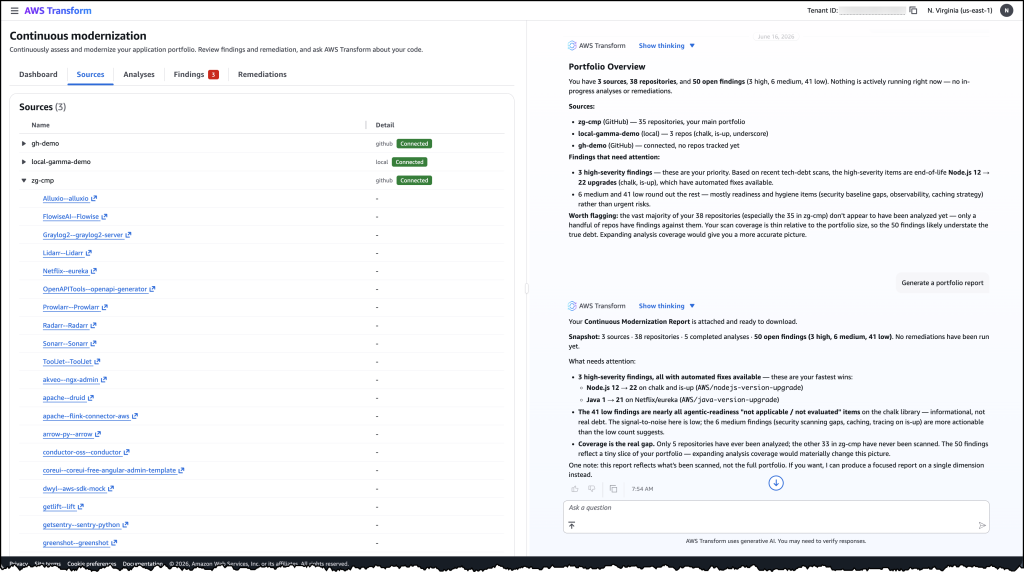
The platform automatically scans an organization’s code repositories against configurable baselines. Unlike traditional periodic scans that might run once a month or quarter, this tool provides near-instant visibility. Within hours of connecting a repository, the tool generates a detailed report of findings, highlighting EOL dependencies, deprecated frameworks, and other common sources of friction.
Crucially, the tool is extensible. Organizations can codify their own internal standards—such as preferred logging patterns or company-mandated libraries—as "policies." Once these policies are set, the system continuously monitors the entire portfolio to ensure compliance. If a team drifts from the baseline, the platform flags it immediately, providing a transparent view for platform teams without requiring manual check-ins.
Autonomous Remediation at Scale
The most transformative aspect of this release is the transition from "detect" to "fix." Once an issue is identified, AWS Transform can generate pull requests (PRs) automatically. These PRs are not merely placeholders; they contain the actual code changes required to resolve the debt, whether that is a Java version upgrade or a complex SDK migration.

When a PR is generated, the owning team receives a notification: "This repository is behind on your organization’s baseline for this dependency. Here is a PR that resolves it." The team then has the agency to review, test, and merge the fix. If they choose to resolve it differently, the system recognizes the change and marks the finding as resolved, ensuring the "ground truth" remains accurate.
Supporting Data and Security Integration
The integration with AWS Security Agent is a critical component of the platform’s value proposition. By funneling security vulnerabilities into the same prioritized list as general technical debt, AWS ensures that security is not treated as an isolated silo.
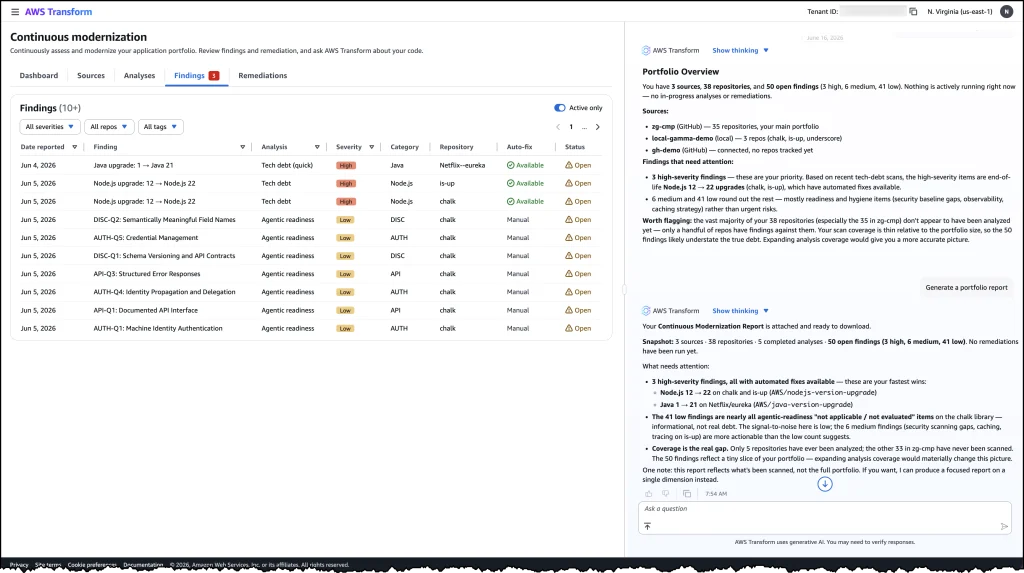
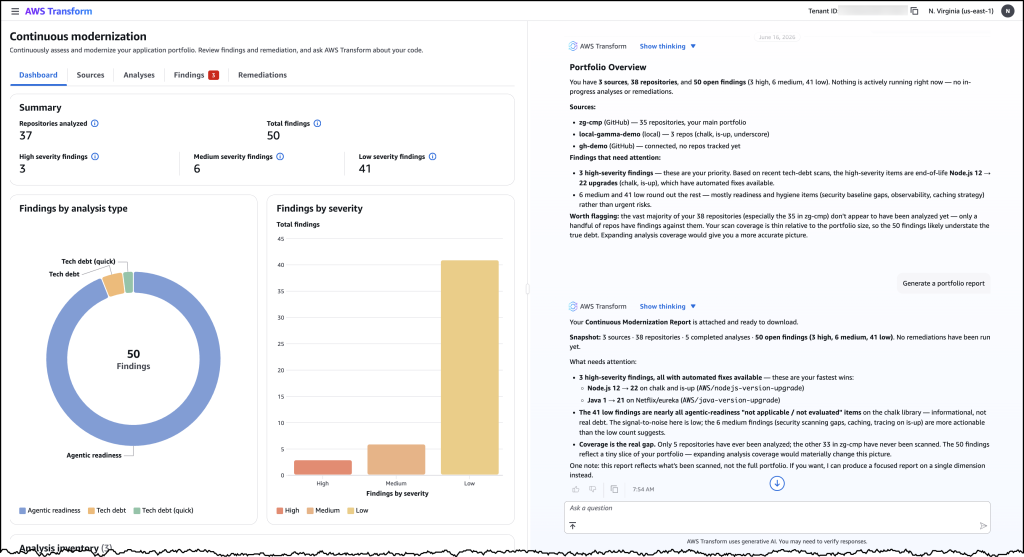
Data visualization is central to the user experience. The AWS Transform dashboard provides:
- Portfolio Overviews: High-level metrics showing the health of thousands of repositories.
- Granular Findings: A breakdown of tech debt by severity, category, and repository.
- Compliance Tracking: Real-time monitoring of which repositories have adopted the latest fixes and which remain "in flight."
By automating these metrics, the platform removes the "status lag" that plagues traditional management reporting, giving CTOs and VPs of Engineering an accurate, data-driven window into their technical risk.
Implications for the Industry
The introduction of this tool signals a profound shift in the role of the platform engineer. As these tools become more sophisticated, the focus shifts from "manual developer effort" to "policy-driven orchestration."
1. The Death of Manual Maintenance
For decades, the "maintenance phase" of software development has been characterized by tedium. By automating the application of patches and upgrades, AWS is essentially "de-risking" the maintenance process. This allows developers to spend less time on dependency versioning and more time on features that provide actual business value.
2. Standardized Enterprise Architecture
Large enterprises often struggle with "code drift," where different departments use slightly different versions of frameworks, creating a massive, fragmented surface area for bugs. With continuous modernization, organizations can enforce a "Golden Path" across the entire enterprise, ensuring that every team is aligned with company-wide architectural standards.
3. The AI-Codebase Symbiosis
As coding agents become more prevalent, the challenge for companies is no longer just writing code, but governing it. AWS Transform provides the governance layer required to make AI-assisted development sustainable. It ensures that while developers (and AI agents) code at high velocity, the underlying structural integrity of the software is maintained by the platform.
Official Perspective and Future Outlook
While in preview, the reception among early adopters has centered on the tool’s ability to handle "campaign mode." For large-scale initiatives—such as a company-wide migration from one framework to another—the tool allows teams to launch a targeted campaign that tracks progress across hundreds of applications simultaneously.
"AWS Transform – Continuous Modernization is purpose-built for the recurring, high-volume work that platform teams manage every day," notes the AWS engineering team. The tool is designed to work within existing developer workflows, including integration with GitHub and local environments, and is accessible through the AWS Transform web application, the AWS Transform Kiro Power, and MCP (Model Context Protocol) for integration with coding agents.
As the industry moves toward this era of autonomous software maintenance, the competitive gap between firms that embrace automated modernization and those that cling to manual processes will likely widen. AWS is betting that by turning technical debt from an unmanaged liability into a governed, automated process, it can help the next generation of enterprises move faster, stay safer, and innovate with confidence.