The Cooperative Revolution: Bharat Taxi Challenges Incumbent Giants in India’s $11 Billion Ride-Hailing Arena
Executive Summary
In a bold move to reshape the dynamics of India’s burgeoning mobility sector, Union Home and Cooperation Minister Amit Shah has announced an aggressive expansion plan for "Bharat Taxi," the nation’s first government-backed, driver-owned cooperative ride-hailing platform. With a vision to reach 500 cities and towns within the next two years, the platform is positioning itself as an ethical, zero-commission alternative to private cab aggregators. However, the rollout is accompanied by sharp rhetoric, as the government accuses incumbent market leaders of predatory pricing and exploitative labor practices aimed at stifling the cooperative’s early momentum.
The Launch: A Nationwide Vision for Mobility
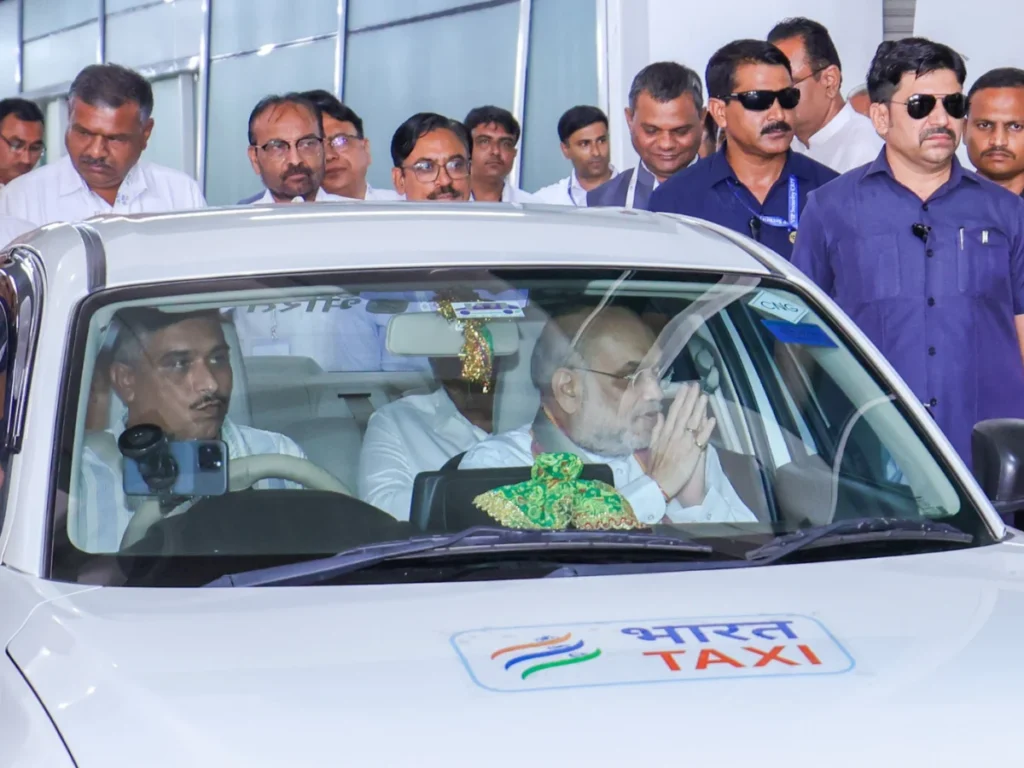
The expansion roadmap was unveiled by Minister Amit Shah in Gandhinagar, Gujarat, during the official inauguration of Bharat Taxi services across 14 major cities in the state. These include Ahmedabad, Surat, Vadodara, Rajkot, Dwarka, Somnath, Jamnagar, Bhavnagar, Junagadh, and Mehsana.
Minister Shah outlined a multi-phase growth strategy that transcends Tier-1 metropolitan hubs. "We will reach Pune, Mumbai, Lucknow, Chandigarh, Jaipur, Kolkata… Bharat Taxi will be in the top seven places, and within two years, combining big and small cities, we plan to roll out two-wheeler, auto, and four-wheeler cabs in 500 towns and cities," Shah declared.
The platform, which currently boasts a network of over 7 lakh registered "Sarathis" (drivers), is designed to function on a cooperative model. Unlike traditional aggregators that act as intermediaries taking significant cuts from every fare, Bharat Taxi aims to function as a bridge between the driver and the commuter, ensuring that the lion’s share of the earnings remains with those behind the wheel.
Unfair Competition: The Government’s Accusations
A central theme of the Minister’s address was the alleged "anti-competitive" behavior of existing private aggregators. Shah did not mince words, suggesting that the sudden dip in fares seen in regions where Bharat Taxi enters is not a result of organic market forces but a calculated move to burn capital and force the cooperative out of business.
The Anatomy of the Conflict
- Predatory Pricing: The government alleges that private platforms are slashing fares to unsustainable levels specifically in cities where Bharat Taxi is operational. This "loss-leading" strategy is intended to force consumers back to established platforms, thereby choking the growth of the new entrant.
- Commission Manipulation: Shah claimed that rival companies are offering temporary, inflated incentives to drivers to prevent them from transitioning to the cooperative model.
- The "Sarathi" Exploitation: The Minister highlighted long-standing grievances regarding the treatment of drivers by private firms, including the arbitrary cancellation of driver IDs without a fair hearing process, delays in payment settlements, and hidden commission deductions that leave drivers struggling to maintain their vehicles.
"Our objective in this competition is not to cause losses to anyone," Shah stated. "This pattern of reducing fares and offering higher commissions to sarathis has been adopted only to stop Bharat Taxi’s entry into the market."
The Cooperative Advantage: Why Bharat Taxi is Different
Bharat Taxi was launched in February with a mandate to democratize the ride-hailing experience. The core differentiator lies in its ownership structure. By operating as a cooperative, the platform intends to provide holistic support to its driver partners, which includes:
- Zero-Commission Structure: By eliminating the middleman’s take, the platform aims to increase the take-home pay for drivers while maintaining affordable rates for passengers.
- Financial and Social Security: The cooperative model aims to facilitate easier access to vehicle loans, comprehensive insurance packages, and welfare schemes that were previously inaccessible to independent contractors.
- Accountability: Unlike the opaque algorithms of private giants, the government-backed model promises a more transparent dispute resolution process, ensuring that drivers are not "de-platformed" without due process.
Market Dynamics: A Sector in Flux
The expansion of Bharat Taxi occurs against the backdrop of a hyper-competitive Indian ride-hailing market. The sector is currently dominated by players like Rapido, which commands a significant share of the bike-taxi and auto-rickshaw segment, alongside global giants Uber and Ola.
Competitive Landscape
- Incumbent Dominance: Rapido, Uber, and Ola remain the primary benchmarks for convenience, though they face consistent criticism from consumer advocacy groups and driver unions regarding service quality and pricing volatility.
- New Entrants: The space is witnessing an influx of new capital and innovation. For instance, the Vietnamese EV manufacturer VinFast has entered the fray with its electric cab service, "Green SM," in the Delhi-NCR region.
- Institutional Players: Automotive giants such as Hyundai and TVS have begun piloting "Blue Move," an EV-focused ride-hailing platform, signaling that the future of the industry is heavily weighted toward sustainable, electric mobility.
According to industry reports, the Indian ride-hailing market is projected to reach a valuation of $11.06 billion by 2033, growing at a CAGR of 20.7%. This massive growth potential explains why the government is keen to secure a foothold for a model that aligns with the "Atmanirbhar Bharat" (Self-Reliant India) vision.
Implications of the Government-Led Strategy
The entry of the state into the ride-hailing sector is a significant policy shift. It signals a move away from purely private-sector-led disruption toward a "public-private cooperative" model.
Potential Challenges
- Operational Scalability: Managing a fleet in 500 cities requires immense logistical coordination. Scaling the technology, maintaining a consistent user experience, and ensuring driver onboarding at this scale will be the primary operational hurdle for the cooperative.
- Regulatory Scrutiny: As the government acts as both the regulator and a participant in the market, it may face legal challenges regarding "level playing fields" from private competitors who argue that the government’s involvement grants it an unfair advantage.
- Technological Maturity: Competing with the highly sophisticated AI-driven matching and routing algorithms of established players will require Bharat Taxi to invest heavily in robust software infrastructure.
The Road Ahead
For the Indian commuter, this competition is likely to result in a short-term benefit—lower fares and potentially better service as companies scramble to retain customers. However, the long-term success of Bharat Taxi will depend on whether its cooperative model can prove to be sustainable without the constant need for government oversight or subsidy.
Minister Shah’s emphasis on the cooperative model suggests that the government is looking to empower the "Sarathi" as a stakeholder rather than a mere employee. If successful, this could set a global precedent for how ride-hailing services can be structured to prevent exploitation and prioritize worker welfare.
Conclusion
The launch of Bharat Taxi in Gujarat marks the beginning of a high-stakes battle for the soul of India’s urban mobility. While the government presents the platform as a champion of the common driver and a victim of corporate greed, the private sector views the move as an intrusion into a market that has thrived on competition and technological innovation.
As the 24-month countdown begins for the 500-city expansion, the industry will be watching closely. Whether Bharat Taxi becomes a transformative force that forces a systemic change in how ride-hailing companies operate, or whether it struggles to compete with the sheer scale and capital of incumbent giants, remains to be seen. One thing is certain: the era of unchallenged dominance for private cab aggregators in India is officially over.