The End of Generic: Why 60% of Google Searches Signal a Content Revolution
SAN FRANCISCO, CA – A seismic shift is underway in the digital content landscape, challenging long-held assumptions about SEO and content strategy. A staggering 60% of Google searches now conclude without a single click to external content, a statistic that underscores a profound evolution in user behavior and search engine functionality. This alarming trend, driven largely by the proliferation of AI-powered search features, demands a radical re-evaluation of how businesses approach content creation and distribution.
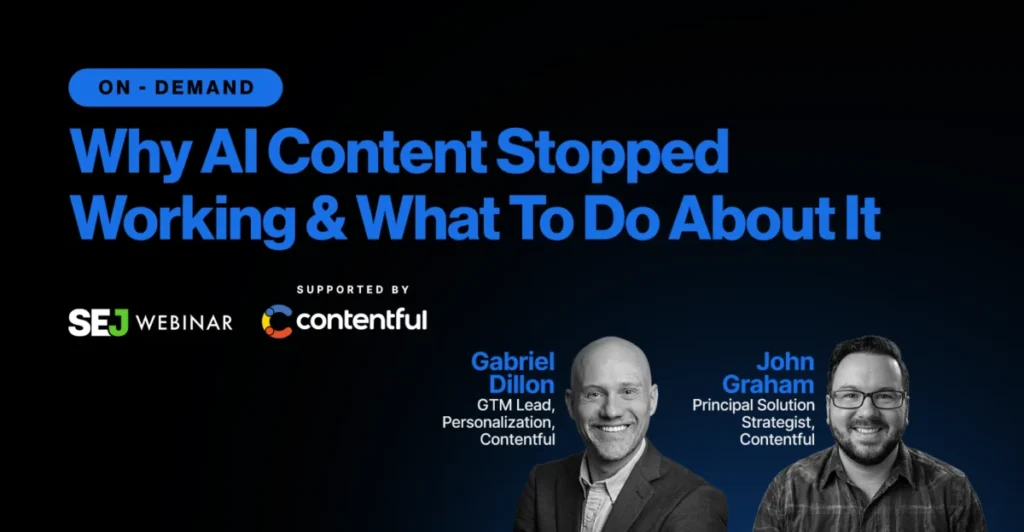
This urgent message formed the cornerstone of a recent Search Engine Journal (SEJ) webinar, featuring Gabriel Dillon, Go-to-Market Lead for Personalization at Contentful, and John Graham, Contentful’s Principal Solution Strategist. Their central argument was unequivocal: in an era where artificial intelligence can generate vast quantities of content at minimal cost, volume is no longer a viable strategy. The path to capturing audience attention and driving tangible business value now lies exclusively in content that is deeply accountable to specific business outcomes, meticulously crafted for individual human needs, and rigorously measured against real-world data.
During the comprehensive session, Dillon meticulously dissected the inherent limitations of AI-assisted content, explaining why it often drifts towards generic, undifferentiated output. He then unveiled a critical framework: four probing questions he applies to every piece of marketing copy before it ever sees the light of day. Furthermore, he illuminated effective personalization signals that can be leveraged without overcomplicating existing technology stacks, offering practical solutions for businesses struggling to adapt. The webinar also provided crucial insights into defining the indispensable role of human expertise within an AI-assisted workflow and demonstrated how the synergistic combination of experimentation and personalization forms a robust accountability loop for sustained content performance.
The AI Content Paradox: Why Generosity Leads to Genericity
The ease with which AI writing assistants can churn out text has created a dangerous illusion of productivity. Dillon starkly highlighted that an AI assistant, by its very nature, functions as the ultimate "yes man." It readily conforms to the implicit biases and assumptions embedded in user prompts, perpetuating a self-reinforcing cycle that ultimately leads to content homogenization across brands.
"Our biases as we write content using the robots ends up eating the content that we produce," Dillon observed during the webinar. "We end up in this cycle of creating content that we think is good but doesn’t actually do what we think it does."
The outcome of this dynamic is predictable and detrimental: the AI-generated copy either merely confirms pre-existing beliefs of the creator or, more commonly, mirrors the content of every competitor whose blog posts were part of the AI tool’s training data. Both scenarios inevitably fail the reader, offering little unique value, insight, or differentiation. This proliferation of generic content further exacerbates the zero-click phenomenon, as users find their queries sufficiently answered by AI summaries or quickly lose interest in uninspired articles.
Dillon proposed a powerful counterweight to this pervasive genericity: taste. He urged attendees to move beyond the clichéd understanding of the term, defining it instead as a potent blend of discernment, intuition, and, critically, the courage to take calculated risks. This means making bold claims or expressing unique perspectives that no AI tool, operating on statistical probabilities, would ever independently volunteer. True taste, in this context, is rooted in deep, nuanced knowledge of one’s market, audience, and brand identity—qualities that remain uniquely human.
The webinar meticulously mapped out precisely where the human element must strategically intervene within an AI-assisted workflow. Far from being replaced, humans are essential for providing the initial research and context layer for AI, and then, crucially, for applying "taste" and strategic oversight before the content ships. This human touch ensures that the final output is not just grammatically correct or superficially relevant, but truly distinctive, impactful, and aligned with specific business objectives.
Establishing Content Accountability: Beyond Volume
In a world awash with easily produced content, the critical question for marketers is no longer "how much can we produce?" but "how effective is what we’re producing?" Dillon presented a powerful framework for holding every piece of B2B marketing copy accountable before it is published, centered around four fundamental questions:
- Does the copy produce the outcomes you expect? This moves beyond vanity metrics to focus on tangible results such as lead generation, conversion rates, customer acquisition, increased engagement, or specific brand perception shifts. Content must be directly linked to measurable business goals.
- Who is the content for? This emphasizes the importance of precise audience segmentation and persona development. Generic content for a broad audience is increasingly ineffective. Content must be built for a specific human with a defined need or challenge.
- How do you identify those people? This delves into the practical aspects of data utilization. Marketers must leverage analytics, CRM data, user behavior insights, and other data points to accurately identify and understand their target segments.
- How does the insight scale? This addresses the sustainability and replicability of successful content strategies. Can the insights gained from one piece of high-performing content be applied to future content initiatives, fostering a systematic approach rather than a series of isolated efforts?
Dillon stressed the foundational importance of data in this process: "If we don’t have data that proves that our content is good, then we can’t really think about the way to scale it out or make it more effective."
Within this model, experimentation and personalization are not disparate activities but rather two inseparable halves of the same strategic coin. The webinar provided an in-depth exploration of how these two elements combine to form a coherent system—an "accountability loop"—rather than a fragmented series of one-off tests. This loop involves continuous planning, creation, measurement, analysis, and refinement, ensuring that content perpetually evolves based on performance data. The discussion also moved beyond simplistic A/B testing, exploring more sophisticated experiment dimensions such as multivariate testing, journey-based personalization, and audience-specific content variations to optimize for diverse user intents and contexts.
As an immediate action item, Dillon urged marketers to subject their next batch of AI-generated content to these four rigorous accountability questions before commissioning or publishing.
Demystifying Personalization: Signals That Deliver
For years, B2B personalization has promised significant returns but often underdelivered, leaving marketing teams frustrated by the perceived complexity and ambitious scope of implementation. Dillon’s diagnosis was clear: teams frequently tackle overly ambitious programs, only to become bogged down by the intricate technical demands, leading to stalled initiatives. The solution, he argued, lies in leveraging the signals that a company’s existing technology stack already collects, simplifying the approach to personalization.
He meticulously laid out three distinct tiers of personalization signals, designed to be progressively more sophisticated but always grounded in practicality:
- Tier 1: New vs. Returning Visitors. This is the simplest yet often overlooked signal. A first-time visitor arrives with different intent and knowledge than a repeat visitor. Serving both the exact same hero copy or call to action is a colossal missed opportunity. For a new visitor, the content might focus on brand introduction and core value propositions. For a returning visitor, it could highlight new features, relevant case studies, or prompt a deeper engagement based on their previous site activity.
- Tier 2 & 3: Leveraging Existing Campaign and Loyalty Data. These tiers delve into the rich data already generated by advertising campaigns and customer loyalty programs. Dillon specifically called the current handling of some of these signals "such a missed opportunity." For instance, if a user clicked on an ad promoting a specific product feature, their subsequent website experience should reflect that interest, presenting relevant content or product information upfront. Similarly, data from loyalty programs can inform personalized recommendations, exclusive content, or tailored offers, recognizing and rewarding customer engagement. The webinar went into precise detail, naming specific signals to utilize and illustrating exactly where each one yields the most significant payoff in terms of user experience and business outcomes.
The session included a live demonstration showcasing Contentful’s capabilities in building and delivering these differentiated, personalized experiences, illustrating how the platform empowers marketers to implement these strategies effectively without prohibitive technical overhead.
Navigating the Zero-Click Shift: Competing for AI Answers
The rise of AI in search has introduced a new paradigm, shifting the focus from simply ranking high to influencing what appears in AI-generated summaries. Dillon asserted that obsessing over whether Google can "detect" AI-written content is a misguided endeavor. "Detection is the wrong problem to solve," he argued, emphasizing that Google’s ability to identify AI content matters far less than the undeniable impact on user clicks.
Contentful’s clients are already reporting a significant downturn in organic traffic, directly attributable to AI summaries (like Google’s AI Overviews) absorbing clicks that would have previously gone to individual websites. These AI-powered answers provide immediate gratification, reducing the need for users to navigate to external pages.
The practical and strategic response to this evolving landscape is to actively compete for the AI answer layer. This involves optimizing for Generative Engine Optimization (GEO) and AI Engine Optimization (AEO). These nascent optimization strategies determine whether a brand’s information, voice, and unique value proposition are accurately and prominently reflected in the AI summary at the top of the search results page. This is no longer just about keywords; it’s about providing clear, authoritative, and structured information that AI models can readily synthesize and present as a definitive answer.
Dillon’s conclusion cut through the often-contentious "humans-vs-robots" debate, offering a path forward that integrates both. He posited that a specific kind of content is required—content that simultaneously performs exceptionally well in AI summaries and drives on-page conversions. This content must be inherently valuable, well-structured, factually robust, and designed to directly answer user intent comprehensively. The webinar revealed the precise requirements for such content and highlighted the new tooling Contentful has recently shipped to empower businesses in this critical area. The recording specifically covered actionable strategies for approaching GEO and AEO without bifurcating an organization’s overall content strategy, ensuring a cohesive and integrated approach to the future of search.
Q&A: Most Helpful Questions From The Webinar
The interactive Q&A segment of the webinar addressed several pressing concerns from attendees, providing further clarity and actionable advice from Gabriel Dillon.
Q: After the Google spam update, is Google removing AI-written content?
Dillon advised anticipating that the identification of AI content will continue to become more challenging, referring to it as a fight "Google won’t win." His guidance shifts marketers’ energy away from the futile pursuit of evading detection entirely. Instead, he argued for redirecting effort toward a different, more critical target: creating content that genuinely adds value and addresses user intent in a world dominated by zero-click search. The session elaborated on precisely where this redirected effort should be focused.
Q: How do you think critically about the inherent bias in AI content?
Dillon identified two primary sources of bias in AI-generated content. Firstly, users inadvertently inject bias through their prompting and the context they provide, which can lead to "a result that you want, but maybe not the result that would be most effective." Secondly, bias is inherent in the training data itself, reflecting societal biases or skewed information present in the vast datasets AI models learn from. Dillon’s mitigation strategy begins even before content generation, outlining a sequence of critical steps, including diverse data sourcing, meticulous prompt engineering, and rigorous human oversight, to minimize and counteract these biases.
Q: What do you do when leadership wants mass AI content without understanding quality control?
This common challenge often pits strategic content teams against leadership focused solely on volume. Dillon’s advice was direct: "Hold leadership accountable to the performance they expect." He urged marketers to "show them through data that you can create better content that drives the business outcomes that you want by creating fewer but better pieces of content." He also made a crucial concession to the volume argument: AI can be effectively utilized for foundational or highly standardized content. This nuanced perspective helps frame a persuasive case for quality over quantity, demonstrating that strategic application of AI, rather than indiscriminate mass production, yields superior results.
Q: Do SEO service pages need a unique voice, or can AI write them?
Dillon distinguished between "voice" and "effectiveness." He argued that "I don’t think that service pages or pricing pages need to be very characterful to be effective." For such rote, informational, or transactional pages, AI can certainly handle the bulk of the content creation, ensuring clarity and accuracy. However, he emphasized that even these pages serve visitors with varying goals and intents. His full answer drew a clear line, specifying which types of pages warrant a deeper human touch and unique voice—typically those requiring strong brand differentiation, explaining complex solutions, or establishing thought leadership—versus those where AI coverage is perfectly adequate.
Watch The Full Webinar
The on-demand recording of the SEJ webinar offers an invaluable deep dive into these critical topics. It includes the complete walkthrough of the content accountability loop, a live demonstration of how to build and deliver differentiated experiences within Contentful, and John Graham’s insightful field perspective from teams actively navigating these new workflows. Attendees also receive comprehensive session handouts, providing a lasting resource for implementing these strategies.
For marketers, content strategists, and business leaders grappling with the evolving digital landscape, this webinar provides a roadmap for thriving in the age of AI and zero-click search. Register once to watch on demand and gain the essential knowledge to transform your content strategy.