The Engineering Frontier: Mastering LLM Inference Optimization
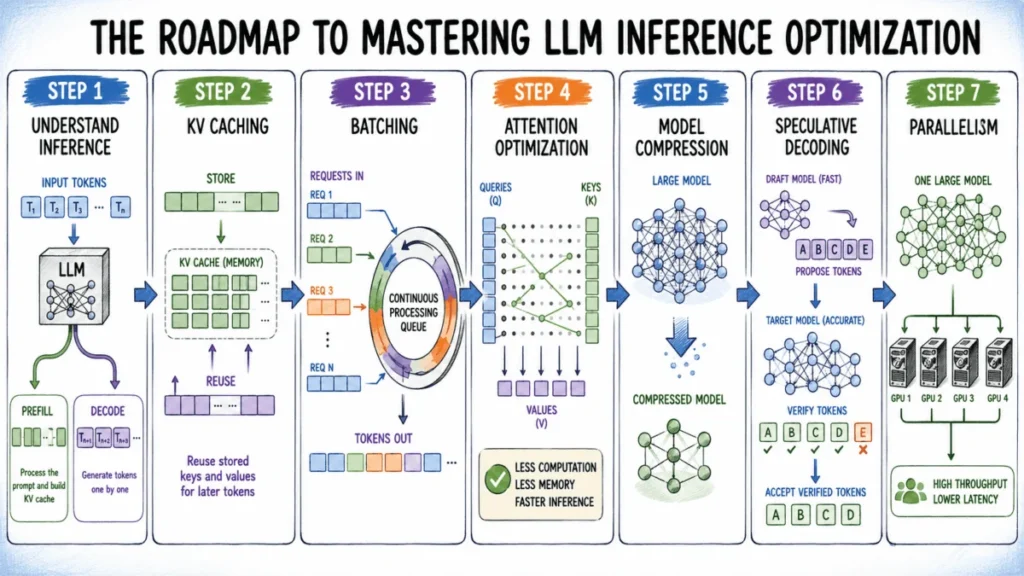
In the rapidly evolving landscape of generative artificial intelligence, moving a Large Language Model (LLM) from a research notebook to a production environment is no longer just a coding exercise—it is a sophisticated engineering challenge. While achieving "correct" output has become a solved problem for most development teams, the real hurdle lies in achieving that output at scale.
As enterprises integrate models into live applications, they inevitably hit a wall: latency targets are missed, costs skyrocket as context windows expand, and the infrastructure struggles to handle concurrent request queues. Inference optimization is the specialized discipline that bridges this gap, enabling models to serve more requests, with lower latency and reduced operational expenditure, all without the need for additional training.
The Two-Phase Engine: Prefill vs. Decode
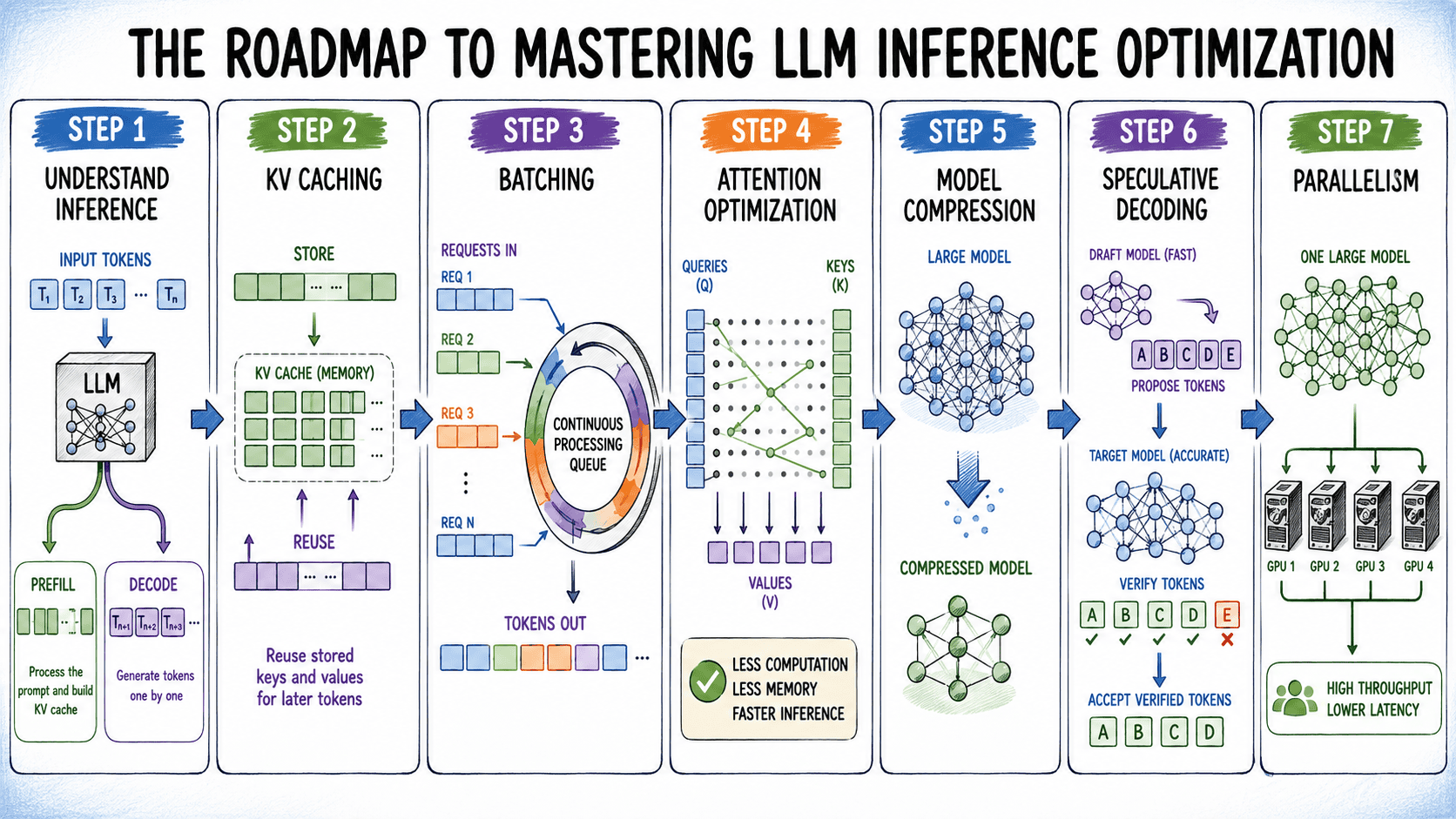
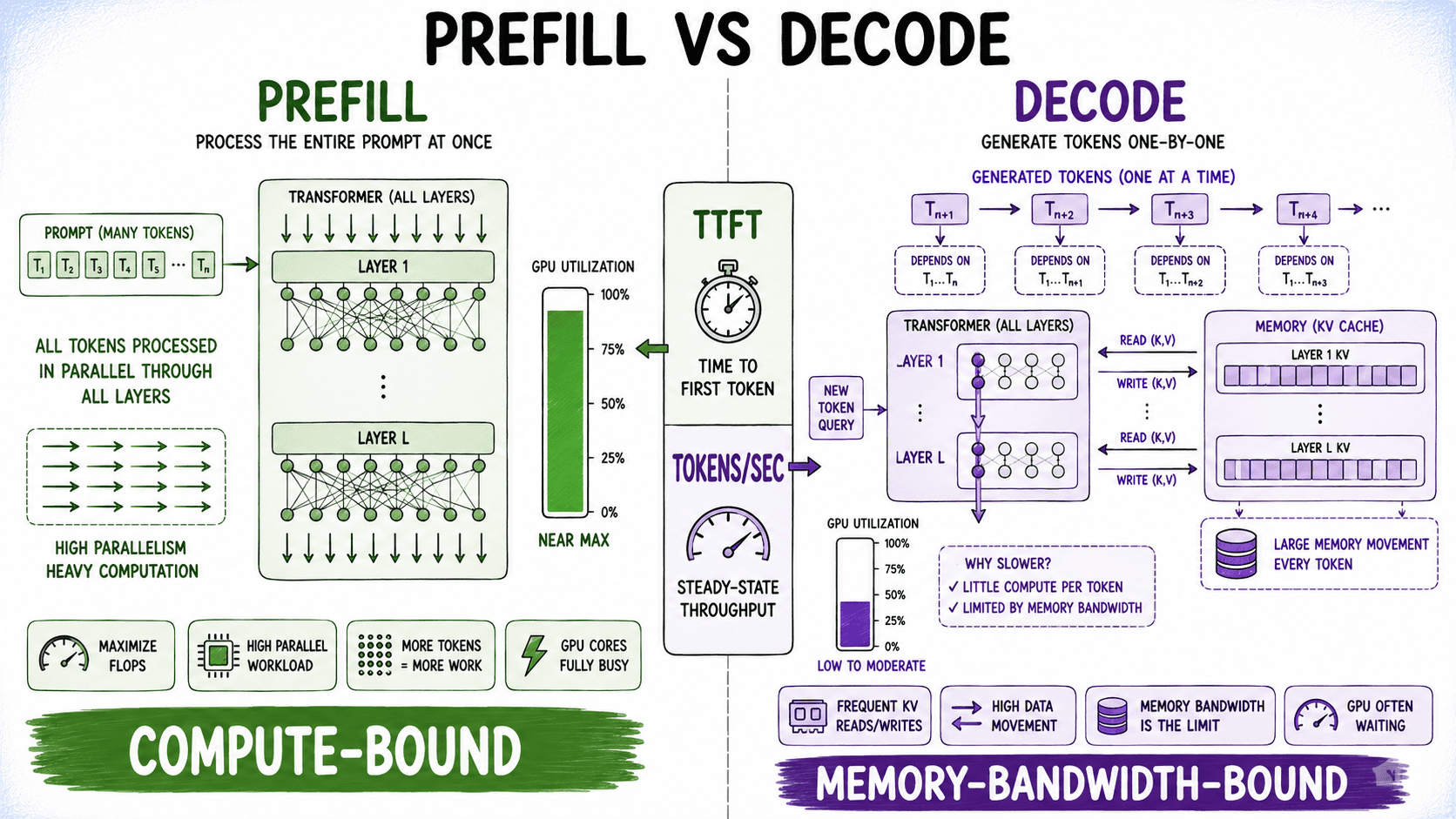
To optimize inference, one must first understand the fundamental mechanics of a transformer-based LLM. Every generation cycle is split into two distinct stages, each governed by different performance bottlenecks.
The Prefill Phase: The Compute-Bound Foundation
When a user submits a prompt, the model enters the "prefill" phase. It processes the entirety of the input tokens simultaneously to calculate the key and value tensors—the "memory" of the model. Because the input sequence is fully known at the start, this operation is highly parallelizable, effectively saturating the GPU’s compute units. In this stage, the system is strictly compute-bound; the speed is dictated by the raw TFLOPS available on the hardware.
The Decode Phase: The Memory-Bandwidth Bottleneck
Following prefill, the model shifts to the "decode" phase. Here, the model generates tokens one by one in an autoregressive fashion. Because each new token depends on the previous one, true parallel generation within a single sequence is impossible. The bottleneck shifts dramatically: the GPU spends most of its time waiting for data to be fetched from high-bandwidth memory (HBM). This is a memory-bandwidth-bound process.
Engineers often make the mistake of optimizing for one metric—such as Time-to-First-Token (TTFT)—while ignoring the other, Tokens-Per-Second (TPS). A high-performance architecture must address both: prefill performance for responsiveness and decode throughput for sustained generation.
The Memory Crisis: KV Caching and PagedAttention
The most effective way to accelerate the decode phase is through Key-Value (KV) caching. By storing the intermediate tensors of previous tokens in GPU memory, the system avoids redundant recomputation. However, this creates a memory footprint that scales linearly with batch size and sequence length.
The Fragmentation Problem
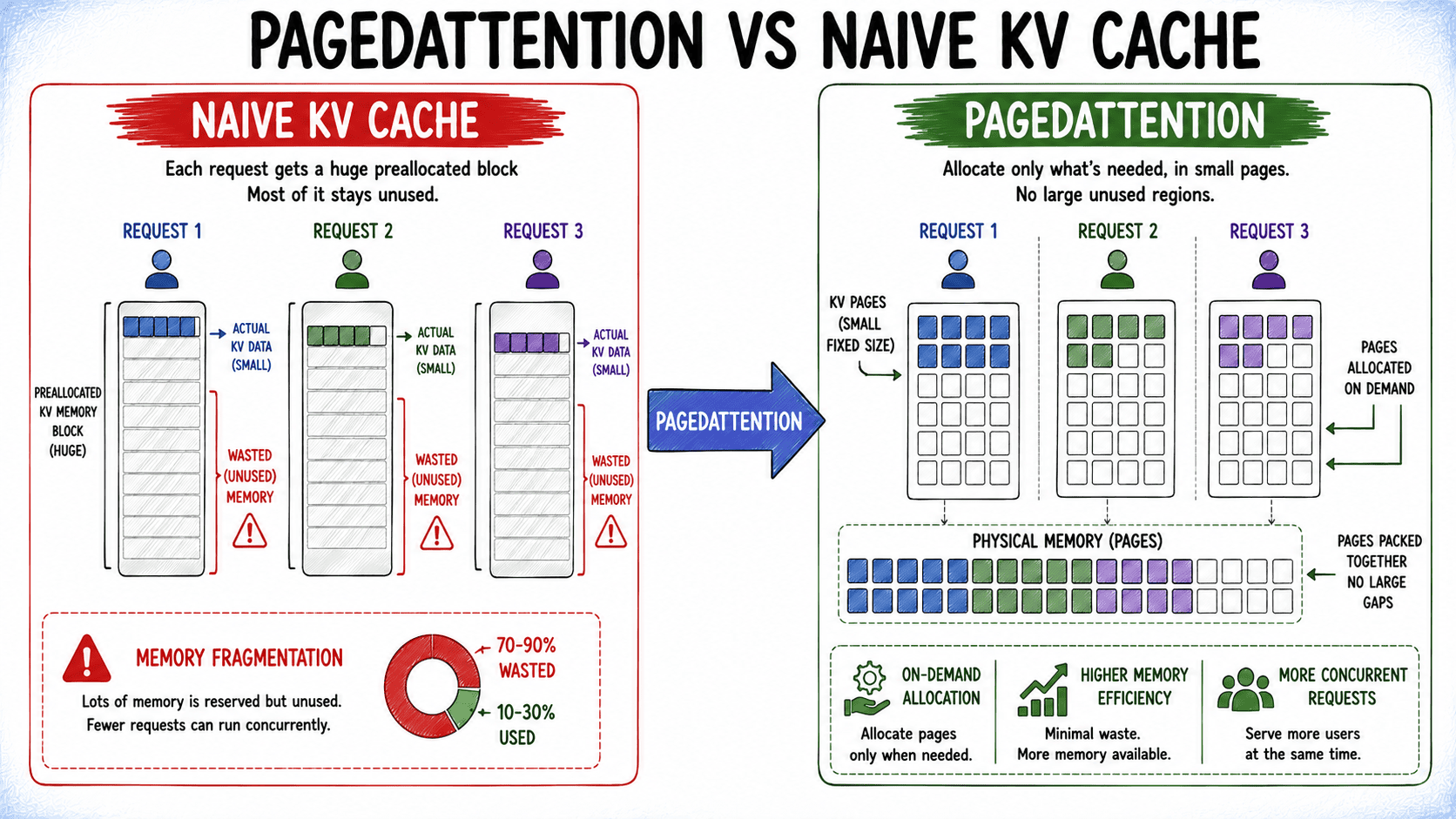
Naive KV cache management typically reserves a contiguous block of memory based on the maximum possible sequence length. This leads to massive internal fragmentation, where most of the allocated memory sits idle, preventing the model from scaling to larger batches.
The PagedAttention Revolution
Inspired by the virtual memory management techniques used in modern operating systems, PagedAttention has emerged as the industry standard. By partitioning the KV cache into fixed-size blocks, the system can allocate memory non-contiguously and on-demand. This breakthrough significantly reduces memory waste, allowing for larger batch sizes and higher throughput on identical hardware. Modern runtimes like vLLM have popularized this approach, making it accessible to production teams.
The Evolution of Batching: From Static to Continuous
Effective hardware utilization is the hallmark of a mature inference system. If a GPU is running a single request at a time, it is effectively wasting 90% of its potential.
Static and Dynamic Batching
Historically, developers relied on static batching, where requests were bundled together until a fixed number was reached. This proved inefficient due to the variance in output lengths; the entire batch remained stalled until the longest sequence finished. Dynamic batching improved this by introducing timeouts, but it still suffered from the "blocking" problem—shorter, faster requests remained stuck behind a long-running task.
The Rise of Continuous Batching
Continuous batching (or in-flight batching) has fundamentally altered the paradigm. In this model, as soon as a single request completes, its slot in the batch is immediately filled by a new request. By decoupling individual request lifecycles from the overall batch execution, this method ensures the GPU is constantly saturated, maximizing throughput regardless of the variance in prompt or output lengths.
Architecture-Level Optimizations: Attention Variants
The attention mechanism, while powerful, is the most computationally expensive component of the transformer architecture. To reduce its impact, several structural optimizations have been developed.
MQA and GQA
Multi-Head Attention (MHA) is standard but memory-intensive. Multi-Query Attention (MQA) simplifies this by having all query heads share a single set of key-value heads. While this results in a marginal accuracy drop, it drastically reduces memory movement during decoding. Grouped-Query Attention (GQA) offers a compromise, grouping query heads to maintain a balance between memory efficiency and model capacity.
FlashAttention
Unlike architectural changes that require retraining, FlashAttention optimizes the computational order. By utilizing tiling and keeping intermediate values in fast on-chip SRAM rather than writing them to global GPU memory, FlashAttention provides a drop-in performance boost. It is widely considered one of the most impactful "zero-cost" optimizations currently available.
Model Compression: Doing More with Less
When hardware constraints are the primary barrier, model compression provides a path to efficiency.
- Quantization: Reducing weights from 16-bit to 8-bit or 4-bit precision can cut memory requirements by half or more. With techniques like GPTQ and AWQ, models can be compressed with negligible impact on quality, often allowing a 70B parameter model to fit on hardware that previously struggled with a 7B model.
- Sparsity: Structured sparsity exploits the fact that many weights in a trained model are near-zero. Hardware-accelerated sparsity, such as NVIDIA’s 2:4 support, allows for significant speedups by effectively ignoring these zero-value connections.
- Knowledge Distillation: For applications where latency is the ultimate metric, distilling a large teacher model into a smaller student architecture often yields better results than simply compressing the teacher, as the student can be optimized for a specific task.
Latency-Critical Applications: Speculative Decoding
For real-time applications like interactive chatbots, waiting for the full autoregressive loop is unacceptable. Speculative decoding solves this by employing a small "draft" model to predict the next few tokens. The main, "verifying" model then checks these tokens in parallel. If the draft model is accurate, the system gains a massive latency reduction. Because the verification is parallel, the throughput gains are substantial, provided the draft model is well-tuned to the main model’s behavior.
Scaling with Parallelism
When models grow beyond the capacity of a single GPU, engineers must turn to distributed strategies:
- Tensor Parallelism: Splitting individual layers across multiple GPUs to reduce memory pressure and increase computation speed.
- Pipeline Parallelism: Distributing layers across a sequence of GPUs. While powerful, this is prone to "pipeline bubbles," which require sophisticated microbatching to mitigate.
- Prefill-Decode Disaggregation: The cutting edge of infrastructure design involves separating the compute-heavy prefill operations from the memory-heavy decode operations. By routing these tasks to distinct hardware pools, teams can optimize for each phase independently, preventing heavy prefill requests from starving the decode engine.
Implications and Future Outlook
The path to production-grade LLM inference is not a single "magic bullet" but a layered strategy. Organizations must profile their specific workloads—identifying whether they are constrained by memory bandwidth, compute power, or latency requirements—and apply the appropriate techniques in sequence.
As we look toward the future, the integration of these optimizations into standardized inference runtimes will continue to commoditize high-performance serving. However, the fundamental tension between context length, throughput, and hardware cost will remain. The engineers who master the balance of these variables will define the next generation of AI-powered applications, turning the promise of large language models into the reliable, scalable reality of modern digital infrastructure.