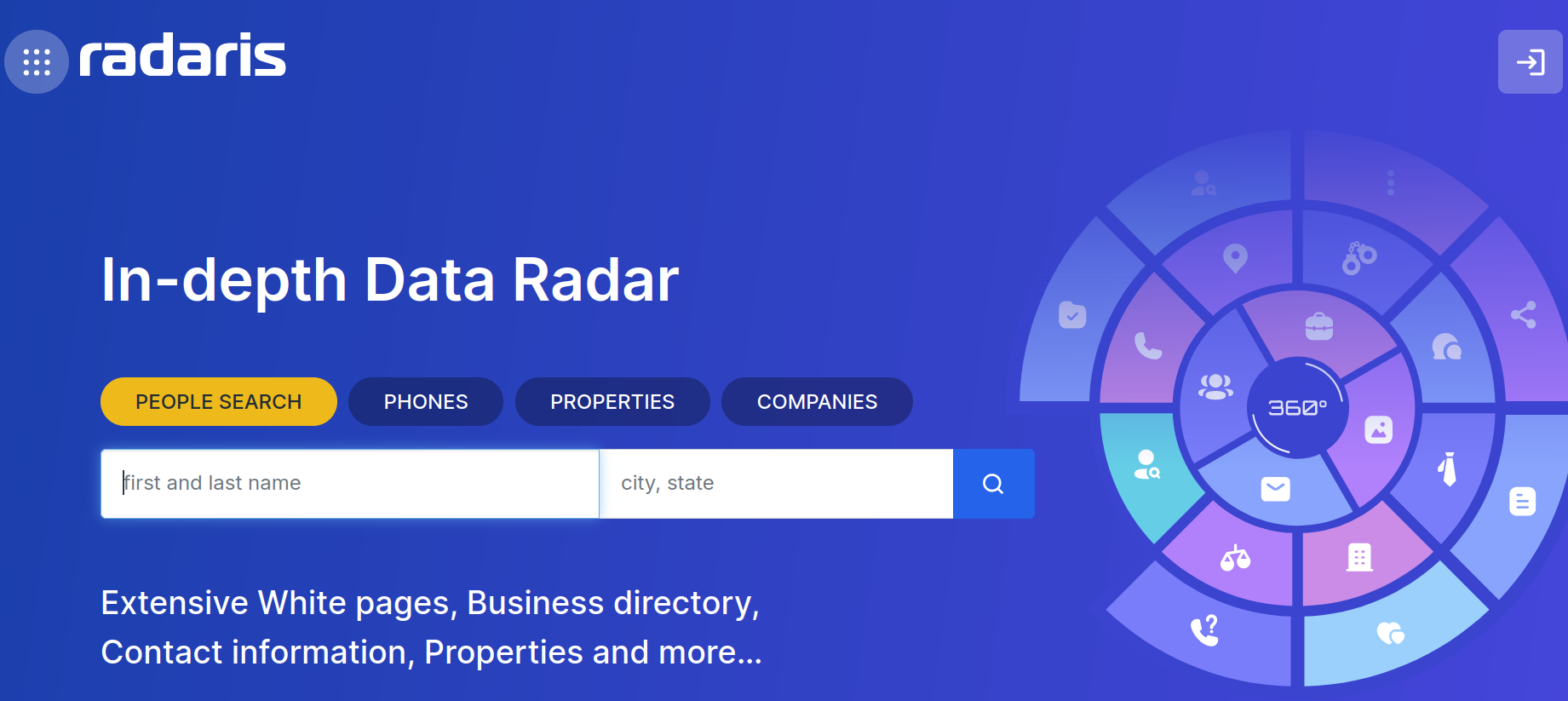
The Fall of a Data Titan: How Radaris Lost Its Domain in a Privacy War

For years, the people-search engine Radaris.com operated as a digital fortress, seemingly immune to the pleas of citizens demanding their personal information be scrubbed from its vast databases. Known for its aggressive data harvesting and a stubborn refusal to comply with privacy removal requests, the company built a reputation on stonewalling and procedural obfuscation. However, that era of impunity has come to an abrupt and dramatic end.
In a landmark judicial development, a New Jersey court has ordered the transfer of Radaris.com and more than a dozen associated data broker domains to the plaintiffs—a move that marks a significant escalation in the ongoing legal war between privacy advocates and the shadowy data-brokerage industry.
The Catalyst: Daniel’s Law and the Fight for Safety
The legal assault on Radaris was initiated by Atlas Data Privacy Corp, an organization dedicated to holding data brokers accountable for violating state privacy statutes. At the heart of the conflict is New Jersey’s Daniel’s Law, a critical piece of legislation named in honor of Daniel Anderl, the son of U.S. District Court Judge Esther Salas, who was murdered at her home in 2020.
Daniel’s Law was designed to provide a "safety shield" for the nation’s most vulnerable public servants. It mandates that commercial data brokers must permanently remove the personal information of law enforcement officers, government personnel, judges, and their family members from public-facing search sites. The statute is designed with teeth, carrying a penalty of $1,000 for every instance where a valid removal request is ignored. For companies that profit by selling the locations and contact details of officials, these fines represent a direct threat to their business model.
A Chronology of Evasion and Defiance
The downfall of Radaris was not an overnight occurrence, but rather the result of a decade-long cat-and-mouse game played in the halls of justice.
The 2017 Precedent
The seeds of the current judgment were actually sown years ago. In 2017, Radaris faced a class-action lawsuit but managed to avoid the consequences by failing to appear in court. When a $7.5 million default judgment was handed down, the court ordered the domain registry Verisign to transfer the Radaris.com domain to the plaintiffs. Radaris dodged the bullet by appealing, claiming the lawsuit had failed to name the "actual" owner—a Cyprus-based shell company called Bitseller Expert Limited. The court halted the transfer, and the plaintiffs failed to refile, allowing Radaris to continue its operations under a new legal entity: the Marshall Islands-based Andtop Company.
The 2024–2025 Legal Offensive
In February 2024, Atlas Data Privacy Corp re-engaged the fight, suing Radaris for its flagrant disregard of Daniel’s Law. What followed was a masterclass in corporate obfuscation. Attorneys for Radaris employed a "shell game" strategy, constantly updating terms of service and shifting ownership between entities in the Marshall Islands, the British Virgin Islands, and the Seychelles to confuse the court.
Matt Adkisson, CEO of Atlas, described this period as the company’s "island-hopping phase." Whenever a legal threat neared, the entity supposedly responsible for the domain would be discarded, replaced by a fresh, elusive entity in a different jurisdiction. When Atlas hired investigators in the Marshall Islands to track down the newest management company, they discovered that the entity cited by Radaris did not even exist.
The stalemate finally broke in August 2026, when a New Jersey judge ruled that the defendants had been given multiple, fair opportunities to defend themselves and had repeatedly chosen to ignore the court’s authority. The resulting default judgment led to the immediate transfer of 14 domains to Atlas.
Unmasking the Operators: The Lubarsky Brothers
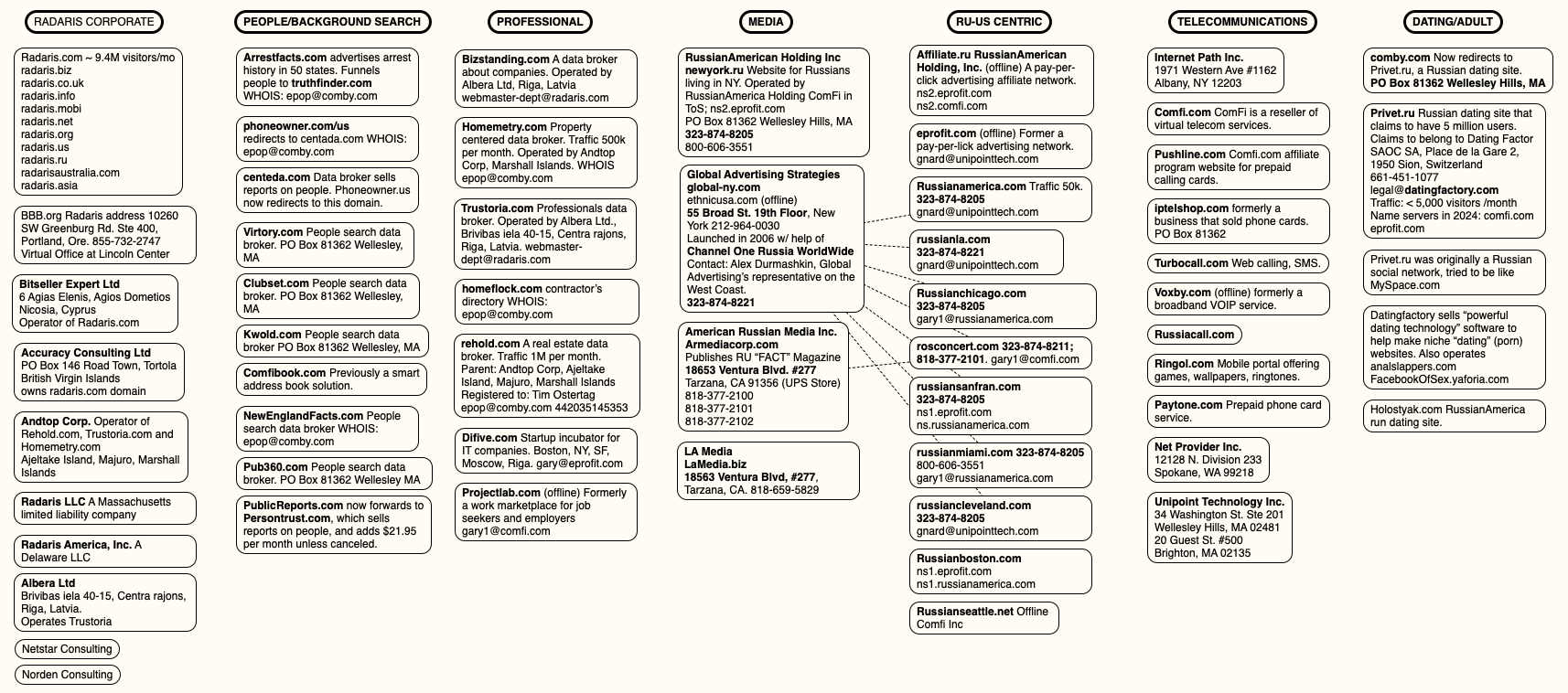
The investigation into Radaris extended far beyond legal filings. In early 2024, KrebsOnSecurity published a detailed exposé linking the Radaris empire to two Russian-born brothers living in Massachusetts: Igor and Dmitry Lubarsky.
The investigation revealed that the brothers operated a sprawling web of people-search sites, Russian-language dating platforms, and affiliate programs. Even more telling was the company’s use of a fictitious CEO. Radaris had for years published press releases and pitched investors using the name "Gary Norden," a fabricated persona that the company’s own attorney, Val Gurvits, eventually admitted was a complete invention. This revelation of a fake executive, used to project legitimacy while soliciting investment, severely undermined the company’s credibility in the eyes of the court and the public.
Documentary Evidence: The "One-Operation" Reality
During the litigation, Atlas obtained over 10,000 internal emails and documents, which provided a granular look at how the Radaris machine functioned. The evidence confirmed that dozens of seemingly independent data brokers—including names like Veripages, Nuform Solutions, and Growth Data Advisors—were, in fact, the same operation.
According to summaries shared by Atlas, these entities shared:
- A single set of bank accounts and payment processors.
- A centralized virtual office address.
- Administrative, financial, and technical functions managed through a unified email domain architecture.
The data further revealed that Radaris was not just profiting from the initial sale of data, but was engaged in a "predatory ecosystem." Radaris was found to earn approximately $42,000 a month from its own sites, while simultaneously partnering with marketing firms and even other privacy-removal companies, such as Onerep. This confirmed the industry’s "sell the disease, sell the cure" business model, where a single operator manages both the sites that leak data and the services that charge fees to remove it.
Official Responses and Legal Maneuvers
Despite the transfer of the domain, the legal battle is far from concluded. Attorneys for the defendants, including Victor Worms, have moved to vacate the default judgment. They argue that because "Radaris.com" is not a legal entity, it cannot be sued, and therefore the transfer of the domain constitutes an unconstitutional forfeiture of property.
"We intend to pursue all appropriate appeals because we believe the transfer of Radaris.com amounts to a forfeiture in violation of various constitutional principles," Worms stated.
Meanwhile, the broader industry has mobilized. Over 150 data brokers are currently challenging the constitutionality of Daniel’s Law in federal court, arguing that the statute violates the First Amendment by restricting the dissemination of "public" information.
Implications: The Need for Federal Privacy Reform
The case of Radaris is a microcosm of a much larger failure in the American legal system. While state-level laws like Daniel’s Law provide essential, targeted protections, they are ultimately stop-gap measures.
Privacy expert Justin Sherman, author of The Middlemen, emphasizes that the data broker industry thrives in the gray area between state and federal law. "The lack of a comprehensive federal privacy law is not for a lack of knowledge," Sherman notes. "We’ve had eight million wake-up calls already."
The current reality is that nearly all state privacy laws contain broad exemptions for "publicly available" information. This includes everything from marriage certificates and property filings to motor vehicle records and court documents. As seen in the recent breach at IDScan.net, where 153 million driver’s licenses were exposed, the current system allows for the mass harvesting of identity data with almost no federal oversight regarding how that data is used, stored, or sold.
As the legal appeals continue, the redirected homepage of Radaris.com stands as a monument to a shifting tide. It is no longer a repository of sensitive dossiers on millions of Americans, but a notice of its own downfall. Whether this will lead to a broader, federal transformation of data privacy remains to be seen, but for the residents of New Jersey and the families of public officials, the removal of the Radaris threat is a long-overdue victory for safety and sanity in an increasingly surveilled world.