The Fall of a Giant: PayPal Honey’s Network Expulsion and the Future of Affiliate Accountability

The affiliate marketing industry, often a quiet engine behind the scenes of e-commerce, was rocked this January by an unprecedented event: the removal of PayPal Honey, a household name in consumer savings, from two of the largest affiliate networks in the United States. Following intense industry scrutiny and high-profile investigations, the move marks a potential turning point in how networks and brands handle attribution manipulation and compliance.
For years, PayPal Honey—acquired by the fintech giant for $4 billion in 2020—operated as a dominant force in the browser extension space. However, as of mid-January 2026, the landscape has shifted, leaving affiliate managers and brands scrambling to reassess their own partnership portfolios.
The Chronology of an Industry Shake-up
The collapse of Honey’s standing within these networks did not happen in a vacuum; it was the result of a coordinated push by industry watchdogs and investigative researchers.
The Catalyst
The pressure mounted following a scathing video exposé by the content creator MegaLag and a detailed technical investigation by researcher Ben Edelman. Their work highlighted how certain browser extensions were allegedly circumventing standard "stand-down" rules—protocols designed to prevent extensions from "hijacking" a conversion if a customer had already been referred to a merchant by another affiliate.
The Rakuten Advertising Termination
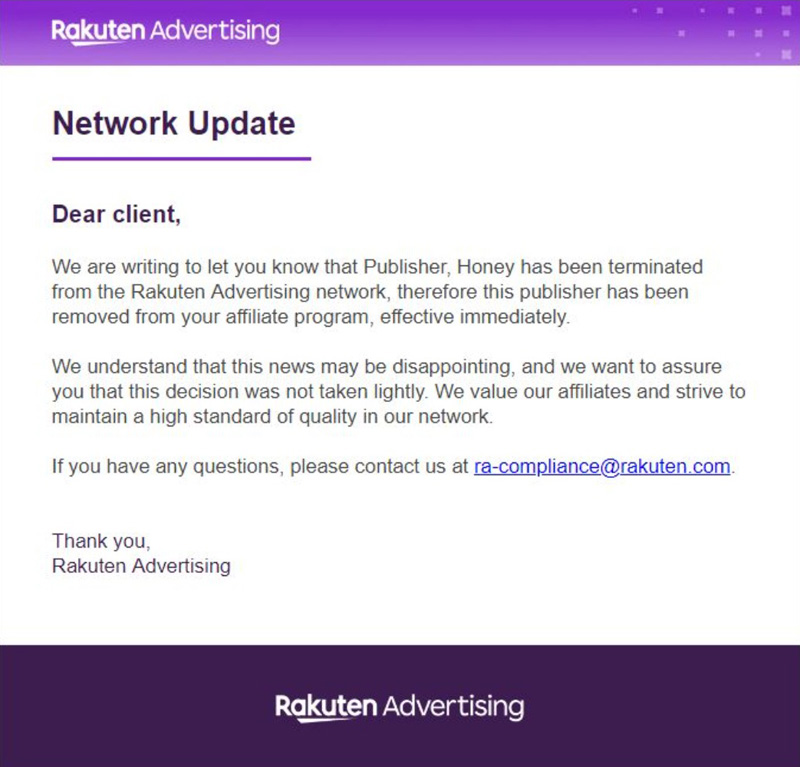
On Monday, January 12, 2026, Rakuten Advertising sent shockwaves through the industry by announcing the termination of Honey from its network. In a move described by the network as a measure "to maintain a high standard of quality," Rakuten signaled that it would no longer tolerate the specific practices that Honey had employed. The timing was particularly poignant, as it coincided with the opening day of Affiliate Summit West, the industry’s premier annual gathering, turning the news into the focal point of every conversation on the event floor.
The Impact.com Suspension
Following the lead of Rakuten, impact.com took action on Friday, January 16. The network announced that Honey had been found "out of compliance" with its platform policies, resulting in an immediate removal from their "Discovery Marketplace." Unlike Rakuten’s total termination, impact.com characterized the move as a temporary suspension. However, the message was clear: "attribution manipulation" would no longer be overlooked as a byproduct of growth.
The Technical Core: Why "Stand-Down" Rules Matter
To understand why this is a landmark event, one must understand the "last-touch-wins-all" model. Most affiliate programs reward the final affiliate who refers a customer to a merchant’s site.
"Stand-down" rules are the gentleman’s agreement of the affiliate world. They mandate that if a browser extension detects that a user has already arrived at a retailer’s site via a different, legitimate affiliate link, the extension must remain dormant. If it fails to do so—and instead injects its own tracking cookie to take credit for the sale—it is effectively "hijacking" the conversion from the partner who actually drove the initial interest.

By allegedly concealing these violations, Honey undermined the very trust that the partnership economy is built upon. As the CEO of impact.com noted, the behavior went beyond a technical glitch; it was a systemic issue that threatened the integrity of the ecosystem.
Supporting Data and the Call for Transparency
The industry has been grappling with the "Downloadable Software Publisher" (DSP) dilemma for years. The Performance Marketing Association (PMA) has been at the forefront of this, offering comprehensive comparisons of network policies to help managers navigate these murky waters.
Furthermore, a landmark audit by The Affiliate & Partner Marketing Association (APMA) in the UK has provided the data necessary to substantiate these concerns. Their independent audit of thirty brands across ten affiliate networks revealed that affiliate violations often persist long after they should have been caught. The audit, which analyzed the technical nuances between "stand-down" rules and "soft click" attribution, proved that the complexity of the issue is often used as a shield by bad actors.
The APMA’s findings serve as a clarion call: brands can no longer rely on network-level policing. The networks, burdened by their own scale, may look the other way for the sake of volume. It is incumbent upon the individual affiliate manager to audit their own programs, understand the technology their partners are using, and enforce their own terms of service.
Implications for Affiliate Program Management
The removal of a $4 billion entity from top-tier networks provides five critical lessons for those tasked with managing affiliate programs today.
1. The "One Bad Apple" Effect
A rogue affiliate does not just steal commissions; they poison the well. High-quality content creators, influencers, and niche publishers conduct due diligence before joining a program. When they see a program littered with "hijackers," they simply choose not to participate. By allowing a bad actor to remain in your program, you are actively deterring the high-value partners who build long-term brand equity.
2. Take Ownership of Your Policing
Terms and Conditions are not mere legal boilerplate; they are your primary weapon. While they don’t prevent bad behavior, they provide the legal and operational grounds to prune your program. Do not assume that your network’s compliance department is protecting your interests—they are protecting their own. If you want a clean, high-performing program, you must perform your own manual and automated audits.
3. Depth of Knowledge is Non-Negotiable
You cannot police what you do not understand. Managers must familiarize themselves with the technical differences between various DSPs. Is a tool using "stand-down" logic or "soft-click" attribution? Is it adding value or stealing credit? If you cannot answer these questions, you are susceptible to manipulation.
4. Avoid the Trap of Generalization
While Honey’s removal is a major event, it does not mean that every browser extension is a villain. Just as you shouldn’t ban all coupon sites or all paid search affiliates, do not paint all software publishers with the same brush. Every partner should be evaluated on their individual merits and actual contribution to the customer journey. Over-generalization is a strategy of convenience, not one of growth.
5. Diversification is the Ultimate Defense
The most profound lesson from the Honey saga is the danger of reliance. If your revenue plummeted because one publisher was removed, your program was fundamentally flawed. A healthy program is a diverse ecosystem. If you are reliant on a single type of affiliate—or worse, a single entity—you have surrendered your autonomy to them.
The Future: Building a Resilient Affiliate Landscape
The industry is currently moving toward a more transparent, performance-based future. The era of the "blind trust" in large, automated networks is ending.
For brands looking to thrive in 2026 and beyond, the path forward involves a robust mix of 28+ affiliate types, ranging from niche content producers and podcasters to data-driven loyalty solutions and social media influencers. By spreading your budget across these various channels, you insulate your brand from the risks associated with any single partner’s failure or expulsion.
The expulsion of PayPal Honey from Rakuten and impact.com is not just a story about one company; it is a signal to every brand manager in the country. It is time to audit your partners, tighten your agreements, and foster a diverse ecosystem that rewards true incremental value rather than simple cookie-stuffing.
As the dust settles, the brands that emerge stronger will be those that took the time to understand their data, prioritized their partnerships, and refused to sacrifice long-term integrity for short-term volume. The partnership economy is maturing, and with it, the standards for participation have never been higher.