The AI Revolution: Redefining the Digital Landscape for Modern Business
Artificial Intelligence (AI) has moved far beyond the realm of science fiction, cementing its place as the foundational architecture of the modern professional ecosystem. As its capabilities diversify, from generative language models to complex predictive analytics, AI is no longer a luxury—it is an operational imperative. For entrepreneurs, digital marketers, and enterprise leaders, understanding how to leverage these tools is the defining factor between stagnation and sustainable growth.
The State of Play: Main Facts and Adoption Trends
The shift toward AI integration is not merely a passing technological trend; it is a fundamental transformation of the global economy. Recent data from AuthorityHacker underscores the velocity of this transition: 35% of companies have already fully integrated AI into their core business processes. Perhaps more telling is the sentiment of the C-suite: 90% of organizational leaders now view AI assistance as a definitive competitive advantage.
This widespread adoption is bolstered by the ubiquity of AI in everyday consumer technology, with 77% of personal and professional devices now utilizing artificial intelligence in their standard functionalities. From voice assistants and predictive text to sophisticated backend security protocols, AI has become the invisible engine of the digital age.
A Brief Chronology: The Evolution of AI in Business
To understand where we are going, we must look at how we arrived here. The trajectory of AI in the commercial sector can be segmented into four distinct eras:
- The Era of Rules (1990s–2010s): Early business software relied on rigid, human-defined "if-then" logic. AI was largely relegated to basic data processing and CRM automation.
- The Rise of Machine Learning (2012–2019): As big data became accessible, businesses began using machine learning to identify patterns. This era gave birth to targeted advertising and personalized product recommendations.
- The Emergence of Natural Language Processing (2020–2022): The refinement of NLP enabled computers to interpret human intent. Chatbots moved from clunky scripts to conversational interfaces, revolutionizing customer service.
- The Generative Explosion (2023–Present): With the arrival of Large Language Models (LLMs) and advanced diffusion models for imagery, businesses transitioned from passive users of AI to active creators. AI is now a partner in design, coding, strategy, and content creation.
Supporting Data: Why AI is No Longer Optional
The data supporting the transition to AI-centric business models is compelling. Beyond the 90% competitive advantage statistic, further research suggests that businesses employing AI see a 20% to 30% reduction in operational costs within the first year of full implementation.
- Content Production Efficiency: Teams utilizing generative AI for content marketing report a 40% increase in output speed without a commensurate increase in headcount.
- Customer Experience: Businesses utilizing AI-driven sentiment analysis and chatbots see a 25% increase in customer satisfaction scores (CSAT) due to 24/7 availability and near-instant response times.
- Design and Development: AI-assisted web design tools reduce the time-to-market for new e-commerce storefronts by nearly 50%.
Official Responses and Industry Sentiment
Industry leaders are vocal about the necessity of this shift. Satya Nadella of Microsoft has famously described AI as the "new electricity," noting that just as electricity transformed every industry in the 20th century, AI is set to do the same for the 21st.
Conversely, regulatory bodies, including the European Union and the U.S. Federal Trade Commission, have issued warnings regarding the ethical deployment of these tools. The consensus among the professional community is one of "cautious optimism." Organizations are being urged to implement "human-in-the-loop" systems, ensuring that while AI handles the heavy lifting of data analysis and generation, the final strategic decisions remain under human governance.
The Toolkit: Navigating the AI Ecosystem
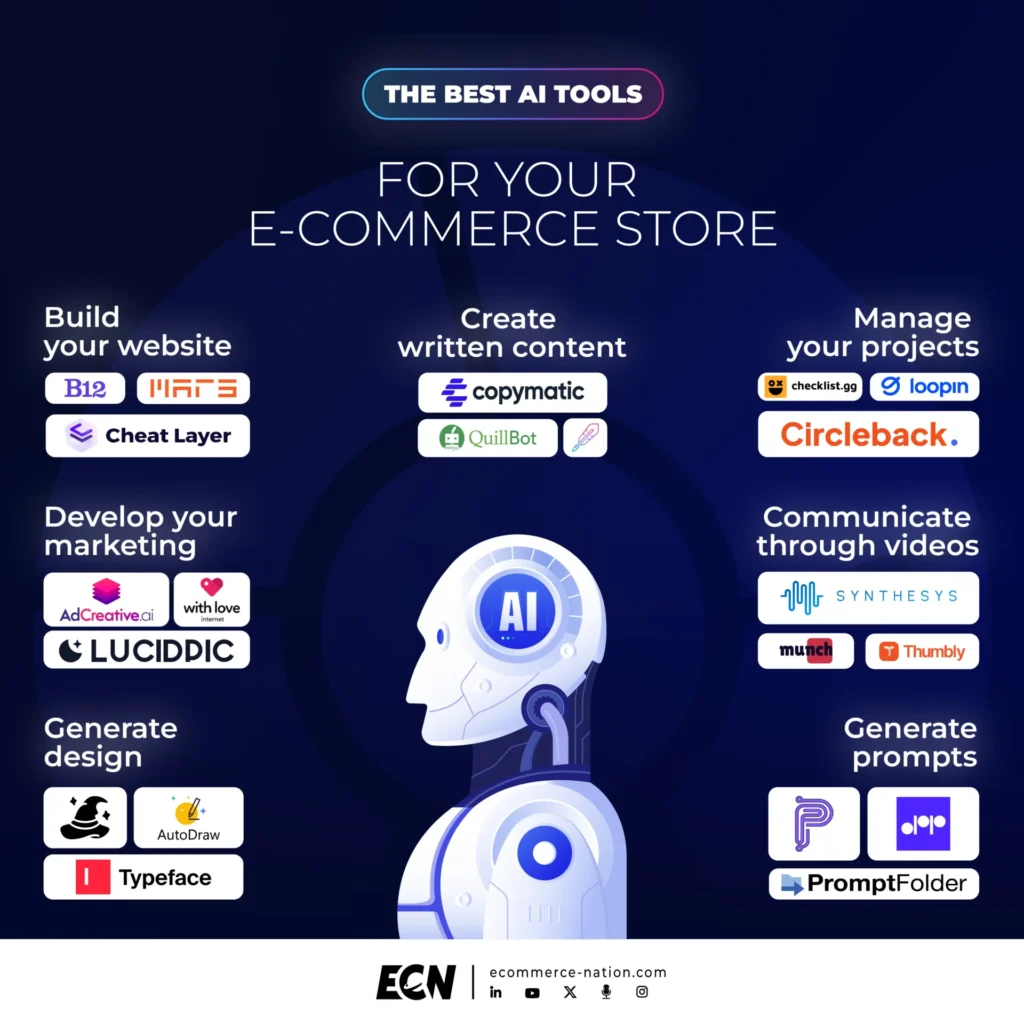
To assist you in optimizing your company, online store, or blog, we have categorized the most essential AI tools currently shaping the industry.
Building and Scaling Your Website
The barrier to entry for professional web development has collapsed. AI-powered platforms like Wix ADI and Framer AI allow users to generate high-functioning, responsive websites by simply describing their brand identity. These tools automatically handle layout optimization, color theory, and mobile responsiveness.
Strategic Marketing and Brand Growth
AI has transformed marketing from a guessing game into a precise science. Tools such as Jasper and Copy.ai assist in crafting brand-aligned messaging, while Seventh Sense optimizes email timing based on individual subscriber behavior, ensuring your communications land at the moment of highest intent.
Visual Communication and Video
Video is the most consumed medium on the internet, yet it was traditionally the most expensive to produce. AI tools like HeyGen and RunwayML are democratizing production. They allow for the creation of lifelike avatars and high-quality video editing from simple text prompts, significantly reducing the cost of video marketing campaigns.
Project Management and Operational Efficiency
Managing complexity is a human weakness but an AI strength. ClickUp’s AI assistant and Asana Intelligence can summarize long project threads, suggest task prioritization, and predict project bottlenecks before they occur. By automating administrative tasks, teams can focus on high-value creative problem solving.
Prompt Engineering: The New Professional Skill
As LLMs become ubiquitous, the ability to "talk" to AI is becoming a vital skill. Tools like PromptPerfect help users refine their inputs to ensure that the output generated by tools like ChatGPT or Claude is precise, professional, and actionable. Learning to structure prompts is effectively learning to communicate with the most powerful library of information ever created.
Content Marketing Strategy
Creating written content at scale is no longer about "spamming" the internet; it is about providing value. SurferSEO and MarketMuse use AI to analyze the competitive landscape and suggest content structures that align with search engine algorithms, ensuring your content is not just written, but discovered.
Design and Creative Assets
For brands without an in-house design team, AI tools like Midjourney and Canva’s Magic Studio are game-changers. Whether you need custom hero images, social media graphics, or UI elements, these tools translate conceptual ideas into high-fidelity assets in seconds, allowing for rapid A/B testing of visual branding.
Implications for the Future
The implication for the modern business owner is clear: the divide between those who use AI and those who do not will soon become an insurmountable chasm.
However, the goal of AI adoption should not be to replace human talent, but to augment it. By delegating repetitive, data-heavy, or time-consuming tasks to intelligent software, companies can free up their human staff to focus on empathy, high-level strategy, and creative innovation—qualities that machines still struggle to replicate.
As we move through 2024 and beyond, the companies that thrive will be those that embrace AI not as a replacement for human intellect, but as a force multiplier for human ambition. Whether you are an e-commerce giant or a boutique blogger, the tools exist to help you scale. The only question remains: how will you integrate them into your workflow to build the future you envision?
Thibault Herpin
March 18, 2024