The Fall of ‘Dort’: Inside the Collapse of the Kimwolf Botnet Empire
In a significant blow to the global cybercrime underground, Canadian authorities have apprehended 23-year-old Ottawa resident Jacob Butler, the alleged architect behind "Kimwolf," a formidable Internet-of-Things (IoT) botnet responsible for some of the most disruptive distributed denial-of-service (DDoS) attacks in recent memory. The arrest marks the culmination of a high-stakes international investigation involving the Ontario Provincial Police, the U.S. Department of Justice (DOJ), the FBI, and the Department of Defense (DoD).
Butler, known in the darker corners of the internet by the alias "Dort," now faces a litany of criminal hacking charges in both Canada and the United States. His capture not only dismantles a sprawling network of millions of enslaved devices but also serves as a stark warning to those who believe their digital footprints can remain permanently hidden behind the veil of anonymity.
The Architecture of Chaos: What was Kimwolf?
Kimwolf was no ordinary botnet. While many DDoS networks rely on compromised servers or PCs, Kimwolf specialized in the "dark matter" of the internet: the millions of unsecured, "firewalled" IoT devices that populate modern homes and offices. From digital photo frames to web-connected security cameras, Butler’s botnet systematically scanned for and exploited vulnerabilities in hardware that users often assume is benign.
Once enslaved, these devices were integrated into a massive, distributed infrastructure. The botnet’s capabilities were staggering; authorities report that Kimwolf was tied to DDoS attacks reaching nearly 30 Terabits per second (Tbps)—a record-breaking volume that dwarfs the standard attacks encountered by most ISPs. These massive traffic floods were either rented out to other cybercriminals as a "DDoS-for-hire" service or deployed by Butler himself to target high-profile entities, including sensitive Internet address ranges belonging to the U.S. Department of Defense.
The financial toll of these operations has been profound. Victims—ranging from small businesses to large-scale enterprises—have reported losses exceeding one million dollars per incident, a testament to the paralyzing effect of Kimwolf’s 25,000+ distinct attack commands.
Chronology of a Digital Manhunt
The unraveling of the Kimwolf empire was neither instantaneous nor purely the work of government agencies. It was a collaborative effort involving private-sector security researchers and investigative journalists.
Early 2026: The Rise and Retaliation
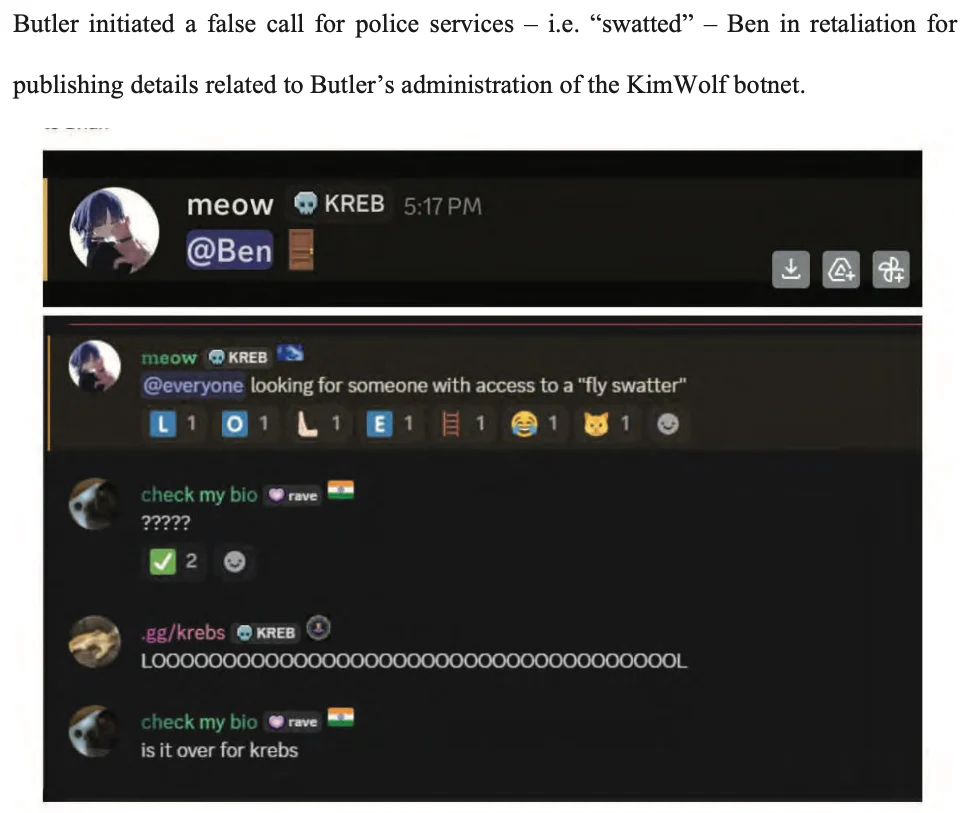
By January 2026, Kimwolf had become a dominant force in the DDoS market, actively competing with other botnets such as Aisuru, JackSkid, and Mossad. During this period, Butler became increasingly aggressive, launching retaliatory DDoS, doxing, and swatting campaigns against security researchers who dared to analyze his code. Among his targets was the founder of Synthient, a security startup that had identified and publicized a critical vulnerability that Kimwolf was using to spread its infection.
February 2026: The Mask Slips
The tide began to turn in late February 2026 when KrebsOnSecurity published a detailed investigation identifying Jacob Butler as the man behind the "Dort" persona. By cross-referencing email addresses, forum registrations, and logs from Telegram and Discord servers, the investigation exposed the blatant lack of operational security maintained by the botmaster. Despite the exposure, Butler continued his campaign of harassment, seemingly emboldened rather than deterred by the public scrutiny.
March 19, 2026: The Infrastructure Raid
The most significant operational success occurred on March 19. A coordinated international law enforcement effort saw the seizure of the technical infrastructure powering Kimwolf and its three primary competitors. Simultaneously, the Ontario Provincial Police executed a search warrant at Butler’s Ottawa residence, seizing a cache of digital devices that would eventually serve as the "smoking gun" for the criminal complaint.
May 2026: Formal Charges and Extradition
Following the analysis of the seized materials—which included IP addresses, financial transaction records, and chat logs—the U.S. Department of Justice unsealed a criminal complaint in the Alaska District Court. Butler was arrested by the Ontario Provincial Police pursuant to a U.S. extradition warrant. As of mid-May, he remains in Canadian custody, awaiting an initial court hearing scheduled for May 26.
Supporting Data: The Anatomy of the Evidence
The downfall of Butler serves as a textbook case study in the dangers of poor "opsec." The criminal complaint reveals a suspect who failed to adequately separate his physical identity from his online criminal persona.
Investigators relied on several layers of evidence to build their case:
- Digital Footprints: Through legal process, investigators obtained IP address logs and online account information that placed Butler directly at the helm of the Kimwolf command-and-control servers.
- Transaction Records: Financial trails linked to the renting of botnet "stresser" services provided a direct correlation between Butler’s personal accounts and the illicit revenue generated by the botnet.
- Communication Logs: Messaging records from encrypted platforms, once decrypted or obtained via legal warrants, showed Butler explicitly discussing the orchestration of attacks and his intent to harass researchers.
The sheer scale of the botnet is further highlighted by its "competitive" environment. The fact that Kimwolf was one of four major botnets competing for the same pool of devices underscores the massive proliferation of vulnerable IoT hardware in the current digital ecosystem.
Official Responses and Institutional Impact
The U.S. Department of Justice and the Department of Defense have praised the inter-agency cooperation that led to the arrests. The Defense Criminal Investigative Service (DCIS) has been instrumental in the investigation, given the specific targeting of DoD address ranges.
"The disruption of the Kimwolf botnet is a testament to the power of international collaboration," a DOJ spokesperson noted in a recent briefing. "By seizing the infrastructure and holding the administrators accountable, we are effectively raising the cost of entry for cybercriminals who view the internet as a playground for disruption."
For those in the cybersecurity sector, the arrest brings a sense of relief. Ben Brundage, founder of Synthient and a primary target of Butler’s swatting attacks, expressed his satisfaction with the outcome: "Hopefully, this will end the harassment. The security community works hard to protect the public from these vulnerabilities; being targeted for doing our jobs is unacceptable."
The Implications: A Shifting Legal Landscape
The arrest of Butler is part of a much broader, ongoing global crackdown on DDoS-for-hire services. In April 2026, the DOJ, in conjunction with European authorities, seized the domain names of nearly four dozen DDoS-for-hire platforms. These sites, which allow users with little to no technical skill to launch massive attacks, are the lifeblood of the modern DDoS industry.
Legal Exposure
Butler currently faces charges in Canada, including unauthorized use of a computer, possession of a device to commit mischief, and mischief in relation to computer data. If extradited to the United States, he faces one count of aiding and abetting computer intrusion, which carries a maximum penalty of 10 years in federal prison.
While the maximum sentence is significant, legal experts anticipate that the final outcome will be tempered by U.S. Sentencing Guidelines. Factors such as Butler’s age, his lack of a prior criminal record, and the level of cooperation he provides to investigators could play a significant role in the duration of his incarceration.
A Warning to the IoT Industry
Beyond the legal repercussions for Butler, this case highlights a systemic failure in the manufacturing of IoT devices. The fact that these devices were "firewalled" yet still exploitable suggests a fundamental flaw in how manufacturers implement network security at the hardware level. The collaboration between the DOJ and private security firms like Synthient signals a shift toward a more proactive, public-private partnership model to address these risks before they can be weaponized.
As the legal proceedings move forward, the case of Jacob "Dort" Butler will undoubtedly serve as a landmark in the history of digital warfare—a reminder that in the interconnected world of the 21st century, no digital empire, no matter how vast, is beyond the reach of the law.