The Future of Data Intelligence: Amazon S3 Introduces Powerful New Annotation Capability
In an era defined by the rapid proliferation of artificial intelligence and autonomous workflows, the ability to manage, discover, and contextualize massive data lakes has become a critical bottleneck for enterprises. Today, Amazon Web Services (AWS) announced a significant evolution in its flagship storage offering: Amazon S3 Annotations. This new metadata capability allows organizations to attach rich, large-scale business context directly to S3 objects, effectively bridging the gap between raw data and actionable machine intelligence.
The Evolution of Data Context: Main Facts
For years, Amazon S3 has served as the bedrock of the modern data lake, housing petabytes of information. However, as AI agents become more sophisticated, they require more than just the binary data itself; they require "context." Previously, metadata in S3 was limited by size and mutability, often forcing developers to build complex, expensive, and fragile "sidecar" databases to track information like AI-generated transcripts, technical specifications, or content compliance ratings.
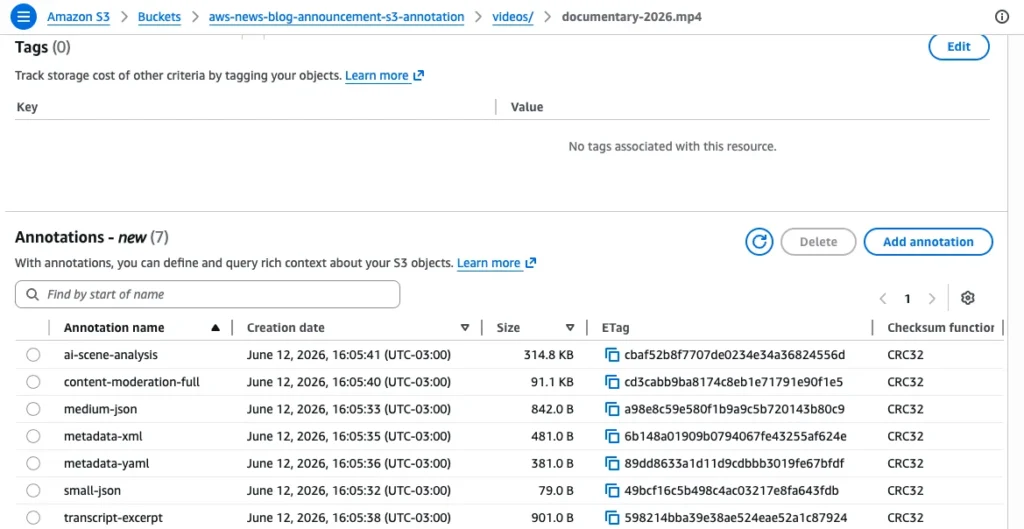
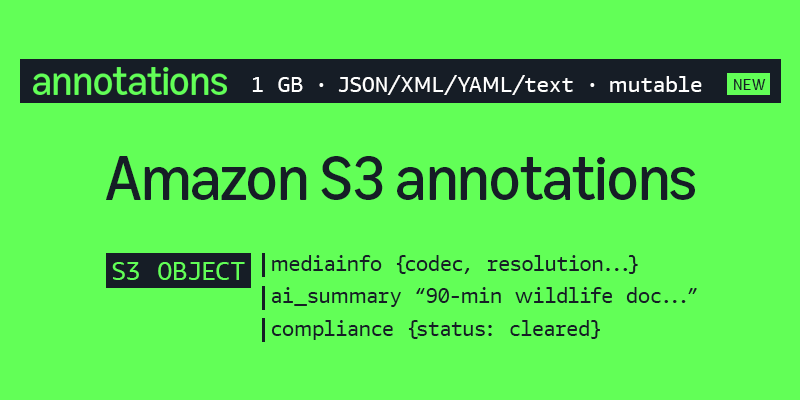
Amazon S3 Annotations fundamentally changes this paradigm. Users can now attach up to 1,000 named annotations to a single object, with each annotation supporting up to 1 MB of data. With a total potential capacity of 1 GB of metadata per object—in formats including JSON, XML, YAML, and plain text—this feature allows for unprecedented depth. Critically, these annotations are mutable, meaning they can be updated or deleted without ever needing to re-write or move the underlying object. This ensures that metadata remains current even as the business logic governing the data evolves.
A Chronology of Metadata Limitations
To understand the significance of this launch, one must look at the historical constraints of cloud storage metadata:
- The Early Days (System-Defined Metadata): At the inception of cloud storage, metadata was primarily restricted to system-level attributes like file size, creation date, and storage class. This provided the "what" and "when" but lacked the "why."
- The Need for Customization (User-Defined Metadata): As storage needs grew, AWS introduced user-defined metadata. While helpful, it was limited to a 2 KB header, effectively restricting its use to simple, short-form labels.
- Operational Control (Object Tags): The introduction of object tags allowed for granular control over lifecycle management and access policies. However, with a limit of only 10 tags and strict character constraints, they were never intended to house complex business logic or AI-driven context.
- The "Sidecar" Era: To overcome these limits, developers resorted to building external databases (like DynamoDB or RDS) to store "sidecar" metadata. This created "data gravity" challenges, where synchronization between the object store and the metadata database became a significant source of latency, cost, and operational overhead.
- The Modern Pivot (S3 Annotations): By integrating the metadata directly into the S3 fabric, AWS has eliminated the need for external synchronization. Annotations now flow with the object during replication and transfer, and they are automatically purged when the object is deleted, ensuring a clean and consistent data lifecycle.
Supporting Data: Comparative Analysis of Metadata Tools
The following table illustrates why S3 Annotations represent a quantum leap in metadata management compared to legacy solutions:
| Capability | Max Size | Mutable | Best For |
|---|---|---|---|
| System Metadata | Fixed | No | File size, storage class, timestamp |
| User Metadata | 2 KB | No | Simple key-value pairs |
| Object Tags | 10 Tags | Yes | Access control, lifecycle rules |
| Annotations | 1 GB | Yes | JSON, XML, AI context, rich business logic |
The architectural shift here is profound. Because annotations are now "first-class citizens" within S3, they are queryable at scale through Amazon Athena. By enabling S3 Metadata annotation tables, users can leverage Apache Iceberg-compatible engines to perform complex, cross-dataset analytics without the need to restore archived objects or incur expensive data retrieval fees.
Official Perspectives and Technical Implementation
In a technical briefing, AWS representatives highlighted that the primary driver for this release was the rise of agentic workflows. "Organizations are building AI agents that need to find, understand, and act on data without human intervention," noted Daniel Abib of the AWS S3 team. "To support these, you need metadata that evolves alongside the data and remains queryable without expensive retrieval."
Implementing the Workflow
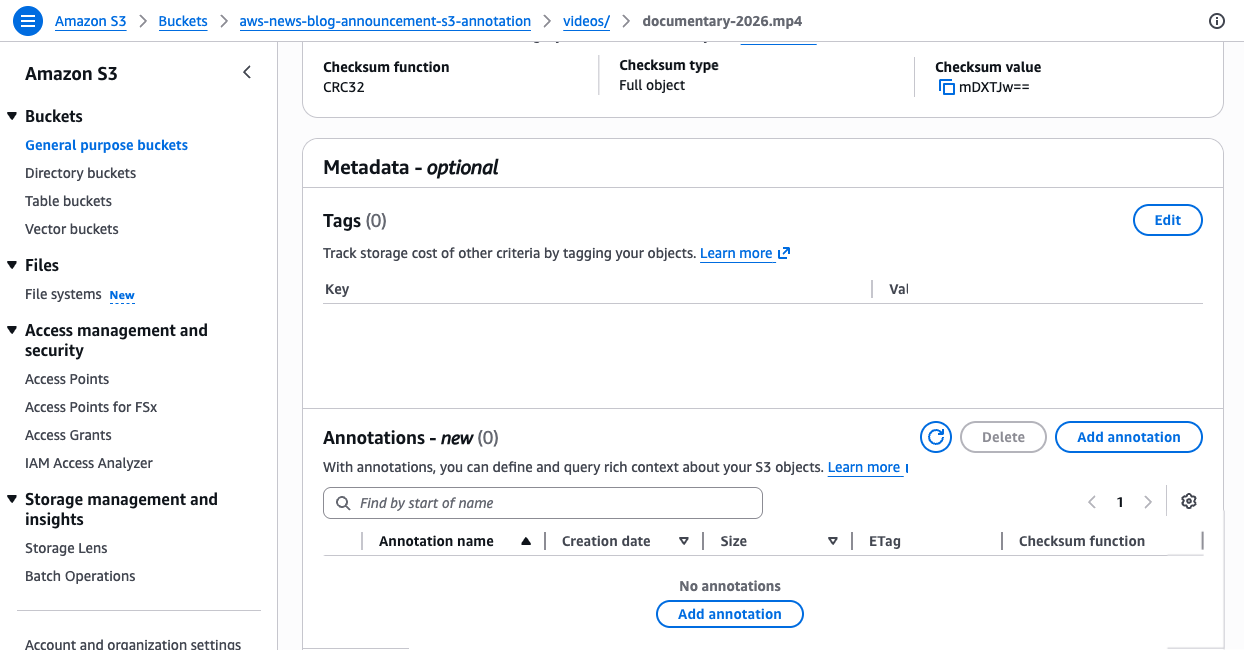
The implementation process is designed to be developer-friendly, utilizing standard AWS Command Line Interface (CLI) commands. For instance, a media company can now programmatically attach technical metadata to a video file:
aws s3api put-object-annotation
  --bucket my-media-bucket
  --key videos/documentary-2026.mp4
  --annotation-name mediainfo
  --annotation-payload ./mediainfo.json
This approach allows different teams to enrich the same object simultaneously. One team can focus on technical specifications (JSON), while another attaches content-safety ratings or summaries (plain text), with zero interference between the two metadata streams.
Implications for Industry and AI
The implications of this update extend across nearly every sector of the digital economy.

1. The Rise of Autonomous Data Discovery
With the integration of the S3 Tables MCP (Model Context Protocol) server, AI models can now "discover" data through natural language. Instead of a developer writing complex SQL queries to find files, an AI agent can query the annotation tables to identify, for example, "all PG-rated videos with Spanish subtitles from 2023." This reduces discovery time from hours to seconds.
2. Streamlining Compliance and Governance
For highly regulated industries, the ability to store compliance metadata directly with the object is a game-changer. Rather than maintaining a separate audit trail of which files have been scanned for PII (Personally Identifiable Information) or checked for regulatory compliance, that information can be stored as a mutable annotation. If a document’s status changes, the annotation is updated instantly, providing a real-time, tamper-evident record of the data’s status.
3. Economic Efficiency
By reducing the reliance on "sidecar" databases, companies can see a marked reduction in their cloud bill. Because annotations are part of the S3 ecosystem, they benefit from the same high-availability and durability guarantees as the object itself. Furthermore, the ability to query this data via Amazon Athena—without having to restore objects from cold storage (like S3 Glacier)—prevents the massive "hidden" costs often associated with large-scale data analysis.
4. Near Real-Time Event Driven Architectures
The inclusion of "journal tables" alongside annotation tables provides a near real-time feed of metadata changes. This allows for the creation of event-driven workflows. For example, when an annotation is added that marks a document as "Reviewed," an AWS Lambda function can trigger an automated publishing workflow.
Conclusion: A New Standard for Data Lakes
The introduction of Amazon S3 Annotations is more than just a feature update; it is a foundational shift in how we think about object storage. By transforming S3 from a passive repository of files into an active, intelligent, and queryable data fabric, AWS is enabling the next generation of AI-driven enterprise applications.
As businesses continue to grapple with the sheer volume of unstructured data, the ability to "annotate" this data at scale will become a competitive differentiator. Organizations that adopt this capability early will be better positioned to automate their internal processes, improve their AI model performance, and maintain a tighter, more efficient grip on their digital assets.
For those ready to integrate these features, documentation is available via the AWS S3 portal, and the capability is already active in all AWS Regions. As we look toward the future, it is clear that the "intelligent data lake" is no longer a vision—it is an operational reality.