The Great Classifier Debate: Benchmarking Classical Machine Learning vs. Zero-Shot LLMs
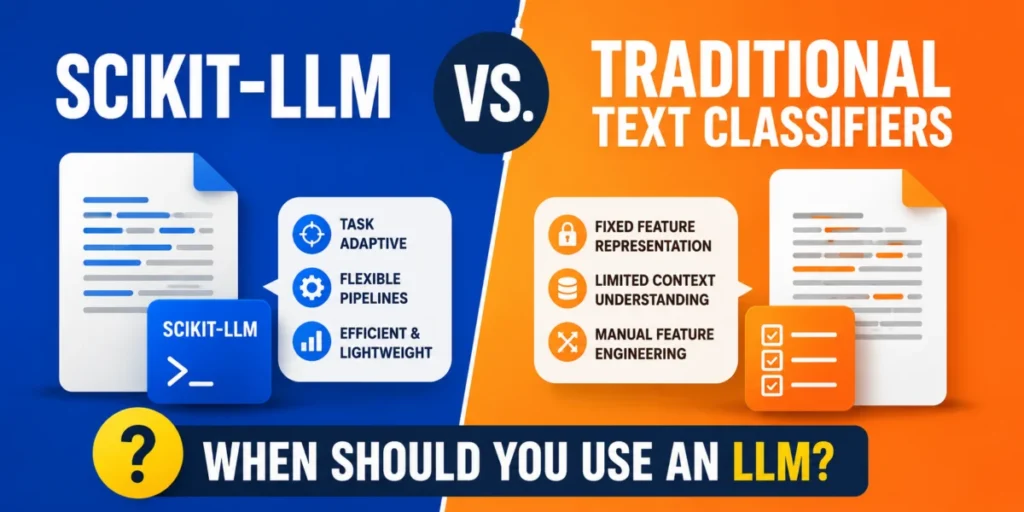
In the rapidly evolving landscape of natural language processing (NLP), developers and data scientists are frequently confronted with a fundamental architectural dilemma: how should we categorize text? For decades, the industry relied on "classical" statistical methods—pipelines built on TF-IDF (Term Frequency-Inverse Document Frequency) and logistic regression. However, the rise of Generative AI and Large Language Models (LLMs) has disrupted this status quo, offering capabilities that were previously unattainable.
But does the latest technology always provide the best solution? This article explores the trade-offs between speed, cost, and accuracy by benchmarking three distinct approaches: a classic TF-IDF pipeline, a transformer-based zero-shot model, and a modern, API-driven zero-shot LLM using Scikit-LLM and Groq.
The Evolution of Text Classification: From Statistics to Reasoning
Historically, text classification was a labor-intensive endeavor. It required extensive preprocessing—tokenization, stemming, and vectorization—followed by training a machine learning model on large, labeled datasets. These "classical" models are incredibly efficient, requiring minimal compute power, yet they are notoriously brittle. They understand the frequency of words, but they rarely grasp the context or intent behind a user’s query.
Enter the Transformer era. Models like BERT and BART changed the game by embedding words within a high-dimensional vector space that captures semantic meaning. With "zero-shot" capabilities, these models can classify text into categories they have never seen during training, simply by leveraging their internal world knowledge.
However, the question remains: when is it appropriate to trade the raw speed of a logistic regression model for the sophisticated reasoning of an LLM?
Establishing the Benchmark: The Methodology
To determine the most appropriate approach, we constructed a synthetic dataset simulating a real-world customer support environment. The dataset consists of 50 customer support tickets categorized into five distinct classes: Technical, Billing, Account, Sales, and Refund.
The Three Contenders
- Classical Baseline: A
TfidfVectorizerpaired with aLogisticRegressionclassifier. This represents the "battle-tested" industry standard. - Transformer Zero-Shot: The
facebook/bart-large-mnlimodel, widely regarded as a high-performing baseline for zero-shot classification. - Modern LLM Approach: A
ZeroShotGPTClassifiervia Scikit-LLM, utilizing thellama-3.3-70b-versatilemodel hosted on Groq’s high-speed inference engine.
Implementation: Setting the Stage
To ensure reproducibility, we utilized scikit-learn for data splitting, ensuring that our five classes were represented proportionally across both training and testing sets.
import pandas as pd
from sklearn.model_selection import train_test_split

# [Code snippet for data initialization and stratified split...]
By maintaining a consistent test set, we ensure that our performance metrics—latency, precision, recall, and F1-score—are strictly comparable.
Chronology of Performance
1. The Classical Baseline: Logistic Regression
The TF-IDF pipeline proved to be the "sprinter" of our experiment. With a latency of just 0.06 seconds, it is near-instantaneous. However, the performance tells a different story.
- Accuracy: 0.53
- Strengths: Extremely fast, low cost, no API dependencies.
- Weaknesses: Struggles with nuance. The model successfully identified "Billing" issues due to common keyword patterns, but failed to distinguish between complex technical queries and account-related requests, leading to an F1-score of 0.55.
2. The Transformer Middle-Ground: BART
The BART model brought a significant leap in linguistic understanding. By treating classification as a natural language inference task, it achieved an accuracy of 0.67.
- Latency: 32.25 seconds.
- Implications: The latency is prohibitive for real-time applications. While it outperformed the classical model, the infrastructure required to host and run such models is significant.
3. The Modern Contender: Scikit-LLM and Groq
Using the Scikit-LLM library, we tapped into Llama-3.3-70b. The results were striking.
- Accuracy: 0.87
- Latency: 2.59 seconds.
- Insights: Not only did the LLM outperform the other models in accuracy, but it was also significantly faster than the local BART transformer. Because the Llama model possesses vast pre-trained world knowledge, it does not need to "learn" the domain; it already understands the context of a "refund request" versus a "technical error."
Supporting Data: Comparative Analysis
| Model | Accuracy | Latency | Complexity |
|---|---|---|---|
| Logistic Regression | 0.53 | 0.06s | Low |
| BART (Transformer) | 0.67 | 32.25s | High |
| Scikit-LLM (Llama 3.3) | 0.87 | 2.59s | Medium |
Official Perspective on Implementation
The integration of Scikit-LLM represents a paradigm shift for developers. Traditionally, integrating an LLM into a Scikit-learn workflow required custom wrapper code and brittle API management. Scikit-LLM abstracts these complexities, allowing developers to use familiar .fit() and .predict() syntax while offloading the heavy lifting to robust inference engines like Groq.
From a production standpoint, the use of a specialized API for inference—rather than running heavy models locally—is becoming the industry standard. It offloads the hardware burden while providing access to state-of-the-art parameters.
Implications for Future Development
When to Use Classical Models
If your application deals with massive volumes of simple, high-frequency queries where latency must be measured in milliseconds (e.g., spam filtering or basic keyword routing), classical models like Logistic Regression remain superior. They are free, private, and exceptionally fast.
When to Use Zero-Shot LLMs
When your data is scarce, or your categories are nuanced, the "Cold Start" problem plagues classical models. In these scenarios, zero-shot LLMs are a game-changer. They require zero training data to achieve high performance. As shown in our benchmark, they excel when the task requires "deep reasoning"—such as distinguishing between a frustrated customer asking for a refund and one reporting a technical bug.
The Role of Infrastructure
The choice of provider matters. Our experiment showed that pairing Scikit-LLM with a specialized, high-performance API like Groq can make LLMs viable for applications where latency was previously a deal-breaker.
Conclusion
The "one-size-fits-all" approach to text classification is a relic of the past. Our benchmarking demonstrates that while classical models maintain a place in the ecosystem for their speed, LLMs have redefined the ceiling for accuracy. For developers, the Scikit-LLM framework provides the perfect bridge: a standardized, production-ready interface that allows you to swap models as your requirements evolve.
As you design your next classification pipeline, ask yourself: is the problem one of simple pattern recognition, or does it require a model that truly understands the complexity of human language? If it is the latter, the investment in a modern LLM approach is not just a trend—it is a competitive necessity.