The Hidden Cost of AI: How Data Formatting is Revolutionizing Agent Efficiency
In the rapidly evolving ecosystem of artificial intelligence, a silent crisis is unfolding behind the scenes of every agentic workflow: the "token tax." As AI agents become more autonomous, their dependency on massive file retrievals, web searches, and log analysis has grown exponentially. While these agents are designed to process information, they are currently consuming vast amounts of computational "fuel"—tokens—that often contain redundant, non-essential, or machine-readable-only noise.
For developers and enterprises, this is more than a technical annoyance; it is a significant financial burden. A simple search query can trigger a cascade of nested JSON objects, tracking pixels, and metadata that the AI model never actually uses. Recent advancements from industry leaders like SerpApi are now addressing this bloat, proposing a shift from verbose JSON to streamlined Markdown to reclaim context windows and reduce operational expenditure.
The Anatomy of Token Bloat
The current standard for data exchange, JavaScript Object Notation (JSON), was built for machine-to-machine communication. It is rigid, highly structured, and filled with syntax—braces, brackets, quotes, and keys—that are essential for a compiler or a web server but largely redundant for an Large Language Model (LLM) attempting to summarize or reason.
When an AI agent performs a search for, say, "best local coffee shops," the resulting payload is rarely just the names of the shops. It is a massive dump of raw data containing tracking links, internal system metadata, and deep-nested UI objects. In many cases, the LLM consumes these tokens, paying the price for the privilege, only to ignore 80% of the input because it lacks semantic value.
This "token bloat" creates a three-fold problem:
- Direct Financial Costs: Every token processed by a model like GPT-4o or Claude 3.5 Sonnet carries a cost. Wasted tokens equal wasted capital.
- Context Window Exhaustion: The "attention" of an LLM is limited. Every character spent reading metadata is a character stolen from the user’s core instructions or relevant historical context.
- Latency: Processing larger payloads takes more time. As recursive loops in agentic workflows compound, the time-to-first-token increases, leading to a sluggish user experience.
A New Paradigm: Markdown as the LLM Native Language
To combat this, the industry is seeing a transition toward Markdown output. Markdown is inherently designed for human readability—the same structure that LLMs were fine-tuned to parse during their pre-training phase. By stripping away the structural "boilerplate" of JSON and replacing it with clean, hierarchical headers, tables, and lists, developers can drastically reduce the token footprint of their data feeds.
Chronology of the Shift
- The JSON Era (2015–2023): Developers prioritized API standardization, leading to JSON becoming the universal language of the web. AI agents inherited this paradigm, treating data streams as code rather than context.
- The Context Window Crisis (Late 2023): As agentic frameworks like LangChain and AutoGPT gained popularity, developers realized that "context window management" was the primary bottleneck to intelligence.
- The Markdown Intervention (2024–Present): Companies like SerpApi began implementing native Markdown rendering for search results, demonstrating that LLMs perform just as well—if not better—when presented with structured human-readable text compared to raw code blocks.
Supporting Data: The 74% Reduction Benchmark
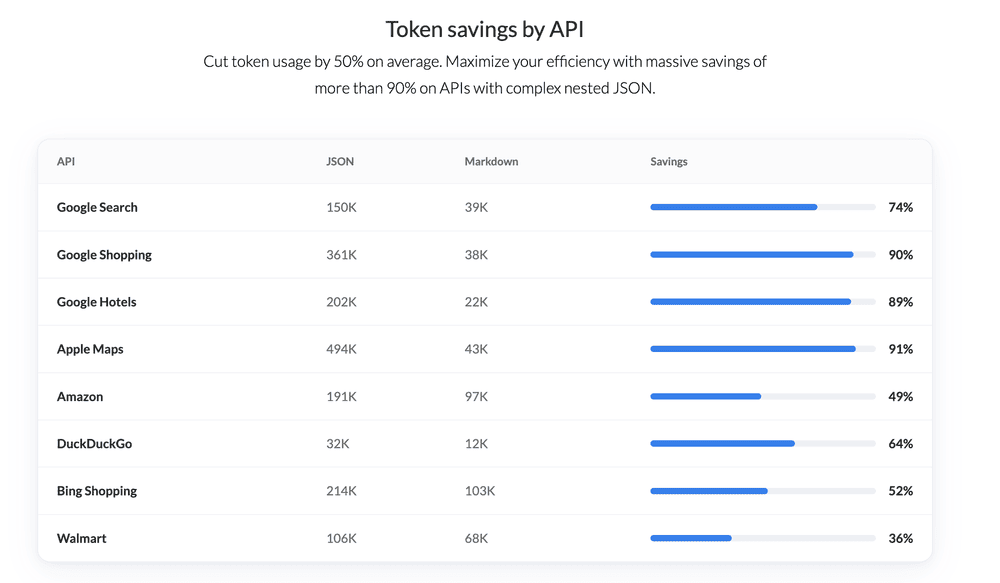
The efficiency gains of moving to Markdown are not merely theoretical. Internal benchmarks conducted by SerpApi provide a clear look at the impact of formatting on token consumption.
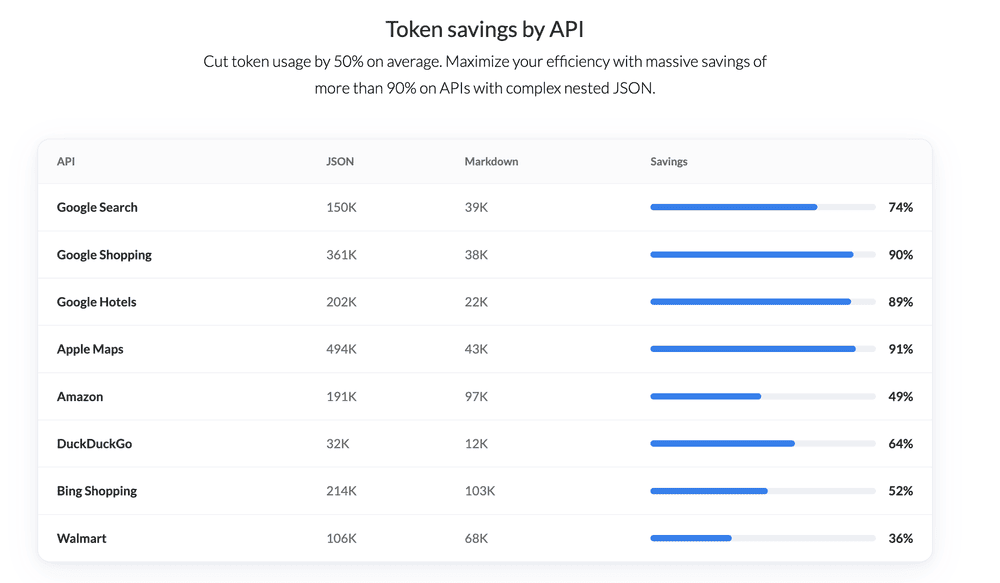
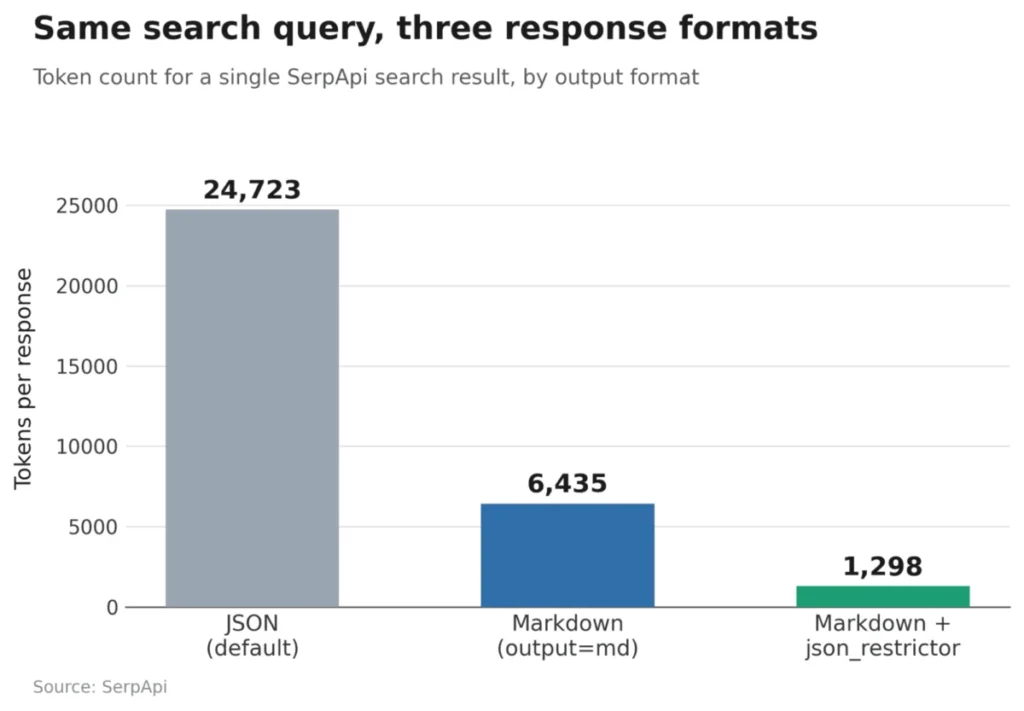
In a controlled test, a search query for "coffee" was executed via the traditional JSON format. The response required 24,723 tokens. By switching the output to Markdown, the same search returned the same semantic content using only 6,435 tokens.
This represents a 74% reduction in token usage. Furthermore, by applying selective filtering (restricting fields to only the essentials), that number dropped to 1,298 tokens. To put this in perspective, a developer could potentially perform 19 searches for the price of one, or fit significantly more search results into a single context window, allowing the AI to synthesize a much broader range of information before hitting its memory limit.
The Trade-off: When JSON Remains King
While Markdown offers superior efficiency for summarization and reasoning tasks, it is not a universal replacement. The industry consensus remains clear: use the right tool for the job.
When to Stick with JSON:
- Downstream Code Processing: If your application requires precise numeric values (e.g., float-based ratings, integer prices, or coordinate arrays), JSON is mandatory. Parsing floats out of a Markdown table is prone to errors.
- Transactional Systems: In scenarios where the data must be piped into a database or a pricing engine, the schema must be strictly defined and validated. JSON’s structure is its greatest strength here.
- Legacy Integration: Many existing microservices expect specific JSON schema validation.
When to Switch to Markdown:
- RAG (Retrieval-Augmented Generation): If your agent is pulling files to answer a user’s question, Markdown is superior.
- Agentic Search: When an agent is browsing the web to synthesize a report, Markdown provides the necessary context without the noise.
- Summarization Tasks: Whenever the objective is "understanding" rather than "computation," Markdown should be the default choice.
Official Perspectives: The SerpApi Strategy
The team at SerpApi has approached this challenge by integrating the solution directly into the data pipeline. Rather than forcing developers to build custom "data scrubbers" on their end, they have enabled a single-switch configuration. By using a query parameter, route extension, or custom header, users can toggle between JSON and Markdown output instantly.
"Our goal is to make AI agents more capable by making them more efficient," a representative noted. "By stripping away tracking noise and duplicate fields server-side, we allow the agent to focus its ‘attention’ on the actual information. The fact that it reduces costs is a secondary benefit to the primary goal: better reasoning."
This approach is available across over 100 different SerpApi services. Furthermore, for users who need even tighter control, the json_restrictor tool allows for server-side field selection. This ensures that data never even hits the network unless it is explicitly requested, preventing unnecessary data transfer and further optimizing the token count.
Implications for the Future of AI Agents
The shift toward optimized data payloads is a sign of a maturing industry. We are moving away from the "more is better" approach to LLM prompting and toward a "precision-engineered" approach.
1. The Economics of Agentic Systems
As enterprises begin deploying autonomous agents at scale, the cost of these agents will become a major line item in IT budgets. Companies that proactively optimize their data pipelines—by moving to Markdown and pruning unnecessary fields—will enjoy a competitive advantage, enabling them to build more complex agents for a fraction of the cost.
2. The Rise of "Small Data"
The industry is beginning to realize that the quality of the context matters more than the volume. By providing the model with clean, Markdown-formatted data, developers are effectively reducing the "noise-to-signal" ratio. This leads to fewer hallucinations, as the model is less likely to get distracted by irrelevant metadata or broken JSON structures.
3. Developer Workflow Evolution
Moving forward, developers should treat "Token Efficiency" as a key performance indicator (KPI) alongside latency and accuracy. Monitoring the delta between a raw JSON payload and a pruned Markdown response should become a standard part of the CI/CD pipeline for any AI-driven application.
Conclusion: The Path Forward
Markdown is not a panacea for all AI challenges, but it is a critical tool for any developer working with LLMs. As we enter an era where agentic systems are expected to handle increasingly complex, multi-step workflows, the efficiency of our data transport will dictate the success of our systems.
If your current architecture relies on passing heavy JSON objects to an LLM, it is time to audit your consumption. By experimenting with output=md and leveraging server-side restrictions, you can unlock immediate cost savings and performance gains. The data is the same; it is simply a matter of shaping it for the intelligence that is reading it.
To see the difference for yourself, consider reviewing SerpApi’s documentation on Markdown output and measuring the token delta on your next query. In the world of AI, those tokens you save today will be the foundation for the more complex, efficient, and intelligent agents of tomorrow.