The M4 Method: A Blueprint for Scaling eCommerce Brands on Facebook
Are your Facebook ads generating clicks but leaving your conversion metrics cold? Many eCommerce founders find themselves in a high-stakes guessing game, pouring capital into ad sets that show promise one day and plummet the next. According to expert Sam Piliero, the difference between a struggling business and one hitting $50 million in annual revenue isn’t luck—it’s a disciplined, four-stage framework known as the M4 Method.
In an era where Meta’s algorithm has evolved from manual targeting to intelligent, creative-led delivery, the old playbooks are obsolete. This report dissects the M4 Method, providing a strategic roadmap for moving beyond short-term metrics to build a sustainable, profit-generating engine.
The Core Barriers: Why Your Ads Are Stalling
Before implementing a new strategy, advertisers must identify the invisible anchors dragging down their performance. Sam Piliero, co-creator of the M4 framework, points to two primary culprits:
1. The Efficiency Trap
Many marketers obsess over Return on Ad Spend (ROAS) and Cost Per Acquisition (CPA) as if they are the ultimate scoreboard. While these are essential guardrails, they are not the end game. Piliero argues that "contribution margin"—the actual cash landing in your pocket—is the only metric that truly matters.
Chasing a 10x ROAS might look impressive on a dashboard, but it often requires throttling spend so significantly that you lose out on market share. Conversely, accepting a 2.2 ROAS can be a superior strategy if it allows you to acquire thousands of customers, benefit from lifetime value (LTV), and generate the word-of-mouth compounding that fuels long-term brand equity.
2. The Illusion of Control
Advertisers tend to fall into two dysfunctional patterns: "Micro-Management," where dozens of fragmented campaigns are pitted against each other, or "Algorithm Blindness," where they surrender all control to Meta and hope for the best. Success lies in the middle. The M4 Method provides the structure necessary to give the algorithm the guardrails it needs to optimize while keeping human oversight focused on high-level performance.

The M4 Method: A Four-Stage Chronological Framework
The M4 Method is designed as a sequential architecture. Each stage builds upon the last, turning raw inputs—creative and budget—into predictable, scalable output.
Stage 1: Architectural Foundation
Think of your account structure as the foundation of a house. If it is disorganized, even the best creative will fail to scale.
The Setup:
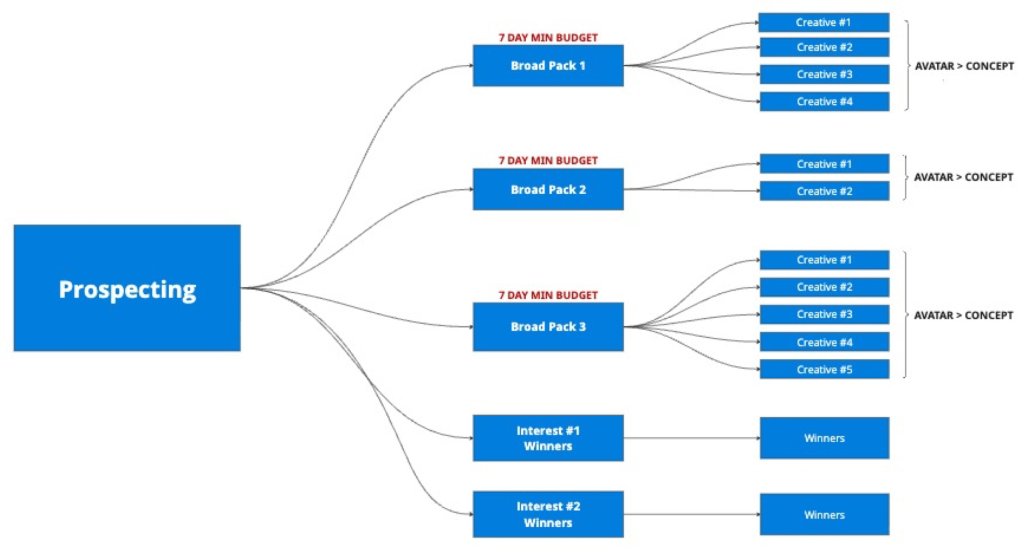
- Prospecting (CBO): A single Campaign Budget Optimization (CBO) campaign serves as the engine. Within this, you house multiple "packs" (ad sets). Each pack contains a fresh batch of creative. CBO allows the algorithm to distribute your budget fluidly toward whichever creative is winning at any given moment.
- Retention: A separate campaign is dedicated solely to existing customers. This separation prevents the "blurring" of data, ensuring you know exactly how much you are spending to acquire new blood versus reactivating past buyers.
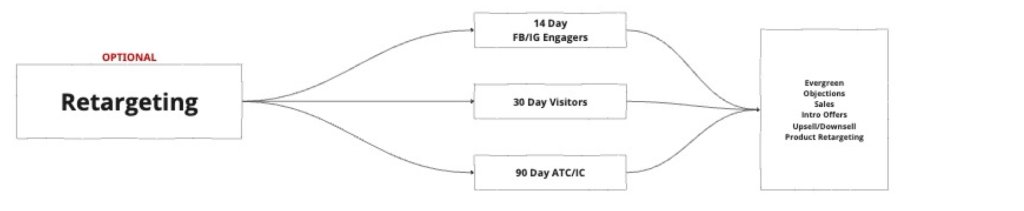
- Retargeting and Scaling (Optional): These campaigns are used selectively to close high-intent leads or to force spend toward proven winners.
Stage 2: Creative as the New Targeting
In the post-Andromeda algorithm landscape, you no longer "target" audiences; your creative does. The content of your ad acts as the primary signal to Meta’s AI, telling it exactly who should view your brand.
The Problem-Solution Mandate:
Generic ads are dead. Successful creative must identify a specific customer avatar and address a specific pain point. For instance, a back brace brand shouldn’t market to "people with back pain." It should market to "construction workers suffering from chronic lumbar fatigue," using visuals that mirror the lives of those specific workers.
Volume and Iteration:

- Manufacture Hits: Define a "hit" as an ad that clears your ROAS threshold and captures 10%+ of your spend.
- Iterate, Don’t Recreate: When a piece of creative wins, don’t start from scratch. Swap the hook while keeping the body, change the influencer delivery, or update the headline. These small, data-backed tweaks are significantly more efficient than producing entirely new concepts.
Stage 3: Deep Dive Analysis
Most businesses are leaving 20% of their potential profit on the table because they operate on a "flat" budget, spending the same amount every day of the week.
The Pattern Recognition Process:
By analyzing 90 to 180 days of non-holiday data, you can uncover hidden patterns. Perhaps your store spikes on Saturdays because your customers are home, or perhaps it peaks on Tuesdays when people plan their weekend purchases.
- The Strategy: Once these patterns are identified, do not simply turn off low-performing days. Instead, redistribute your budget: lower spend on slow days to save cash, and increase spend aggressively on high-conversion days. This tactical pivot often yields a 20% improvement in overall ROAS without changing the ad creative at all.
Stage 4: Scaling Strategies
Scaling is not a default setting; it is a response to success. You should only scale when your ROAS is stable and your creative is performing.
- Vertical Scaling: Increasing the budget of an existing, high-performing campaign by 10–30% every few days. This allows the algorithm to adjust without triggering a "re-learning" phase.
- Horizontal Scaling: Launching temporary, separate campaigns for promotions or limited-time events to avoid disrupting your always-on prospecting engine.
- Twin-Engine Scaling: The gold standard. You combine vertical budget increases with the injection of new creative iterations derived from your "hits." This creates a compounding effect where you acquire more customers at a stable, profitable rate.
Supporting Data and Real-World Results
The efficacy of this method is best illustrated by the results seen at The Moonlighters. Five client businesses that were spending under $30,000 per month—and generating less than $100,000 in monthly revenue—utilized this four-stage approach to scale into the $50 million-plus annual revenue bracket within a year.
While these results are exceptional and not guaranteed for every brand, they underscore the power of moving from reactive, "ad-by-ad" management to a structured, data-driven system.
Official Perspective: The "King Goal"
A critical takeaway from this framework is the importance of the "King Goal." Every business, regardless of industry, must define one North Star metric. For many, this is CAC (Cost Per Acquisition).
When you have a King Goal, you gain the clarity to ignore the noise. If your CPMs (Cost Per Mille) rise or your CTR (Click-Through Rate) fluctuates, but your King Goal is being met, you have the confidence to keep spending. By focusing on the North Star rather than getting distracted by secondary "proxy metrics," you prevent emotional decision-making and ensure your scaling efforts remain tied to profitability.
Implications for Future Operations
As Meta’s AI continues to automate targeting, the role of the media buyer is shifting from a technical operator to a creative strategist. The implications for eCommerce businesses are clear:
- Inventory is a Constraint: For businesses with supply-chain limitations, the goal of the M4 Method shifts from "scaling at all costs" to "maximizing profit on constrained volume." Scaling spend without fulfillment capability is a recipe for brand erosion.
- Creative Velocity: The brands that win in the coming years will be those that can produce, test, and iterate creative at high velocity. The ability to churn out high-quality, UGC-style content—often via micro-influencers—is now a core business competency.
- Data Discipline: The "set it and forget it" mentality is no longer viable. Success now requires a rhythm of weekly deep dives into day-of-week and placement performance.
By integrating the M4 Method, eCommerce brands can transform their Facebook ad accounts from black-box liabilities into reliable, growth-oriented assets. The path to scale is not found in a secret setting or a hidden hack; it is found in the relentless application of structure, creative evolution, and a laser focus on the King Goal.