The Paradox of Convenience: Mastering the Complex Ecosystem of E-commerce Returns in Europe
The digital transformation of the European retail landscape has fundamentally altered the consumer journey. Today, the purchase process does not terminate at the digital "checkout" button; it extends through the "last mile" of the return process. For modern e-commerce merchants, returns have transitioned from a minor logistical nuisance to a critical strategic pillar that dictates profitability, brand loyalty, and environmental footprint. As European consumers increasingly demand the convenience of "buy-and-try" shopping, retailers are facing a mounting challenge: how to reconcile the high cost of reverse logistics with the imperative of a seamless customer experience.
The Landscape: An Overview of European Returns
E-commerce in Europe is not a monolith; it is a fragmented collection of markets with distinct cultural expectations and regulatory frameworks. However, the overarching trend is clear: returns are an integral component of the contemporary shopping experience.
Statistical Reality: The Scale of the Challenge
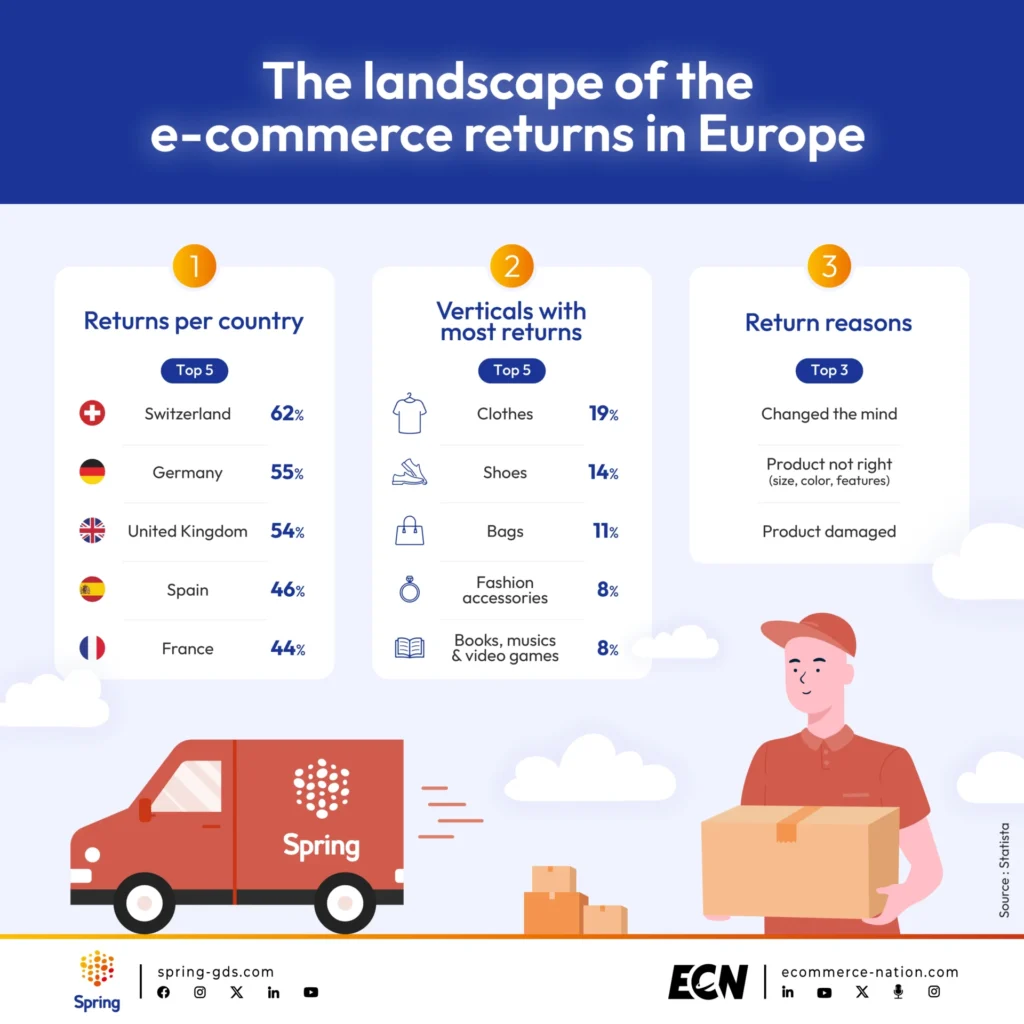
Current data indicates that the average return rate for online purchases in Europe oscillates between 30% and 40%. Yet, these figures mask significant regional disparities. According to recent insights from Statista, Switzerland leads the continent with an staggering 62% return rate per online buyer. Germany and the United Kingdom follow closely, with return rates of 55% and 54%, respectively.
These figures are not merely percentages; they represent a massive logistical flow of goods back through the supply chain. In sectors like fashion and apparel, where "bracketing"—the practice of purchasing multiple sizes or colors with the intent to return the surplus—has become standard behavior, return rates can climb even higher. Electronic goods and household appliances, while seeing lower volume in returns, often present more complex challenges involving technical defects or compatibility issues, necessitating specialized inspection and refurbishment processes.
The Evolution of Consumer Behavior
Why do European consumers return goods at such high frequencies? The primary drivers include:
- Size and Fit Discrepancies: Particularly in fashion, where the inability to try on items physically leads to "size uncertainty."
- Product Mismatch: The item received fails to match the online representation (color, quality, or material).
- Bracketing: A deliberate consumption pattern where the consumer treats their home as a fitting room.
- "Wardrobing": A subset of returns where items are purchased for a one-time event (e.g., an outfit for a party) and returned after use.
Chronology of a Return: The Lifecycle of a Package
To understand the complexity of returns, one must track the "reverse journey" of a product:
- Initiation: The consumer triggers the return request via an online portal. This is the moment of truth for customer service. A frictionless interface here is often the deciding factor in whether the customer returns to the store.
- The Logistics Gap: The item is collected from a home or drop-off point. In a cross-border scenario, this involves navigating different courier networks and international transit hubs.
- Transit and Processing: The package reaches a return center. It must be scanned, inspected for damage, and categorized. Is it "Grade A" (sellable as new), "Grade B" (refurbished), or "Damaged/Waste"?
- Re-allocation: If the item is sellable, it must be returned to inventory. If not, it enters the secondary market, donation channels, or recycling streams.
- Refund Settlement: The financial loop closes. Delays here are the primary cause of negative customer reviews and brand attrition.
The Multi-Faceted Challenges for European Retailers
Logistical and Regulatory Complexity
Cross-border trade within Europe, while supported by the Single Market, remains a minefield of regulatory nuances. Customs regulations—especially for companies shipping from the UK to the EU or vice versa—can add layers of documentation and cost that turn a standard return into a bureaucratic hurdle. Variations in consumer protection laws between member states mean that a return policy that is compliant in France might be insufficient or legally problematic in Poland.
The Financial Burden
The hidden costs of returns are substantial. Beyond the obvious shipping fees, merchants must account for:
- Inspection Labor: Manual checks to verify product integrity.
- Repackaging: The cost of new materials to make the item "shelf-ready."
- Depreciation: The reality that a returned item is often sold at a discount, eroding profit margins.
- Opportunity Cost: Capital tied up in inventory that is sitting in transit or a warehouse rather than being available for sale.
The Ecological Mandate
The environmental impact of returns is no longer a peripheral concern; it is a primary ESG (Environmental, Social, and Governance) issue. The carbon emissions generated by "reverse logistics"—where a package travels back to a warehouse—are significant. Furthermore, the reliance on single-use plastics for packaging in transit contributes to a growing waste crisis. Many retailers are now facing pressure from European regulators to justify the disposal of unsold or returned goods, with the EU increasingly pushing for "circular economy" legislation that discourages the destruction of returns.
Strategic Imperatives: Optimizing for the Future
For retailers aiming to thrive in this environment, a reactive approach to returns is no longer sufficient. A proactive, data-driven strategy is required.
1. Technological Integration
Modern retailers are turning to AI-powered returns management platforms. These systems provide real-time visibility into the return flow, allowing for predictive analytics. By identifying which products are returned most often and why, companies can adjust their product descriptions, implement "virtual fitting rooms" (AR/VR technology), or refine size guides to manage customer expectations before the purchase occurs.
2. The Rise of "Sustainable Returns"
Optimizing for the environment is increasingly synonymous with optimizing for profit. Strategies include:
- Consolidated Shipping: Encouraging customers to return items via batching or specific, lower-emission drop-off points.
- Eco-friendly Packaging: Transitioning to reusable or biodegradable packaging materials that are designed for the round-trip journey.
- Secondary Market Channels: Rather than shipping returns back to a central hub, some retailers are now utilizing local liquidation partners or internal secondary marketplaces to sell "pre-loved" items directly from the region where they were returned, cutting down on transit-related carbon emissions.
3. Transparent and User-Friendly Policies
The most successful brands are those that treat the return policy as a marketing asset rather than a defensive shield. By offering clear, easy-to-understand return windows and utilizing local return addresses, brands reduce the friction that leads to customer churn. Transparency regarding costs—such as whether returns are free or carry a restocking fee—is essential for setting expectations and maintaining long-term trust.
Implications for the Future of Retail
The "return economy" is at a crossroads. As retailers struggle to balance the need for high-conversion, low-friction shopping experiences with the rising costs of reverse logistics, we are likely to see a shift in market dynamics.
Official Industry Responses:
Industry leaders are increasingly advocating for a "Return Policy Reset." This includes the widespread adoption of paid returns—a shift already seen in major fashion retailers—to discourage the unsustainable behavior of over-ordering. Simultaneously, there is a push for standardization in European return regulations to simplify the cross-border experience.
Conclusion
Returns are not merely a post-purchase event; they are a critical performance indicator for the entire e-commerce enterprise. The European market, with its high standards for consumer protection and its growing emphasis on environmental sustainability, serves as the testing ground for the future of global retail. By treating returns as a core component of the business strategy—supported by technology, data analytics, and a commitment to circularity—merchants can transform a logistical challenge into a competitive advantage, turning the return process into an opportunity to solidify customer loyalty and build a more resilient, sustainable brand.