The State of Blogging: Why Effort, Not AI, Remains the Gold Standard for Success
In the evolving landscape of digital marketing, the corporate blog has long been a foundational pillar. For years, brands have relied on blogging to fuel search engine optimization (SEO), establish industry thought leadership, and provide actionable value to their target audiences. However, the digital ecosystem is currently undergoing a tectonic shift. As generative AI tools flood the market and search algorithms become increasingly volatile, the "tried and true" methods of the past decade are facing a crisis of effectiveness.
To navigate this uncertainty, marketers are looking for hard data rather than anecdotal trends. For the 11th consecutive year, Orbit Media has released its Annual Blogger Survey, a definitive report that serves as a compass for content teams worldwide. The latest findings, discussed with industry veteran and Orbit Media co-founder Andy Crestodina, provide a sobering reality check: the era of "easy" content is over, and the path to high-impact results requires a more strategic, human-centric approach.
The Reality of Time Investment: Why Efficiency Isn’t Improving
One of the most persistent questions in modern content marketing is the impact of generative AI on productivity. With tools like ChatGPT and Claude promising to draft articles in seconds, many expected to see a significant drop in the time required to produce a high-quality blog post.

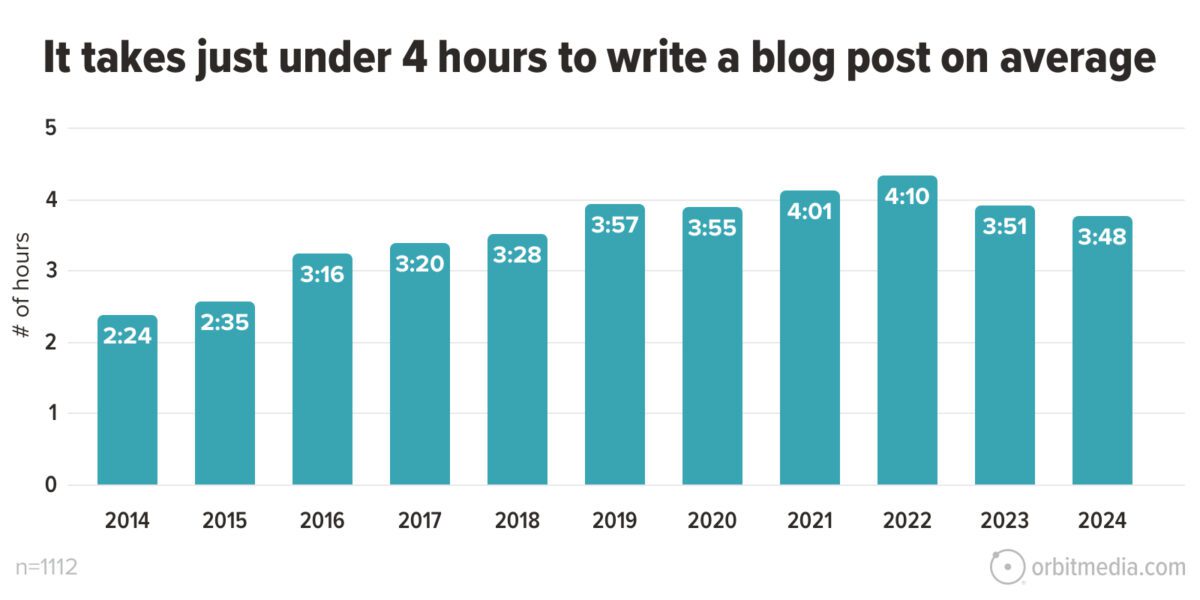
The survey results, however, tell a different story. The average time to produce a single blog post now sits at three hours and forty-eight minutes—a decrease of a mere three minutes compared to the previous year.
This negligible shift suggests that while AI may be accelerating the initial drafting phase, it is not reducing the total time investment required for professional-grade content. The reality is that "production" is only a fraction of the work. Strategic planning, fact-checking, editorial oversight, original research, and the human creative spark required to differentiate content in an AI-saturated web continue to demand significant human resources. In short, AI might help you write faster, but it does not necessarily help you win faster.
The "Big Effort" Correlation: Data-Backed Results
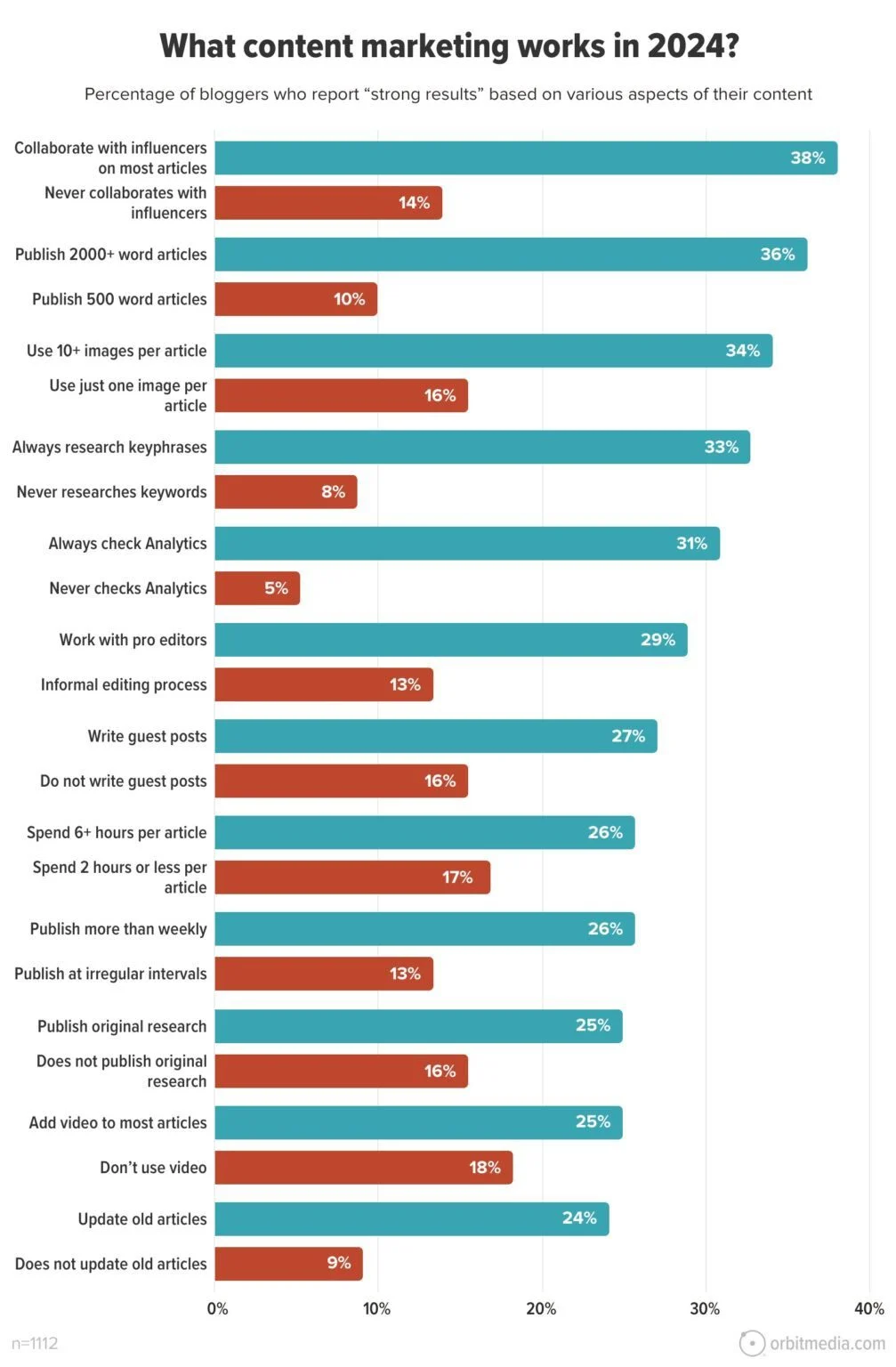
The survey highlights a clear, albeit challenging, reality: there is a strong correlation between the effort invested and the outcomes achieved. The data reveals that bloggers who consistently produce long-form content (2,000+ words) and spend more than four hours per article are significantly more likely to report "strong results" than their counterparts who stick to short-form, quick-turnaround pieces.
This isn’t just about length; it is about depth. Search engines and readers alike are increasingly rewarding content that demonstrates "Experience, Expertise, Authoritativeness, and Trustworthiness" (E-E-A-T). Superficial, thin content that provides no unique value is finding it harder than ever to rank or resonate.
Furthermore, the data suggests that a bi-weekly posting cadence is the minimum threshold for maintaining a high-performance blog. While quality is paramount, it must be paired with enough frequency to keep an audience engaged. The lesson is clear: sporadic, low-effort content is essentially invisible in today’s crowded digital landscape.
Treating the Blog as a Living Feed
Perhaps the most transformative insight from the report is the recommendation to shift the mental model of a blog. Too many brands treat their blog as an archive of static articles. Instead, the most successful content programs treat their blog like a social media feed.

Social media platforms have spent billions on UX testing to determine what keeps users scrolling and engaged. They leverage visual storytelling, high-value hooks, consistent cadence, and community interaction. By adopting these same principles—such as integrating more interactive media, fostering direct reader feedback, and ensuring a consistent, reliable publishing schedule—brands can revitalize their blogging efforts.
The AI Paradox: Adoption vs. Performance
The 2024 survey confirms a massive surge in AI adoption, with roughly 80% of bloggers now utilizing generative tools in some capacity. Yet, there is a distinct lack of correlation between the volume of AI usage and improved performance.
This is the "AI Paradox." While AI is excellent for overcoming writer’s block, generating outlines, or summarizing data, it lacks the strategic nuance of an experienced content marketer. Content that is purely AI-generated often feels generic or "middle of the road." To truly break through, brands must use AI as a tool for efficiency, but rely on human experts to provide the "strategic glue" that gives the content its unique voice, authority, and emotional resonance.

Expert Q&A: Perspectives from the Frontline with Andy Crestodina
To provide context to these findings, we sat down with Andy Crestodina, CMO and Co-Founder of Orbit Media. His insights bridge the gap between abstract data and tactical application.
Q: What is the most surprising takeaway for you personally this year?
"The data tells us, year after year, that big efforts drive big outcomes. What’s surprising is to see so many content programs sticking to the same low-effort, low-frequency strategies. No original research, no collaboration, no multimedia. When you see the gap between those who put in the work and those who don’t, it’s stark. If you are doing the bare minimum, you should expect the bare minimum in terms of results."
Q: Why do podcasters and creators who use audio report such strong results?
"It’s not just the audio itself. The podcaster is usually doing other things right: they are collaborating, they are interviewing guests, they are creating original primary research through their discussions. They aren’t going it alone. They are hitting the record button and building a network around their content. That human-to-human connection is something an AI-drafted text post simply cannot replicate."

Q: With traffic from search declining, how should we define success?
"We need to stop obsessing over vanity metrics like traffic and start looking at the metrics that actually drive business. Traffic is easy to track, but it’s often a shallow indicator. We should be measuring bottom-of-funnel conversions, word-of-mouth sentiment, and top-of-mind awareness. These are harder to track, but they are where the real value lies."
Strategic Implications: Moving Toward a Sustainable Future
For content marketing leaders, the 11th Annual Blogger Survey serves as both a warning and a roadmap. If the status quo is yielding diminishing returns, it is time to pivot toward higher-value strategies.
1. Shift to "Low-Volume, High-Impact"
Stop chasing quantity. If you can only afford to produce one truly great, original research piece per month, do that instead of four mediocre articles. Invest in primary data, expert interviews, and proprietary insights that no one else has.

2. Embrace "Rented Land" Strategically
Crestodina notes that his #1 tip for B2B brands right now is the launch of a LinkedIn Newsletter. While the old mantra was "don’t build on rented land," the reality is that major platforms are now prioritizing their own native tools. By publishing directly to LinkedIn, brands can tap into established, high-traffic ecosystems rather than fighting for scraps in organic search.
3. Focus on "Zero-Click" Value
As search engines move toward "zero-click" experiences, your goal should not just be to drive a user to your site, but to build brand affinity wherever the user is. Whether it’s through a newsletter, a podcast, or a social feed, focus on providing value that is self-contained.
4. Human-in-the-Loop Content
If you are using AI, ensure that every piece of content undergoes a rigorous human review for accuracy, brand voice, and strategic alignment. Use AI for the grunt work, but keep the storytelling and the strategic direction firmly in the hands of your human team.

Conclusion: The New Standard
The 2024 data from Orbit Media confirms that the "easy" days of SEO-driven blogging are behind us. The barrier to entry has risen, and the bar for quality has moved higher. However, this is not a death knell for blogging—it is a filtering mechanism.
Brands that are willing to put in the time, prioritize original research, leverage the power of audio and collaboration, and treat their audience as a community rather than a traffic source will continue to see success. As Andy Crestodina aptly puts it, the most important marketing outcomes are the ones that are hardest to measure. By focusing on the human elements of content marketing, organizations can build a brand that resonates in a world increasingly filled with automated noise.