Unlocking Hidden Insights: Building a Scalable Text Clustering Pipeline with LLMs and HDBSCAN
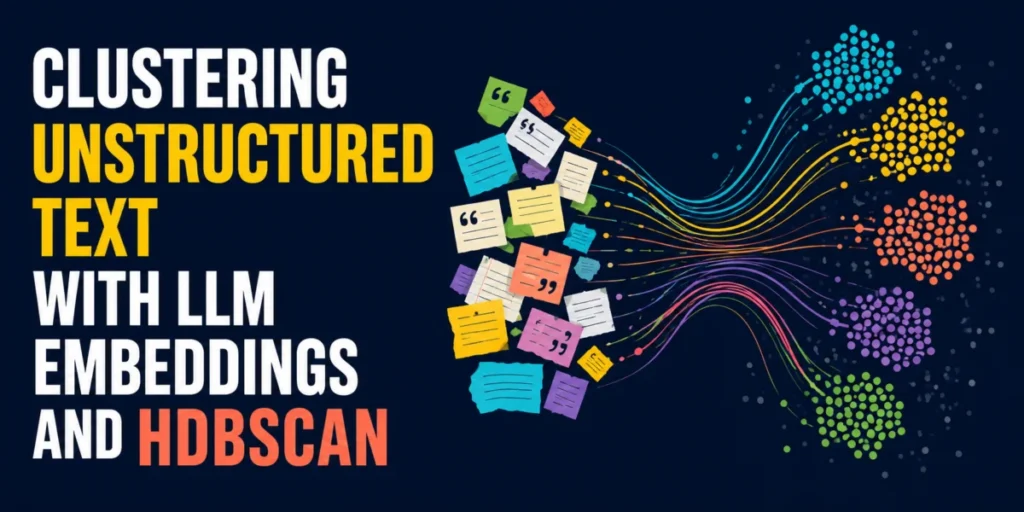
In the contemporary landscape of Artificial Intelligence, the narrative has been overwhelmingly dominated by conversational interfaces and generative prompts. While ChatGPT and its counterparts have captured the public imagination, the true industrial value of Large Language Models (LLMs) often lies in their capacity to serve as sophisticated feature extractors. By transforming vast, amorphous pools of unstructured text into semantically dense mathematical vectors—known as embeddings—developers can unlock a new frontier of data organization: unsupervised topic discovery.
This article provides an in-depth exploration of how to architect a production-grade text clustering pipeline. By marrying the semantic depth of modern embedding models with the density-based clustering power of HDBSCAN (Hierarchical Density-Based Spatial Clustering of Applications with Noise), we can move beyond keyword-based filtering to uncover nuanced, context-aware patterns in unlabeled data.
Main Facts: The Architecture of Semantic Discovery
The core challenge of modern data science is the "unstructured data deluge." Organizations are flooded with emails, support tickets, news feeds, and logs that lack metadata labels. Traditional methods, such as Latent Dirichlet Allocation (LDA) or basic K-Means clustering, often struggle with the high-dimensional, sparse nature of natural language.
The proposed pipeline solves this through a three-stage transformation:
- Vectorization: Utilizing a Sentence-Transformer model (e.g.,
all-MiniLM-L6-v2) to map textual input into a high-dimensional vector space where semantic similarity corresponds to spatial proximity. - Dimensionality Reduction: Applying UMAP (Uniform Manifold Approximation and Projection) to distill these high-dimensional embeddings into a manageable feature set without losing the local manifold structure.
- Density Clustering: Deploying HDBSCAN to define clusters based on the density of data points, inherently identifying both coherent topic groups and stochastic "noise."
Unlike K-Means, which forces every point into a pre-defined number of clusters, HDBSCAN learns the topology of the data. If a document does not belong to a significant cluster, it is labeled as noise rather than being erroneously shoehorned into a category, making it an ideal tool for exploratory data analysis.
Chronology: A Step-by-Step Implementation
Building this pipeline requires a clean, modular approach. Below is the technical progression required to move from raw data to actionable insights.
Phase 1: Environment Setup
Before processing, we must ensure our environment is equipped with the necessary computational libraries. Using the Python ecosystem, the installation is straightforward:
pip install sentence-transformers umap-learn scikit-learn pandas matplotlib seabornPhase 2: Data Acquisition and Preprocessing
For this demonstration, we utilize the fetch_20newsgroups dataset. While this dataset includes labels, we treat the text as unlabeled to simulate a real-world scenario. We filter for specific categories—sci.space, sci.med, and rec.autos—to ensure there is enough semantic variance to test our model’s discriminatory capabilities.
Phase 3: Generating Embeddings
The all-MiniLM-L6-v2 model is the engine of this process. It maps input strings into 384-dimensional vectors. Because these vectors capture the "meaning" of the sentence rather than the specific vocabulary, the model can group synonyms and related concepts effectively.
Phase 4: Dimensionality Reduction with UMAP
HDBSCAN performs best when the "curse of dimensionality" is mitigated. By using UMAP to project our 384-dimensional vectors into 5 dimensions, we retain the most critical topological features. This step is delicate; over-reduction can lose semantic nuance, while under-reduction leaves the data too sparse for density algorithms.
Phase 5: Clustering with HDBSCAN
With the reduced features, we initialize the HDBSCAN object. Setting min_cluster_size is crucial: this parameter dictates the threshold for what constitutes a "topic." A lower value will yield a higher number of granular, smaller clusters, whereas a higher value will group broader, more general themes.
Supporting Data: Validating the Pipeline
The efficacy of this pipeline is best observed through the distribution of the results. In our experimental sample of 150 documents, the algorithm successfully separated the text into distinct clusters.
Comparative Analysis of Cluster Assignments
| Cluster ID | Characteristics |
|---|---|
| 0 | Heavily weighted towards technical medical discussions and scientific inquiry. |
| 1 | Focused on automotive performance, engine specifications, and consumer vehicle data. |
| -1 | Identified as "Noise." These are often short, ambiguous, or incoherent snippets. |
The identification of Cluster -1 is perhaps the most vital feature of the pipeline. In real-world data, not every document is meaningful. By effectively isolating "noise" as outliers, the model prevents the contamination of legitimate topic clusters, a feat that standard algorithms often fail to accomplish.
Official Perspectives on Model Selection
Industry experts from the Hugging Face and scikit-learn communities advocate for this specific combination due to the "decoupling" of the feature extraction from the clustering logic. By using sentence-transformers, developers are not locked into a specific clustering algorithm.
Furthermore, the choice of HDBSCAN is supported by its robustness to outliers. In a business environment, such as a customer service desk, "noise" often represents irrelevant spam or system-generated messages that do not reflect human intent. By filtering these out automatically, the pipeline ensures that the discovered topics are statistically significant and represent actual user concerns.
Implications: The Future of Unstructured Data
The integration of LLM-based embeddings with density-based clustering has profound implications for data strategy:
1. Automation of Taxonomy Creation
Rather than manual tagging, which is prone to human error and bias, this pipeline allows businesses to generate an evolving, data-driven taxonomy. As new documents arrive, they can be embedded and mapped against existing cluster centroids.
2. Anomaly Detection
The "noise" label in HDBSCAN is essentially a built-in anomaly detection mechanism. If a high volume of new documents starts falling into the "noise" category, it may indicate a shifting user base or a new, emerging trend that the model has not yet been trained to categorize.
3. Cost-Effective Scaling
Because the all-MiniLM-L6-v2 model is lightweight and can run on standard CPUs, this architecture is highly cost-effective compared to calling proprietary APIs for every single document in a massive corpus. It democratizes access to sophisticated NLP, allowing startups and research labs to perform high-end semantic analysis without massive infrastructure overhead.
4. Semantic Search Integration
Once these clusters are established, they can serve as the backbone for Retrieval-Augmented Generation (RAG) systems. By grouping data into semantic clusters, organizations can narrow down their search space, ensuring that the LLM is provided with the most relevant context for any given query.
Conclusion
The marriage of LLM embeddings and density-based clustering represents a significant leap forward in how we handle unstructured information. By moving away from the rigid structures of the past and embracing the fluid, semantic nature of vector space, developers can build systems that don’t just store data—they understand it. As we continue to integrate these tools into our production environments, the ability to automatically "discover" the unknown will become the primary competitive advantage in the AI-driven economy.
By experimenting with the hyperparameters—specifically the min_cluster_size and UMAP’s n_neighbors—users can tune this pipeline to be as broad or as granular as their specific use case demands, providing a flexible and powerful solution for the modern data era.