Unlocking Insights: Building a Semantic Text Clustering Pipeline with LLMs and HDBSCAN
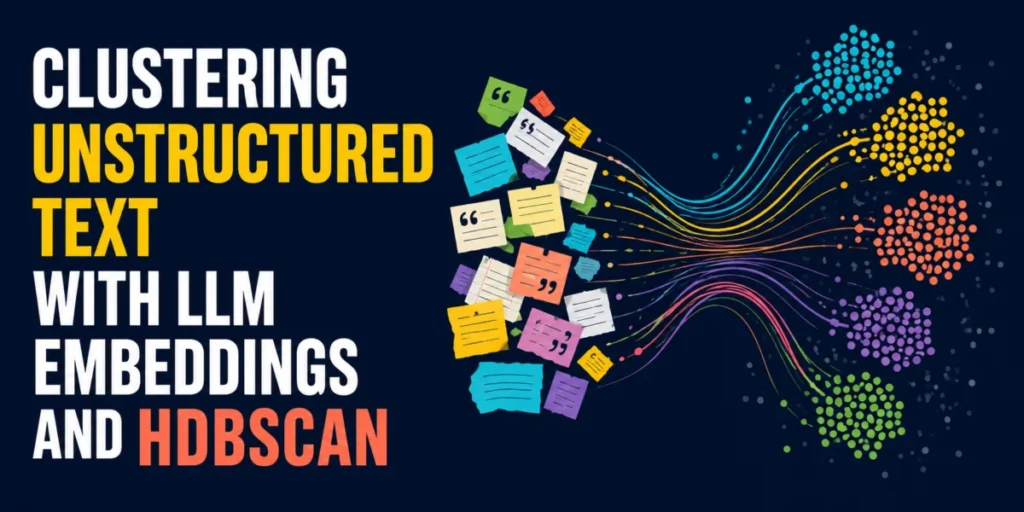
In the rapidly evolving landscape of artificial intelligence, the discourse is frequently dominated by the capabilities of Large Language Models (LLMs) in the context of conversational agents and prompt engineering. However, the true utility of these models extends far beyond simple chat interfaces. One of the most transformative applications of contemporary NLP (Natural Language Processing) is the conversion of messy, unstructured textual data into high-dimensional, semantically dense vectors known as embeddings.
By marrying the semantic depth of LLM-generated embeddings with the robust, density-based clustering capabilities of HDBSCAN (Hierarchical Density-Based Spatial Clustering of Applications with Noise), developers can now extract latent topics, hidden patterns, and organizational structures from vast datasets—all without the need for prior human annotation. This article provides an in-depth exploration of constructing a professional-grade text clustering pipeline from scratch.
Main Facts: The Power of Semantic Grouping
At its core, the methodology relies on a three-stage architectural pipeline:
- Semantic Vectorization: Utilizing a transformer-based embedding model to map text strings into a mathematical coordinate space where similar meanings are positioned in close proximity.
- Dimensionality Reduction: Employing UMAP (Uniform Manifold Approximation and Projection) to compress these complex vectors into a manageable form that retains local and global structural information.
- Density-Based Clustering: Implementing HDBSCAN to identify high-density regions in the vector space, automatically distinguishing between significant clusters and noise.
Unlike traditional clustering algorithms like K-Means, which require the user to pre-define the number of clusters ($k$), HDBSCAN excels by identifying clusters of varying shapes and sizes, effectively treating outlier data as "noise" rather than forcing it into a predetermined category.
Chronology: Building the Pipeline
Step 1: Environment Preparation
To initiate the project, you must secure the necessary computational libraries. The ecosystem relies heavily on Python’s scientific stack. You will need to install sentence-transformers for embedding generation, umap-learn for reduction, and the standard suite of scikit-learn, pandas, and matplotlib.
pip install sentence-transformers umap-learn scikit-learn pandas matplotlib seabornStep 2: Data Ingestion and Preprocessing
We utilize the fetch_20newsgroups dataset to simulate a real-world scenario. While the dataset is labeled, we consciously treat it as unlabeled to demonstrate the power of unsupervised discovery. We sample 150 instances, focusing on three specific categories: sci.space, sci.med, and rec.autos.
import pandas as pd
from sklearn.datasets import fetch_20newsgroups

categories = ['sci.space', 'sci.med', 'rec.autos']
newsgroups = fetch_20newsgroups(subset='train', categories=categories, remove=('headers', 'footers', 'quotes'))
df = pd.DataFrame('text': newsgroups.data, 'true_label': newsgroups.target)
df = df[df['text'].str.strip().str.len() > 100].sample(150, random_state=42).reset_index(drop=True)
Step 3: Generating LLM Embeddings
We leverage the all-MiniLM-L6-v2 model from Hugging Face. This model is an ideal choice for a production pipeline due to its balance between inference speed and semantic accuracy. It transforms raw text into a 384-dimensional vector.
from sentence_transformers import SentenceTransformer
model = SentenceTransformer('all-MiniLM-L6-v2')
embeddings = model.encode(df['text'].tolist(), show_progress_bar=True)
Step 4: Dimensionality Reduction with UMAP
HDBSCAN struggles with the "curse of dimensionality" when dealing with high-dimensional embedding spaces (e.g., 384 dimensions). UMAP reduces this to a five-dimensional manifold, preserving the core structure required for effective clustering.
import umap
reducer = umap.UMAP(n_neighbors=15, n_components=5, min_dist=0.0, random_state=42)
reduced_embeddings = reducer.fit_transform(embeddings)
Step 5: Clustering with HDBSCAN
Finally, we apply the clustering algorithm. By setting min_cluster_size=8, we instruct the model to only consider groupings that contain a sufficient number of data points, ensuring statistical significance.
from sklearn.cluster import HDBSCAN
clusterer = HDBSCAN(min_cluster_size=8, min_samples=3, store_centers='centroid')
df['cluster'] = clusterer.fit_predict(reduced_embeddings)
Supporting Data: Interpretation and Analysis
The results of our pipeline reveal the efficacy of this approach. Upon running the clustering process, the data is partitioned into distinct groups. Analyzing the output, we observe:
- Cluster 0 (101 items): These documents, when inspected, show clear semantic commonality, typically involving technical or scientific discourse.
- Cluster 1 (49 items): This group reflects a separate domain, largely centered around mechanical and automotive subjects.
- Noise/Outliers: HDBSCAN labels points that do not fit into high-density regions as
-1. In a real-world scenario, these points are invaluable for identifying "anomalies" or "out-of-distribution" data that may require manual human review.
The visualizations provided by a pairwise scatterplot matrix confirm that the five-dimensional reduction successfully separates the classes, with distinct visual boundaries appearing across multiple dimensions.
Official Perspectives: The Experts’ View on Embeddings
Industry experts argue that the integration of transformer-based embeddings has fundamentally altered the paradigm of unsupervised learning. According to researchers in the field of semantic search, the traditional "bag-of-words" or TF-IDF methods often failed to capture synonymy or context. By contrast, LLM embeddings capture the intent of the document.
When combined with HDBSCAN, this creates a "self-organizing" data architecture. Instead of a human having to define taxonomy upfront, the data is allowed to "speak for itself." This is particularly critical in corporate environments where the volume of incoming documentation—emails, support tickets, and legal filings—grows faster than any team can manually categorize.
Implications: Why This Matters for Modern Business
The implications of this pipeline are profound for several industries:
- Customer Support Automation: By clustering thousands of support tickets, companies can automatically identify emerging product bugs or recurring user frustrations before they become widespread crises.
- Market Research: Analysts can ingest vast swaths of social media data or news reports to identify evolving trends in real-time, essentially performing "topic discovery" without needing to guess which keywords are relevant.
- Compliance and Legal: Law firms can use this pipeline to quickly group massive document productions during discovery, allowing lawyers to identify potentially privileged or irrelevant materials with high efficiency.
- Content Personalization: Media platforms can use these clusters to build recommendation engines that align user content consumption with semantic topic clusters rather than just tags.
A Note on Optimization
While the pipeline demonstrated here is robust, it is essential to remember that clustering is an iterative process. The choice of the min_cluster_size parameter in HDBSCAN or the n_neighbors parameter in UMAP acts as a "lens." A lower min_cluster_size will yield many granular, small clusters, while a higher value will prioritize broader, more general topics. Practitioners should approach these hyper-parameters as variables to be tuned based on the specific granularity required by their business use case.
Conclusion
Building a text-based clustering pipeline by combining LLM embeddings with HDBSCAN represents the gold standard in modern unsupervised learning. It offers a scalable, accurate, and highly intuitive way to handle the noise of the modern information age. By moving away from rigid, pre-defined categorization and toward a model that understands the nuance of human language, organizations can turn their unstructured data into their most valuable strategic asset. As these tools continue to evolve, the barrier to entry for implementing high-level AI analysis continues to drop, democratizing the power of machine learning for developers and data scientists alike.